
Allantus viennensis
(Schrank, 1781)
Curled Rose Sawfly, Rose Sawfly
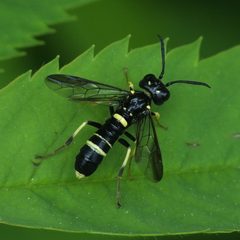
Allantus viennensis is a in the Tenthredinidae, commonly known as the curled rose sawfly. The larvae are significant pests of roses, feeding on leaf margins and causing defoliation. are small, -like insects with saw-like ovipositors used to insert into rose tissue. The is distinguished by the larval habit of curling cryptically on leaves when not feeding.
Pronunciation
How to pronounce Allantus viennensis: /əˈlæntəs viˈɛnːɛnsɪs/
These audio files are automatically generated. While they are not always 100% accurate, they are a good starting point.
Identification
Larvae resemble caterpillars but can be distinguished by having six or more pairs of (caterpillars have five or fewer) and the absence of on prolegs. Larvae characteristically curl tightly on leaf undersides or buds when not feeding, providing cryptic camouflage. are identified by their -like appearance and association with roses. Distinguished from roseslug sawfly (Endelomyia aethiops) by feeding pattern: A. viennensis consumes leaf margins while E. aethiops skeletonizes leaves between .
Images
Habitat
Gardens, nurseries, and landscapes where roses (Rosa spp.) are cultivated. Found in temperate regions with established rose plantings.
Distribution
Native to Europe; introduced to North America. Records from Belgium, Canada, and the United States. Established in regions with suitable rose .
Seasonality
emerge in spring when rose foliage returns. Larvae feed through May and June. Two per year in some regions: first generation completes development in early summer, second generation follows. Overwinters as immatures in soil beneath plants.
Diet
Larvae feed exclusively on rose leaves (Rosa spp.), consuming leaf margins and causing defoliation. do not feed; their mouthparts are not adapted for chewing plant material.
Host Associations
- Rosa - Larvae feed on leaves of cultivated and wild roses
Life Cycle
are inserted into rose leaf tissue using the saw-like ovipositor. Larvae hatch and feed on leaf margins, curling cryptically when not active. Upon completing development, larvae bore into rose twigs to pupate. emerge, mate, and initiate a second in favorable conditions. Overwinters as stages in soil beneath plants.
Behavior
Larvae exhibit cryptic , curling tightly on leaf undersides or buds when not feeding, blending with plant tissue. Gregarious larvae may display defensive posturing when disturbed, arching backs and curling . are active fliers, seeking rose plants for oviposition.
Ecological Role
Herbivore that can significantly impact rose plant health through defoliation. Serves as prey for ground beetles, lightning larvae, and other . Contributes to nutrient cycling through leaf consumption and processing.
Human Relevance
Recognized pest of ornamental roses in gardens and commercial production. Damage can reduce aesthetic value and plant vigor. Managed through physical removal, water sprays, or OMRI-listed including insecticidal soap and spinosad. Not known to sting or bite humans.
Similar Taxa
- Endelomyia aethiopsAlso called roseslug sawfly; larvae skeletonize leaves between rather than consuming margins, and have only one per year
- Cladius pectinicornisBristley rose sawfly; larvae have distinctive bristle-like and different feeding patterns on rose foliage
- Lepidoptera caterpillarsLarvae resemble caterpillars but differ in number (6+ vs. 5 or fewer) and absence of
- Other Tenthredinidae sawfliesShare -like and plant-feeding larvae, but differ in association and larval
Sources and further reading
- BugGuide
- GBIF taxonomy match
- iNaturalist taxon
- NCBI Taxonomy
- Rosie defoliators: Roseslug sawfly, Endelomyia aethiops, Curled rose sawfly, Allantus cinctus, and Bristley rose sawfly, Cladius pectinicornis — Bug of the Week
- Rosie defoliators - Roseslug sawfly, Endelomyia aethiops, Curled rose sawfly, Allantus cinctus, and Cladius pectinicornis — Bug of the Week
- Sawflies - Curled rose sawfly, Allantus cinctus, and dusky birch sawfly, Croesus latitarsus — Bug of the Week
- Archive — Bug of the Week