
Megischus
Brullé, 1846
crown wasp
Species Guides
5- Megischus arizonicus(Arizona Crown Wasp)
- Megischus bicolor(Bicolored Crown-of-thorns Wasp)
- Megischus brunneus
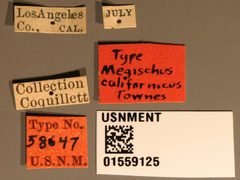
- Megischus californicus
- Megischus texanus(Texas Crown Wasp)
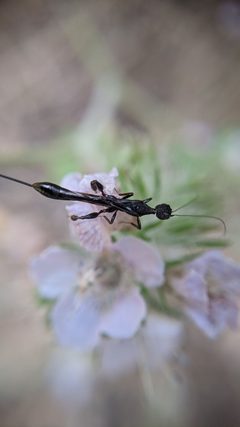
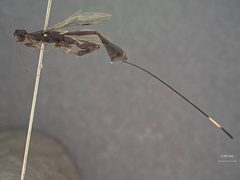
Megischus is a large of crown wasps ( Stephanidae) containing over 90 described with a distribution centered in subtropical and tropical regions. The genus is characterized by medium to large body size, with ranging from approximately 10–40 mm in length (excluding the ovipositor). Females possess an exceptionally long ovipositor that typically exceeds body length, used to parasitize wood-boring and hymenopteran larvae. The genus serves as an important agent for pest of hardwood-damaging insects.
Pronunciation
How to pronounce Megischus: /mɛˈɡɪskʊs/
These audio files are automatically generated. While they are not always 100% accurate, they are a good starting point.
Identification
Megischus can be distinguished from other Stephanidae by two key characters: the hind tibia is transversely depressed, and setae are absent on the M+Cu1 wing . Additional diagnostic features include: sub-spherical bearing a crown of five spike-shaped ; , non-elbowed with 12–44 segments; extremely long metasomal petiole inserted low between the hind ; wide hind with toothed margin; wings lacking a costal or with a very narrow one; at most three cubital cells with the last (c3) open; and without plantar lobes. Females are identified by the presence of an ovipositor longer than the body; males emerge several days before females and are slightly larger.
Images
Habitat
Primarily associated with hardwood forests and woodlands. Distribution closely tracks that of hardwood tree including oak, pine, mesquite, mangrove, and other tree groups that support wood-boring Coleoptera. Collections documented from protected forest reserves at elevations around 541 m in subtropical China.
Distribution
but concentrated in subtropical and tropical regions. Present across six zoogeographical regions: Neotropical, Palearctic, Afrotropical, Oriental, Australasian, and Oceanian. highest in the Neotropical and Oriental regions. Documented from China (Guizhou, Hubei, Fujian, Guangdong, Shaanxi, Sichuan, Zhejiang), Vietnam, and numerous other countries across the global range.
Seasonality
activity peaks during summer months, with highest collection frequency at approximately the 26th week of the year. A Vietnamese collected in May using sweep netting.
Host Associations
- Buprestidae - wood-boring jewel beetles
- Cerambycidae - longhorned beetles
- Curculionidae - true weevils
- Siricidae - wood wasps
- Apoidea - solitary bees
Life Cycle
Ectoparasitoid development. Females use chemosensors and a to detect vibrations, then spend hours boring through wood with the ovipositor to deposit on or near host larvae. Emerging chew exit holes through wood. Males emerge several days before females.
Behavior
. females engage in prolonged wood-boring to access concealed . Host location involves vibration detection and chemical sensing. Specimens are rarely collected and considered poorly represented in collections, with nearly 95% of Stephanidae described from single specimens.
Ecological Role
agent regulating of wood-boring beetles and other insects that damage hardwood trees and vegetation. Acts as a natural population limiter for pest affecting forestry and tree health worldwide.
Human Relevance
Potential value in forestry and agricultural pest management through natural suppression of wood-boring . No documented negative impacts to humans.
Similar Taxa
- HemistephanusShares tribe Megischini; distinguished by different hind tibia structure and wing venation
- PseudomegischusShares tribe Megischini; distinguished by morphological differences in leg and wing characters
- Other Stephanidae generaMegischus uniquely lacks setae on M+Cu1 and has transversely depressed hind tibia, versus other crown