
Ammophila placida
F. Smith, 1856
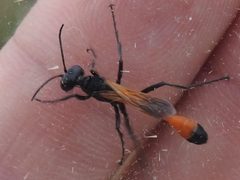
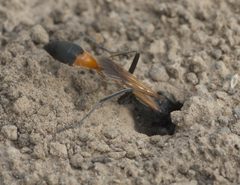
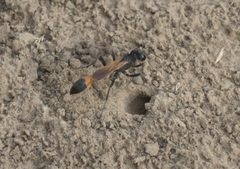
Ammophila placida is a thread-waisted wasp in the Sphecidae, found across the continental United States and Central America. Females construct nests in firm soil, provisioning them with 1–5 paralyzed caterpillars as food for their larvae. The has been documented using small tools such as pebbles or wood pieces to compact nest closures. Larval development is rapid, with hatching in two days and larvae reaching maturity after five days of feeding.
Pronunciation
How to pronounce Ammophila placida: /ˌæm.əˈfaɪ.lə ˈplæs.ɪ.də/
These audio files are automatically generated. While they are not always 100% accurate, they are a good starting point.
Images
Habitat
Open areas with firm or compact soil suitable for nest excavation. Nests are constructed in relatively firm ground, with females sometimes required to dig auxiliary holes to obtain loose material for filling burrow entrances.
Distribution
Continental United States and Central America.
Diet
are nectar-feeders. Larvae feed on paralyzed caterpillars provisioned by the female. Documented prey includes caterpillars from Noctuidae, Hesperiidae, and Geometridae.
Life Cycle
hatches in approximately two days. Larva feeds for five days before reaching maturity. Total developmental period from egg to mature larva is approximately seven days.
Behavior
Females dig vertical or nearly vertical burrows 4–10 cm deep, ending in a horizontal approximately 2.5 cm in length. Excavated soil is scattered 30–50 cm from the nest, transported primarily by low and rarely by . Females close burrows by buzzing loudly for approximately 30 minutes while filling the hole, using loose soil obtained by digging auxiliary holes if necessary. Documented use of small pebbles or wood pieces to hammer and push soil into the burrow. Females exhibit roosting , gripping vegetation with and propping bodies at approximately 45-degree angles with middle and hind legs.
Ecological Role
of caterpillars, potentially contributing to regulation of herbivorous lepidopteran . Serves as for Strepsipteran , with maternal provisioning influencing parasite transmission risk to offspring.
More Details
Tool use in nest closure
Ammophila placida has been observed using small pebbles or pieces of wood as tools to hammer and push soil into burrow entrances during nest closure. This was historically interpreted as evidence of intelligence but is now understood as the culmination of instinctive behavioral sequences. The will not use tools before the appropriate stage of nest construction, and may reject offered items until ready.
Parasite transmission and parental care
Research on Ammophila , including A. placida, has demonstrated that extended maternal contact with offspring—resulting from provisioning nests with multiple small caterpillars rather than one large caterpillar—increases risk of Strepsipteran transmission from mother to offspring. This represents a trade-off where parental care inadvertently facilitates vectoring.
Sources and further reading
- BugGuide
- Wikipedia
- GBIF taxonomy match
- iNaturalist taxon
- NCBI Taxonomy
- Catalogue of Life
- 'When I Grow Up, I Want to Be an Entomologist' | Bug Squad
- Humbled and Honored to Receive ACE Awards | Bug Squad
- RJ Millena: from Entomology-Focused Kindergartener to Scoring Cover of Journal With Her Research | Bug Squad
- Bug Eric: Wasp Wednesday: Ammophila procera
- Bug Eric: Ammophila in Action
- Bug Eric: Wasp Wednesday: Ammophila pictipennis