
Pepsis mildei
Stål, 1857
Milde's tarantula-hawk wasp, Milde's tarantula hawk
Pepsis mildei is a large spider wasp in the Pompilidae, commonly known as Milde's tarantula-hawk . It is native to the Western Hemisphere, with documented records across the southwestern and central United States, Mexico, and Central America. The exhibits in structure and lifespan, with females living longer than males. feed on nectar from flowers, while larvae are obligate of tarantulas. The wasp has been observed to learn from experience, avoiding chemically defended spiders after a single negative encounter.
Pronunciation
How to pronounce Pepsis mildei: /ˈpɛpsɪs ˈmɪl.deɪ/
These audio files are automatically generated. While they are not always 100% accurate, they are a good starting point.
Identification
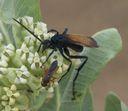
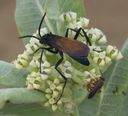
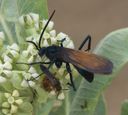
Pepsis mildei measures 20–30 mm in length with a metallic blue-black body. Wings are duller overall than those of Pepsis grossa or Pepsis cinnabarina, and may be black, orange, or rarely leucistic in males. Per Edward Essig, wings are described as "fiery red with the bases and apices dusky." are reddish with dusky coloration at the extreme base in males and the basal third dusky in females. in antennae shape is diagnostic: male antennae are straight or gently arced, while female antennae are distinctly curved.
Images
Habitat
Associated with tarantula in arid and semi-arid regions, including desert scrublands and grasslands. frequently visit flowers for nectar, particularly milkweeds (Asclepias spp.), creosote bush, blue palo verde, eucalyptus, and various mesquites and acacias. Males aggregate on trees during midday heat and overnight.
Distribution
North America and Central America. In the United States, documented in California, Nevada, Arizona, New Mexico, Utah, Colorado, Texas, Oklahoma, Kansas, Arkansas, and Missouri. One of four tarantula hawk recorded at Quitobaquito Springs, Organ Pipe Cactus National Monument, Arizona.
Diet
feed on nectar from flowers. Larvae are obligate of tarantulas, specifically documented on Aphonopelma hentzi (Texas brown tarantula).
Host Associations
- Aphonopelma hentzi - Texas brown tarantula; first Missouri record documented in 2025
Life Cycle
Female lays a single on a paralyzed tarantula . The larva develops by consuming the living but immobilized spider, eventually pupating within a silken cocoon and emerging as an . Male lifespan is one to two months; females live longer.
Behavior
Females hunt tarantulas primarily during cooler morning and evening hours to avoid overheating. They search on foot with flickering wings and quivering , or fly low to detect occupied burrows. Upon finding a spider, the provokes it into emerging, then stings it on the underside to paralyze it. The wasp drags the paralyzed spider to a burrow—often the spider's own—and seals it inside after oviposition. exhibit experience-dependent learning: naive wasps attack both palatable and unpalatable spiders equally, while experienced wasps avoid chemically defended after a single negative encounter, with memory persisting at least two weeks. Wasps also learn to associate specific microhabitats with unpalatable prey.
Ecological Role
Top of large spiders; exerts top-down control on tarantula . Selective and learned avoidance of chemically defended spiders may influence spider community composition and the evolution of chemical defenses. serve as while foraging on flowers.
Human Relevance
Sting is extremely painful but not life-threatening to humans without allergy; pain subsides within approximately three minutes according to Justin Schmidt's sting . The 's aposematic coloration serves as a warning. Occasionally encountered in residential areas near natural .
Similar Taxa
- Pepsis grossaLarger (females 30–51 mm), with brighter, more vivid wing coloration; P. mildei wings are distinctly duller
- Pepsis cinnabarinaBrighter wing coloration than P. mildei
- Hemipepsis ustulataMatte black body coloration versus iridescent blue-black in Pepsis; flies earlier in season in southwestern regions
- Pepsis mexicanaSimilar size and coloration; distinguished by subtle morphological differences and geographic overlap in some regions
Sources and further reading
- BugGuide
- Wikipedia
- GBIF taxonomy match
- iNaturalist taxon
- Catalogue of Life
- Of Lady Beetles and Green Fruit Beetle Larvae | Bug Squad
- My Publications | Beetles In The Bush
- Bug Eric: Tarantula Hawks
- Bug Eric: Wasp Wednesday: Pepsis grossa
- Bug Eric: Wasp Wednesay: Hemipepsis ustulata
- Bug Eric: Spider Sunday: Longlegged Sac Spiders
- EXPERIENCE AFFECTS HUNTING BEHAVIOR OF THE WASP, PEPSIS MILDEI STÅL (HYMENOPTERA: POMPILIDAE)
- Parasitoidism of Aphonopelma hentzi (Girard, 1852) (Araneae: Theraphosidae) and first records of Pepsis mildei Stål, 1857 (Hymenoptera: Pompilidae) in Missouri, U.S.A.