
Pseudomethoca sanbornii
(Blake, 1871)
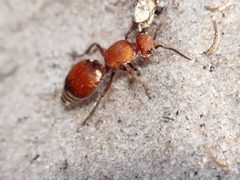
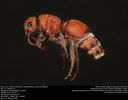
Pseudomethoca sanbornii is a of velvet ant in the Mutillidae, a group of solitary known for their aposematic coloration and powerful sting. Females are wingless and -like in appearance, while males possess wings. The species occurs across much of the eastern and central United States. Like other mutillids, females are reportedly capable of delivering a painful sting, though they are not aggressive and sting only in defense.
Pronunciation
How to pronounce Pseudomethoca sanbornii: //suːdoʊˈmɛθəkə sænˈbɔːrni.aɪ//
These audio files are automatically generated. While they are not always 100% accurate, they are a good starting point.
Identification
Pseudomethoca sanbornii can be distinguished from similar mutillid by examination of specific color patterns and structural features. The species belongs to a characterized by particular arrangements of setae and integumental sculpturing. Accurate identification typically requires reference to specialized keys for North American Mutillidae and comparison with vouchered specimens.
Images
Habitat
Sandy or loose soil , including dry sand deposits along river systems.
Distribution
United States: Arkansas, Connecticut, Florida, Georgia, Iowa, Kansas, Louisiana, Maryland, Massachusetts, Mississippi, Missouri, Nebraska, New Jersey, New York, North Carolina, Oklahoma, Pennsylvania, South Carolina, Tennessee, Texas, Virginia, Wisconsin.
Similar Taxa
- Pseudomethoca simillimaSimilar member with comparable coloration and preferences; both occur in Missouri and other central U.S. states and share the characteristic wingless female of the genus.
- Dasymutilla quadriguttataAnother mutillid suggested as a potential model for mimicry by other insects; shares aposematic coloration and general body form.
- Dasymutilla gloriosaCongeneric in the same with similarly striking appearance, though notably larger and with distinctive thistledown-like setation.