
Megachile rotundata
(Fabricius, 1787)
Alfalfa Leafcutter Bee, Alfalfa Leaf-Cutter Bee, Leafcutter Bee
is a solitary leafcutting native to Europe and the Mediterranean region, now widely established as a managed across North America and other continents. It is the second most important commercial pollinator globally after the , specifically renowned for its in alfalfa pollination. Females construct individual nests in pre-existing cavities, lining with precisely cut circular leaf pieces. The is non-aggressive, does not produce honey, and has been introduced deliberately and accidentally to multiple regions for agricultural pollination services.
Pronunciation
How to pronounce Megachile rotundata: /ˌmɛɡəˈkaɪli roʊˈtʌndətə/
These audio files are automatically generated. While they are not always 100% accurate, they are a good starting point.
Identification
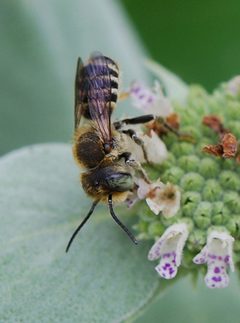
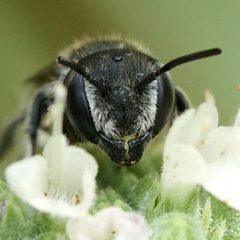
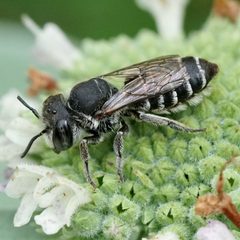
Distinguished from other Megachile by its small size, dark grey coloration with white hairs in females, and white/yellow abdominal spotting in males. The scopal hairs for pollen transport are diagnostic for the . Males are smaller and more slender than females with different abdominal patterning. When foraging on alfalfa, the 's method of tripping the flower's staminal column is characteristic. Nests with circular leaf discs sealing confirm identity when found.
Images
Habitat
Requires open, sunny environments with access to flowering plants for forage and leaf material for nest construction. Nests in pre-existing cavities including hollow plant stems, holes in wood, cracks in buildings, and ground burrows. In agricultural settings, readily uses artificial nesting boards, paper straws, and drilled wooden blocks. Thrives in alfalfa fields, meadows, and gardens where suitable nesting substrates and floral resources coincide.
Distribution
Native to Europe and the Mediterranean region. Introduced to North America in the 1940s–1950s, now established across the United States and Canada wherever alfalfa is grown commercially. Introduced to New Zealand in 1971 and Australia in 1987. Present on all continents except Antarctica. established outside managed agricultural systems in many introduced regions.
Seasonality
active primarily during summer months, with timing synchronized to alfalfa bloom periods. Under favorable conditions, partially with potential for two per year; typically in northern climates with one generation annually. Males emerge before females (protandry). Managed can be induced to emerge by temperature manipulation of .
Diet
feed on nectar and pollen. Females provision with a mixture of pollen and nectar (approximately 2:1 nectar-to-pollen ratio) for larval development. Strong preference for alfalfa (Medicago sativa) when available; will forage on other legumes, Brassica napus, Trifolium , Vaccinium angustifolium, various vegetables, and wildflowers. Each brood cell requires 15–20 foraging trips to provision.
Host Associations
- Ascosphaera aggregata - Causative agent of chalkbrood ; infects larvae through contaminated provisions, causing milky and fungal cysts under
- Pteromalus venustus - Most formidable ; female stings and paralyzes developing larvae or pupae, lays on surface
- Coelioxys spp. - Cuckoo bees that lay in when females are away foraging; larva kills host larva and consumes provisions
- Nemognatha lutea - Female lays on flowers; triungulin larvae attach to foraging bees, enter nest , and consume provisions
- Trichodes ornatus - that lays in leaf cracks; larvae kill larvae and consume provisions, burrow between cells
- Trogoderma glabrum - Dermestid that lays in nest cracks; larvae consume larvae from back to front of nest, preferentially eating females
- Trogoderma variabile - Attacks bees in cocoon or pupal stage
- Melittobia chalybii - Parasitic wasp
- Monodontomerus obscurus - Parasitic wasp
- Sapyga pumila - Parasitic wasp
- Diachys confusus - Parasitic wasp
- Apilactobacillus micheneri - microbial associate gut microbe; presence influences larval development and survival
- Sodalis - endosymbiontBacterial endosymbiont whose abundance increases when A. micheneri is introduced to provisions
Life Cycle
Complete (holometabolous). Females construct linear series of 6–12 in cavities, each cell lined with approximately 15 circular leaf discs and provisioned with pollen-nectar mass. Single laid per cell; cell sealed with leaf pieces. Larva passes through four instars, consuming provision, then defecates in ring formation and spins silk cocoon. Overwinters as in facultative ; development resumes in spring with 3–4 week period. emerges by chewing through cocoon and cell cap. Second possible in warm conditions with non-diapausing larvae developing directly to adults. Sex ratio varies with cell size and position: larger inner cells typically produce females, smaller outer cells produce males.
Behavior
Solitary nesting with females constructing and provisioning individual nests without cooperation. Non-territorial and tolerant of conspecifics in adjacent cavities. Leaf-cutting involves precise circular cutting of leaf pieces using for construction. Females apply olfactory cues to nests by running along nest surface or excreting liquid from abdominal tip, enabling nest recognition; experimental removal of these cues impairs recognition. Males patrol nesting and foraging areas seeking mates; females typically monandrous, resisting multiple matings by fleeing, which may cause loss of nesting materials. Foraging increases with age due to learning and physiological changes. No defensive stinging unless directly threatened or squeezed; mandibles used for defense.
Ecological Role
Critical commercial for alfalfa seed production, significantly more efficient than honey bees due to effective tripping of alfalfa flowers and dry pollen transport. Contributes to pollination of legumes, canola, carrots, blueberries, and various vegetables. Serves as for diverse , , and . Transfers microbial communities between flowers and provisions, potentially influencing floral microbiome dynamics. Managed support agricultural productivity in seed production systems globally.
Human Relevance
Second most important managed worldwide after , with extensive commercial industry producing for distribution to farmers. Used for pollination of alfalfa, canola, carrots, blueberries, and other crops. Can be induced to emerge synchronously with crop bloom through temperature manipulation of prepupae. Non-aggressive nature allows handling without protective equipment. Subject to management research optimizing nest box design, orientation, and cavity size for productivity. Vulnerable to chalkbrood requiring measures in commercial operations. exposure routes differ from honey bees, requiring specific risk assessment protocols.
Similar Taxa
- Megachile plutoMuch larger body size (wingspan ~60 mm), nests in arboreal mounds using resin rather than leaves, native to Indonesia, not managed for agriculture
- Osmia lignaria (blue orchard bee)Also solitary cavity-nesting managed , but uses mud rather than leaf pieces to seal , different body shape with metallic coloration, earlier spring
- Apis mellifera (honey bee)Social colony-dwelling with honey storage, have corbiculae () on hind legs rather than scopa, stings readily and dies after stinging, less efficient alfalfa
More Details
Nest microclimate preferences
Females preferentially select nest cavities on cooler, north-facing sides of nest boxes. Northeast-facing cavities produce 15% more offspring than southeast-facing cavities. Females also prefer top-row cavities with more shade and limited temperature range. Optimal cavity diameter is 7–8 mm: 7 mm maximizes offspring quantity, 8 mm maximizes offspring size and performance. At 9 mm, females construct parallel rather than linear arrangements.
Reproductive senescence
Contrary to predictions based on disposable soma theory, older females (14–21 days) show no reproductive decline. Instead, they exhibit increased foraging rate and , produce larger provisions, and generate bigger offspring. Ovarian development ( volume) increases through day 14 then stabilizes without decline.
Pesticide exposure routes
Solitary lifestyle creates distinct exposure compared to honey bees: larvae receive single mass provision that if contaminated cannot be avoided; nest construction materials (cut leaves, soil) may provide chronic contact exposure; females have more direct contact with treated surfaces during foraging and nest building.
Sources and further reading
- BugGuide
- Wikipedia
- GBIF taxonomy match
- iNaturalist taxon
- NCBI Taxonomy
- Catalogue of Life
- Looking for Cheap Urban Real Estate | Bug Squad
- In Search of the World's Biggest Bee: How It Came to 'Bee' | Bug Squad
- How One Entomologist Learned to Appreciate the Little Things (Microbes) in Life
- To Grow a Right-Sized Bee, Give It a Right-Sized Nest
- Alfalfa Leafcutting Bees Like Nests That Face North, Study Shows
- Beyond the Honey Bee: How Pesticides Affect Solitary Bees
- Reproductive Senescence in the Pollinator, Megachile rotundata
- Aerobic microorganisms associated with alfalfa leafcutter bees (megachile rotundata)
- Alfalfa Leaf-Cutter Bee Megachile rotundata (Insecta: Hymenoptera: Megachilidae)
- Microclimate Temperatures Impact Nesting Preference in Megachile rotundata (Hymenoptera: Megachilidae)
- REPRODUCTION OF MEGACHILE ROTUNDATA FAB. FORAGING ON TRIFOLIUM SPP. AND BRASSICA CAMPESTRIS
- Microbiome Dynamics Influence Larval Nutrition, Survival and Endosymbiont Abundance in the Solitary Bee, Megachile rotundata
- What's in a pollen provision? Using larval provisions to quantify pesticide exposure in Megachile rotundata (Hymenoptera: Megachilidae).