
Trogoderma glabrum
(Herbst, 1783)
glabrous cabinet beetle, colored cabinet beetle
Trogoderma glabrum is a dermestid known for its unusual developmental plasticity. Under optimal conditions, it completes its in approximately eight weeks, but when deprived of food, large larvae can extend their lifespan to over two years through a process of 'retrogressive molting'—molting backwards into progressively smaller stages rather than progressing toward . This is a pest of stored products and has been documented in Europe, Northern Asia (excluding China), and North America. Females exhibit circadian-regulated release synchronized to .
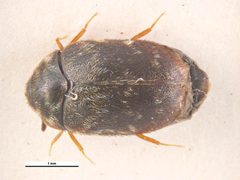
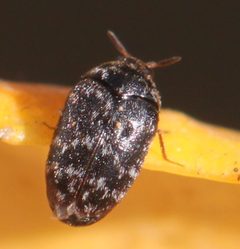
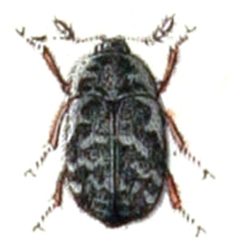
Pronunciation
How to pronounce Trogoderma glabrum: /trɔɡoˈdɛrmə ˈɡlæbrəm/
These audio files are automatically generated. While they are not always 100% accurate, they are a good starting point.
Identification
Differentiation from other Trogoderma , particularly the warehouse beetle (Trogoderma variabile) and (), requires careful morphological examination. The species is commonly confused with Anthrenocerus australis. Identification to species level within Trogoderma generally requires examination of microscopic characters and is not reliably accomplished from casual observation.
Images
Appearance
are small beetles, typical of the Trogoderma. Larvae are characteristic dermestid larvae with setae (hairs), though specific distinguishing morphological features from closely related Trogoderma require expert identification.
Habitat
Associated with stored products and indoor environments. As a stored product pest, it inhabits warehouses, food storage facilities, and domestic settings where dried organic materials are present. Specific outdoor preferences are not well documented in available sources.
Distribution
Documented from Europe and Northern Asia (excluding China) and North America. Present in Austria based on distribution records. The has been transported through human commerce and occurs in association with stored products across its range.
Diet
Feeds on stored products, including dried organic materials. Specific dietary items are not detailed in available sources, but as a Trogoderma , it likely consumes grain products, seeds, and other stored plant and animal materials. Larvae are the primary feeding stage.
Life Cycle
Under optimal conditions, completes development from to in approximately eight weeks, progressing through egg, larva, pupa, and adult stages. When large larvae are deprived of food, they exhibit retrogressive molting—molting backwards into progressively smaller larval stages rather than pupating. This can extend the larval period to over two years. The retrogressive cycle can be repeated if food becomes available and is subsequently withdrawn again, though each cycle requires progressively more time to regain previous size. The backward molting process does not reverse ; aging continues at a reduced rate.
Behavior
Females exhibit a characteristic 'calling' posture for release: body raised on forelegs and midlegs with tilted upward, terminal abdominal segments extended and exposed. -releasing shows circadian rhythmicity, with peak calling activity occurring during the photophase (light period) under 12:12 light-dark conditions. The rhythm is and persists under constant darkness, with acting as the zeitgeber. Larvae can withstand extended periods without food through retrogressive molting.
Ecological Role
As a stored product pest, this impacts human food storage systems. It functions as a decomposer of dried organic matter. It serves as a for the ectoparasitoid Laelius pedatus (Hymenoptera: Bethylidae), though comparative suitability relative to other Trogoderma species has been studied.
Human Relevance
Pest of stored products, causing damage to grain, seeds, and other stored organic materials. Its ability to survive extended periods without food through retrogressive molting makes it particularly difficult to control. Has been used as a research organism for studies on developmental plasticity, aging, and effects (notably analogs such as methoprene).
Similar Taxa
- Trogoderma variabile (warehouse beetle)Closely related congeneric with overlapping pest status in stored products; both are common dermestid pests of grain and stored products, requiring expert morphological examination for reliable differentiation.
- Trogoderma granarium (khapra beetle)Congeneric of significant concern; distinguished by regulatory status and morphological characters, though both are Trogoderma pests of stored grain.
- Anthrenocerus australisExplicitly noted as commonly confused with T. glabrum; both are small dermestid beetles associated with stored products and indoor environments.
More Details
Developmental plasticity research
The retrogressive molting phenomenon in T. glabrum was last investigated in depth over 30 years ago, representing a significant gap in understanding of this unusual biological process. The has been proposed as a potential model organism for studying the interaction of aging, , and development due to its ability to extend lifespan through developmental reversal while continuing to age.
Insecticide susceptibility
Laboratory studies have demonstrated that methoprene, a analog, severely disrupts normal development in T. glabrum, causing prolonged larval periods, reduced , abnormal , and significantly impaired reproductive capacity.
Sources and further reading
- BugGuide
- Wikipedia
- GBIF taxonomy match
- iNaturalist taxon
- NCBI Taxonomy
- Oh, the Bugs They Saw at the Bohart! | Bug Squad
- Trogoderma glabrum: The Benjamin Button of the Insect World
- New Analysis Refines Taxonomy of Dermestid Beetles
- Khapra Beetle Can't Beat the Heat
- Invasive Insects: The Top 4 "Most Wanted" List
- Bug Eric: Carpet Beetles, Genus Anthrenus
- Sex pheromone-releasing behaviour in females of the dermestid beetle, Trogoderma glabrum
- Effect of Dianex (Methoprene) on Growth and Reproduction of Trogoderma glabrum (Herbst) (Coleoptera: Dermestidae) 1
- Circadian rhythm of sex pheromone-releasing behaviour in females of the dermestid beetle, Trogoderma glabrum: Regulation by photoperiod
- Comparative Suitability of Trogoderma variabile and T. glabrum (Coleoptera: Dermestidae) as Hosts for the Ectoparasite Laelius pedatus (Hymenoptera: Bethylidae)