
Laelius pedatus
(Say, 1836)
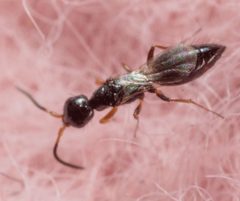
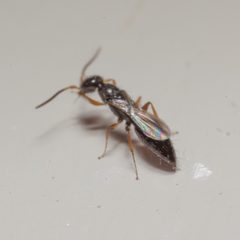
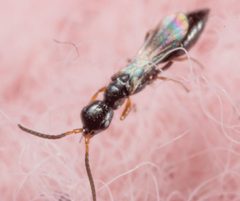
Laelius pedatus is a gregarious idiobiont larval ectoparasitoid in the Bethylidae. It attacks larvae in the family Dermestidae, particularly of Trogoderma and Anthrenus. The species exhibits plastic reproductive strategies, with females adjusting offspring size and number based on quality and availability. It has been introduced to multiple regions as a agent for stored-product and museum pests.
Pronunciation
How to pronounce Laelius pedatus: /ˈlaɪliːəs pɪˈdeɪtəs/
These audio files are automatically generated. While they are not always 100% accurate, they are a good starting point.
Images
Habitat
Stored-product environments; associated with of dermestid beetles in stored goods, museums, and domestic settings.
Distribution
Native to the New World; confirmed present in the Netherlands through conspecificity with North American . GBIF records indicate presence in Brazil (Minas Gerais, Santa Catarina, São Paulo) and Belgium.
Host Associations
- Anthrenus flavipes - larval
- Anthrenus sarnicus - larval
- Anthrenus verbasci - larval
- Trogoderma angustum - larval Successfully parasitized by Dutch ; museum and domestic pest
- Trogoderma glabrum - larval Dutch suffers high developmental mortality on this
- Trogoderma granarium - larval
- Trogoderma variabile - larval developmental stage and size affect parasitization success
Life Cycle
Gregarious ectoparasitoid development on larvae. Survivors of mortality grow larger and take longer to complete development. Developmental mortality varies with host .
Behavior
Females demonstrate adaptive plasticity in size allocation based on quality and abundance, producing larger eggs for high-quality hosts and smaller eggs when hosts are abundant. Clutch laying time increases with clutch size and is longer in unmated than mated females.
Ecological Role
agent against stored-product and museum pest beetles, particularly dermestid .
Human Relevance
Used as a agent against pests in stored products and museums. Monoclonal antibodies have been developed for its identification and quantification in stored-product environments.
More Details
Reproductive plasticity
Female size correlates positively with both size and number of mature eggs carried. Larger females also show lower developmental mortality in offspring.
Sperm depletion
Male number per increases with female oviposition experience, indicating sperm depletion through life.
Taxonomic confirmation
A Dutch was confirmed as with New World L. pedatus through reciprocal crosses with specimens from Madison, Wisconsin, USA.
Sources and further reading
- BugGuide
- Wikipedia
- GBIF taxonomy match
- iNaturalist taxon
- NCBI Taxonomy
- Offspring size-number strategy in the bethylid parasitoid Laelius pedatus
- Life history correlates and reproductive biology of Laelius pedatus (Hymenoptera: Bethylidae) in The Netherlands
- Monoclonal antibodies specific for Laelius pedatus (bethylidae) and Bracon hebetor (braconidae), two hymenopterous parasitoids of stored-product pests
- Comparative Suitability of Trogoderma variabile and T. glabrum (Coleoptera: Dermestidae) as Hosts for the Ectoparasite Laelius pedatus (Hymenoptera: Bethylidae)
- Host Developmental Stage and Size as Factors Affecting Parasitization of Trogoderma variabile (Coleoptera: Dermestidae) by Laelius pedatus (Hymenoptera: Bethylidae)