
Laelius
Ashmead, 1893
Species Guides
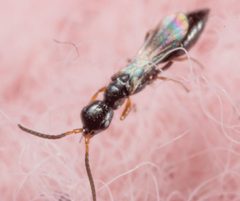
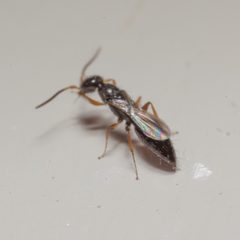
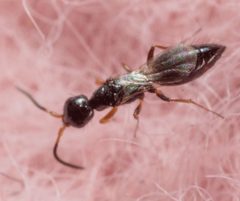
1Laelius is a of small in the Bethylidae, Epyrinae. are ectoparasitoids of larvae, primarily attacking Dermestidae (larder beetles), with some species also associated with Scolytinae and . The genus contains approximately 68 valid species worldwide, with significant diversity in the Palaearctic region. Several species have been investigated for of stored product pests and forest pests.
Pronunciation
How to pronounce Laelius: //ˈlæ.li.us//
These audio files are automatically generated. While they are not always 100% accurate, they are a good starting point.
Identification
Distinguished from other Bethylidae by the combination of thick black setae on body and wings, projected clypeal lobe, and complete occipital carinae. The presence of carinae on the metapostnotum and metapectal-propodeal disc, along with forewing venation patterns (particularly 2r-rs&Rs length), provides diagnostic characters. Male genitalia is critical for -level identification.
Images
Appearance
Small with thick black setae covering the body and wings. Key morphological features include a projected clypeal lobe, complete occipital carinae, and diagnostic carinae on the metapostnotum and metapectal-propodeal disc. Forewings with 2r-rs&Rs of characteristic length. Male genitalia used for -level identification.
Habitat
Forests and stored product environments. Specimens collected via sweeping net, , or rearing from larvae. Elevation range includes at least 1706 m (Yunnan, China).
Distribution
distributed across most zoogeographic regions worldwide except the Oceanian region. Approximately 33% of described from the Palaearctic region. Documented from China (Yunnan, Jiangsu, Hunan, Northeast China), South Korea (Seoul, Jeju-do), and Scandinavia (Denmark, Norway, Sweden).
Diet
Ectoparasitoid of larvae; primarily attacks larvae of Dermestidae (larder beetles).
Host Associations
- Thaumaglossa ruficapillata (Coleoptera: Dermestidae) - Confirmed by rearing
- Thaumaglossa sp. (Coleoptera: Dermestidae) - Confirmed by rearing
- Anthrenus flavipes (Coleoptera: Dermestidae) -
- Trogoderma granarium (Coleoptera: Dermestidae) -
- Glossina morsitans (Diptera: Glossinidae) - Exception for L. glossinae
- Dermestidae (Coleoptera) - General -level association
- Scolytinae (Coleoptera) -
- Glossinidae (Diptera) - General -level association
Life Cycle
Ectoparasitoid development on larvae; reared from host larvae in laboratory conditions. Parasitizes larvae of host .
Behavior
Potential biocontrol agent for agroforestry and stored product pests. Some (Thaumaglossa) are and of mantis , making relevant for protecting breeding structures and traditional Chinese medicine ingredients.
Ecological Role
agent of pest beetles including destructive stored product pests and ; regulating of Dermestidae.
Human Relevance
Investigated for of stored product pests (e.g., ) and forest pests. Potential application in protecting breeding structures used in traditional Chinese medicine.
Similar Taxa
- Other Bethylidae generaLaelius distinguished by thick black setae, projected clypeal lobe, complete occipital carinae, and specific carinae patterns on metapostnotum and metapectal-propodeal disc
More Details
Taxonomic diversity
contains approximately 68 valid worldwide. Six species recognized from China including one new species (L. longus) and three new country records. Four new species described from South Korea (L. afores, L. atratus, L. sulcatus, L. tricuspis).
Collection methods
Specimens primarily collected using , sweeping nets, or rearing from larvae. Male of L. longus unknown.
Sources and further reading
- BugGuide
- Wikipedia
- GBIF taxonomy match
- iNaturalist taxon
- NCBI Taxonomy
- Catalogue of Life
- Four new species of Laelius Ashmead (Hymenoptera, Bethylidae) from Korea with an updated key to species in the Eastern Palaearctic region.
- Revision of the Genus Laelius (Hymenoptera, Chrysidoidea, Bethylidae) from China.