
Nemognatha lutea
LeConte, 1853
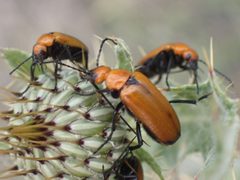
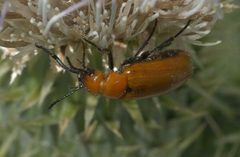
Nemognatha lutea is a blister beetle in the Meloidae, native to North America. The Nemognatha is distinguished by elongated maxillary mouthparts adapted for nectar feeding from deep flowers. are typically found on flowers, where they use their specialized mouthparts to access nectar via capillary action rather than suction. The was described by LeConte in 1853 and is represented by approximately 400 specimens in the Entomology Research Museum collection.
Pronunciation
How to pronounce Nemognatha lutea: /nɛ.moʊɡˈnæθ.ə ˈluː.tiː.ə/
These audio files are automatically generated. While they are not always 100% accurate, they are a good starting point.
Identification
Nemognatha lutea can be distinguished from other Nemognatha by its yellowish (lutea) coloration. Members of the are characterized by greatly elongated maxillary that form a -like structure, with the length of these mouthparts varying among species. The elongated mouthparts are densely covered with long bristles that facilitate nectar uptake through capillary action. Identification to species level requires examination of coloration and detailed morphological features; reference to Enns (1956) revision of North American Nemognatha is recommended.
Images
Distribution
North America. The has been documented across the continent, with museum specimens and observations spanning multiple regions.
Diet
feed on nectar from flowers with deep corollas. Nectar uptake occurs through capillary action along the bristles of the elongated maxillary , not through suction. The are used for feeding on pollen.
Behavior
are commonly observed on flowers, where they employ their specialized elongated mouthparts to access nectar. The mouthparts are tucked beneath the body when not in use.
Ecological Role
function as while feeding on nectar and pollen. Like other blister beetles, larvae are likely or of other insects, though specific details for this are not documented.
Similar Taxa
- Nemognatha cribrariaSimilar elongated mouthpart and flower-visiting , distinguished by coloration and specific mouthpart proportions
- Nemognatha nigripennisCongeneric with similar nectar-feeding adaptations, distinguished by dark wing coloration versus the yellowish lutea coloration
- Nemognatha scutellarisAnother abundant congeneric in North American collections, requiring careful examination of scutellum and coloration for separation
Misconceptions
The elongated mouthparts of Nemognatha and related have been frequently mischaracterized in entomological literature as 'sucking' or 'siphoning' structures. However, research by Wilhelmi & Krenn (2012) demonstrated that no food canal exists; instead, nectar transport occurs via capillary action along the bristle-covered .