
Nemognatha cribraria
LeConte, 1853
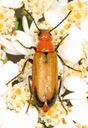
Nemognatha cribraria is a blister beetle in the Meloidae, characterized by elongated adapted for feeding on flower nectar. The occurs in North America, with two recognized : N. c. cribraria and N. c. fuscula. are typically found on flowers, particularly those with deep corollas, where they feed on nectar and pollen using their specialized mouthparts.
Pronunciation
How to pronounce Nemognatha cribraria: //ˌnɛmoʊˈnæθə krɪˈbrɛəriə//
These audio files are automatically generated. While they are not always 100% accurate, they are a good starting point.
Identification
Distinguished from other Nemognatha by the specific structure of its elongated and overall body proportions. The two differ in coloration: N. c. cribraria is lighter, while N. c. fuscula is darker. Close examination of the maxillary palpi and length relative to body size is necessary for definitive identification.
Images
Habitat
Open areas with abundant flowering vegetation, particularly where plants with deep corollas occur.
Distribution
North America. The nominate N. c. cribraria is found broadly across the region, while N. c. fuscula has a more restricted range.
Seasonality
active during flowering season; specific timing varies by region.
Diet
feed on nectar and pollen from flowers, utilizing elongated to access nectar in deep corollas. are used for pollen consumption.
Behavior
are and frequently observed on flowers. The elongated mouthparts represent a distinctive for nectar feeding uncommon among Coleoptera, which typically possess strictly chewing mouthparts. Nectar uptake occurs via capillary action along bristles on the rather than through a true sucking mechanism.
Ecological Role
of flowering plants; contributes to pollen transfer while feeding.
Similar Taxa
- Nemognatha luteaSimilar elongated and flower-feeding , but differs in body coloration and maxillary proportions.
- Nemognatha nigripennisShares the distinctive nemognathine mouthpart structure; separation requires detailed examination of maxillary and body proportions.
Misconceptions
The elongated mouthparts are often described as a '' for 'sucking' nectar, but scanning electron microscopy has demonstrated that no food canal exists. Nectar uptake occurs through capillary action along bristles on the surfaces, not through true sucking.