
Monodontomerus obscurus
Westwood, 1833
Monodontomerus obscurus is a gregarious in the Torymidae. Native to Europe, it has been introduced to North America and Japan, where it was first recorded in 2000. The primarily attacks solitary bees, with documented including Megachile sculpturalis, Coelioxys fenestrata, Osmia species, and Stelis chlorocyanea. Genetic studies indicate extremely low genetic diversity in introduced , consistent with founding by a single female lineage.
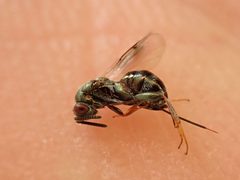
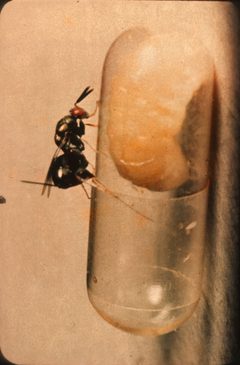
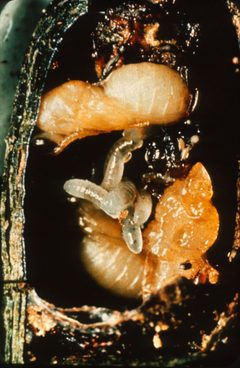
Pronunciation
How to pronounce Monodontomerus obscurus: /moʊ.nəˈdɒn.təˌmɛr.əs əbˈskjʊr.əs/
These audio files are automatically generated. While they are not always 100% accurate, they are a good starting point.
Images
Habitat
Bamboo cane nests and gaps in field environments; parasitizes of solitary bees within these cavities. In Japan, studied utilized bamboo traps placed in field settings.
Distribution
Native to Europe; introduced to North America and Japan. In Japan, documented from Hachioji (Tokyo), Ninohe (Iwate), Otu (Shiga), Shizuoka (Shizuoka), and Hiratsuka (Kanagawa) prefectures. GBIF records also include Alberta, California, Azores, Assam, and Pico.
Seasonality
as and emerges following spring. In Japan, rates increased significantly from negligible levels before 2018 to higher rates by 2025 in monitored .
Diet
of solitary . Documented include Megachile sculpturalis (giant ), Coelioxys fenestrata (social of M. sculpturalis), Osmia nigrifrons, and Stelis chlorocyanea.
Host Associations
- Megachile sculpturalis - primary giant ; main in Japan
- Coelioxys fenestrata - social of Megachile sculpturalis
- Osmia nigrifrons -
- Stelis chlorocyanea -
Life Cycle
Gregarious developing within . Overwinters as diapausing prepupae, emerging the following spring. Exhibits haplodiploid sex determination without complementary sex determination (CSD), with females developing from fertilized and haploid males from unfertilized eggs.
Behavior
Mates with close relatives exclusively at sites soon after . Shows strong tendency to attack located at innermost or outermost positions within bamboo cane nests. Exhibits sibmating system that enables single-female founding of .
Ecological Role
of solitary bees; biological invader with increasing rates in Japan. Potential -level impact on Megachile sculpturalis in invaded range.
More Details
Genetic diversity
Microsatellite analysis of 52 female individuals from the Hiratsuka (2016-2023) revealed extremely low genetic diversity, indicating the Japanese population was founded by very few individuals, most likely a single female or effectively single genetic lineage.
Taxonomic verification
identification in Japanese studies was based on morphological features matching M. obscurus and supported by COI phylogenetic analysis.