
Stelis
Panzer, 1806
leach orchids
Species Guides
12- Stelis australis
- Stelis coarctatus(Compressed Dark Bee)
- Stelis costalis(cuckoo bee)
- Stelis diversicolor(All-black Dark Bee)
- Stelis interrupta(cuckoo bee)
- Stelis lateralis(Spot-sided Dark Bee)
- Stelis laticincta(Wide-striped Painted-Dark bee)
- Stelis louisae(Louisiana Painted-Dark bee)
- Stelis melanotricha
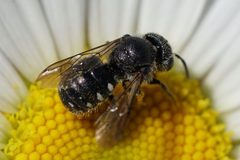
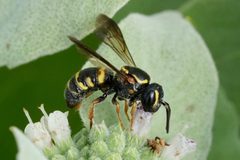
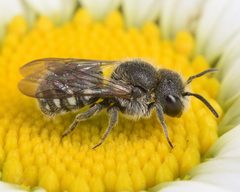
Stelis is a of Old World cleptoparasitic bees in the Megachilidae, tribe Anthidiini. These bees are obligate , meaning they do not construct their own nests but instead lay in the nests of bees, where their larvae consume the host's pollen provisions. The genus was established by Panzer in 1806 and contains multiple distributed across Europe, Asia, and into the Arabian Peninsula. Some species have shown recent range expansions, with new country records continuing to be documented.
Pronunciation
How to pronounce Stelis: /ˈstiːlɪs/
These audio files are automatically generated. While they are not always 100% accurate, they are a good starting point.
Identification
Stelis bees can be distinguished from other Megachilidae by their cleptoparasitic and associated morphological adaptations. within the often exhibit metallic coloration and relatively compact body forms. The subgenus Stelidomorpha and other subgeneric divisions show morphological variation useful for species-level identification. Detailed examination of genitalia and other microscopic features is typically required for definitive species identification, as cryptic diversity is common within the genus.
Images
Distribution
Old World distribution including Europe, Asia, and the Arabian Peninsula. Specific records include: Stelis franconica in the Pyrenees and at least three French departments; Stelis murina across the Old World; and multiple species in the Arabian Peninsula. The shows a broad Palearctic distribution with some species demonstrating recent range expansions into new regions.
Host Associations
- Osmia emarginata - probable Inferred from correlational evidence for Stelis franconica in the Pyrenees based on temporal overlap and abundance at collection sites, in absence of alternative Osmia mustelina
Life Cycle
Cleptoparasitic; larvae develop within nests by consuming pollen provisions stored by the host . The last larval instar of Stelis murina has been described morphologically. Mature have been documented in Stelis murina, indicating reproductive readiness in females.
Behavior
Obligate cleptoparasitism: females enter nests to deposit , and larvae subsequently consume host provisions rather than being fed directly by . This eliminates the need for nest construction and pollen collection by adult Stelis.
Ecological Role
Cleptoparasitic bees act as natural regulators of their . By exploiting host nest provisions, they influence host and may affect local structure. Their presence indicates established populations of suitable host bees.
Human Relevance
Some Stelis are rare or scarce, with conservation interest in certain regions. The Spotted Dark (Stelis ornatula) has been recorded as the rarest bee found in some UK localities, indicating potential use as a conservation for quality assessment.
Similar Taxa
- AnthidiumBoth belong to tribe Anthidiini and share general megachilid , but Anthidium are nest-building and collect their own pollen rather than being cleptoparasitic
- OsmiaFrequent for Stelis ; females may be confused but differ in nesting and often in body proportions
Sources and further reading
- BugGuide
- Wikipedia
- iNaturalist taxon
- NCBI Taxonomy
- Catalogue of Life
- Bare ground experiments to help save rare bees and wasps - Buglife Blog - Buglife
- Stelis franconica Blüthgen 1930 (Apoidea - Megachilidae - Anthidiini), une nouvelle espèce pour la faune de France et mise au point de la liste des Stelis Panzer 1806 de France
- Last Larval Instar and Mature Oocytes of the Old World Cleptoparasitic Bee Stelis murina, Including a Review of Stelis Biology (Apoidea: Megachilidae: Megachilinae: Anthidiini)
- A new species of Stelis subgen. Unciferia (Orchidaceae: Pleurothallidinae) from Costa Rica
- Cryptic and Non-Cryptic Diversity in Cleptoparasitic Bees of the Genus Stelis Panzer, 1806, Subgenus Stelidomorpha Morawitz, 1875, with a Description of New Species from the Arabian Peninsula (Hymenoptera, Megachilidae).