
Stelis louisae
Cockerell, 1911
Louisiana Painted-Dark bee
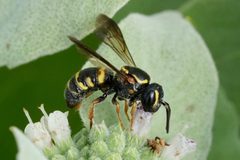
Stelis louisae is a cuckoo bee (kleptoparasite) in the Megachilidae, described by T.D.A. Cockerell in 1911. It occurs in the eastern United States and Ontario, Canada, with activity recorded from March through September. The has been observed visiting Helianthus (sunflower) flowers. As a member of the Stelis, it likely parasitizes nests of other bees, though specific records for this species are not documented in the provided sources.
Pronunciation
How to pronounce Stelis louisae: /ˈstɛ.lɪs luˈiːzaɪ/
These audio files are automatically generated. While they are not always 100% accurate, they are a good starting point.
Identification
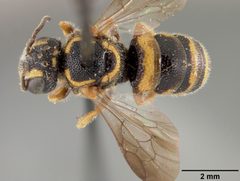
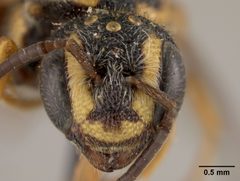
As a member of Stelis, this likely exhibits the -typical compact body form and reduced scopa (pollen-carrying structures) characteristic of cuckoo bees that do not provision their own nests. The specific epithet "louisae" and synonym "floridana" suggest potential geographic or morphological distinctions, but no diagnostic features separating it from are provided in the available sources. Identification to species level likely requires examination of subtle morphological characters such as punctation patterns, coloration details, or male genitalia.
Images
Distribution
Eastern United States and Ontario, Canada. GBIF records confirm presence in North America.
Seasonality
Active from March to September, based on observation records.
Host Associations
- Helianthus - flower visitationhas been observed visiting flowers; not a for
Behavior
As a cuckoo bee, exhibits kleptoparasitic typical of the Stelis: females enter nests of bees to lay in provisioned . The developing larva consumes the host's pollen/nectar provisions and typically kills the host egg or larva. Specific host and detailed behavioral observations for S. louisae are not documented in the provided sources.
Ecological Role
Functions as a (kleptoparasite) of other bees, likely within Megachilidae. Such may influence and nest-site competition, though specific ecological impacts for this are unstudied.
Similar Taxa
- Other Stelis speciescongeneric cuckoo bees share similar and ; -level distinction requires detailed examination
- Non-parasitic MegachilidaeStelis females lack the dense scopa (pollen brush) on the underside of the that characterizes pollen-collecting megachilid bees
More Details
Taxonomic note
Synonym Stelis floridana indicates potential confusion with Florida or morphological variants; the was described by T.D.A. Cockerell, a prolific early 20th-century hymenopterist.
Data gaps
Specific , detailed requirements, and morphological remain undocumented in the provided sources. The 1,171 iNaturalist observations suggest sufficient occurrence data exists for further study.