
Megachile sculpturalis
Smith, 1853
giant resin bee, sculptured resin bee
Megachile sculpturalis is a large solitary leafcutting native to Japan, China, and South Korea. First detected in North Carolina in 1994, it has become established across much of eastern North America and has spread rapidly through Europe since its first detection near Marseille, France in 2008. Females are notably larger than males and use their powerful to collect plant resin for sealing . Unlike carpenter bees, M. sculpturalis cannot excavate wood and relies entirely on pre-existing cavities, particularly abandoned galleries of carpenter bees (Xylocopa spp.) in wooden structures.
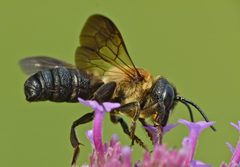
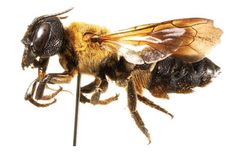
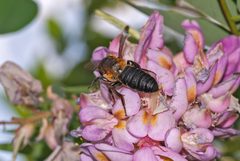
Pronunciation
How to pronounce Megachile sculpturalis: /ˌmɛɡəˈkaɪli skʌlpˈtjʊərəlɪs/
These audio files are automatically generated. While they are not always 100% accurate, they are a good starting point.
Identification
Distinguished from other Megachilidae by its exceptional size—most other leafcutting bees are considerably smaller. The combination of large body, shiny black , and densely hairy yellowish-brown is diagnostic. In North America and Europe, no other Megachile approaches this size. Females may be confused with carpenter bees (Xylocopa), but have more slender build, different abdominal shape, and lack the metallic sheen of many Xylocopa. The truncated male abdomen differs from the pointed female abdomen.
Images
Appearance
Large, robust solitary with cylindrical body. Females 21–25 mm, males 19–22 mm—substantially larger than most other Megachile . and primarily black; abdomen shiny and largely hairless. covered with dense yellowish-brown . Wings transparent, brownish, darkening toward tips. Females possess four dentate used for resin collection. Male abdomen truncated and squared; female abdomen tapered and pointed.
Habitat
Uses pre-existing cavities in wooden structures, particularly abandoned tunnels of carpenter bees (Xylocopa spp.) in fence posts, mailbox posts, decks, porches, and other weathered wood. Readily occupies artificial nest boxes and hotels. Shows ecological plasticity in nest site selection but demonstrates consistent recolonization of previously used cavities.
Distribution
Native to East Asia: Japan, China, and South Korea. Introduced to eastern North America (first record 1994, North Carolina); now established in most states east of the Mississippi River plus Ontario, Canada, with recent expansion to Arkansas, Louisiana, Mississippi, Missouri, and Texas. In Europe, first detected 2008 in France; now recorded in at least 13 countries including Italy, Germany, Spain, Switzerland, Hungary, Slovenia, Serbia, Bosnia & Herzegovina, and Ukraine. Also recorded on Mediterranean islands (Elba, Mallorca).
Seasonality
active from June to September in temperate regions. Larvae overwinter within sealed , pupate in spring, and emerge as adults in early summer.
Diet
Polylectic pollen collector with documented preference for shrubs of Asian origin. Recorded plants include: Styphnolobium japonicum (Japanese pagoda tree, formerly Sophora japonica)— pollen source in some European ; Ligustrum lucidum ( privet); Koelreuteria paniculata (golden rain tree); Pueraria lobata (kudzu); Buddleja ; Lathyrus latifolius; Pycnanthemum species; Lythrum salicaria. In Bologna, Italy, pollen provisions were almost monofloral from Styphnolobium japonicum; females estimated to require approximately 180 flower visits to provision one .
Host Associations
- Xylocopa spp. - nesting site provideruses abandoned galleries
- Stelis costalis - cuckoo bee that develops in M. sculpturalis nests
- Heriades - competitor/potential victimfemale observed killing Heriades in Switzerland
Life Cycle
Solitary; each female independently constructs and provisions nest. Nest architecture: entrance tunnel of variable length without , followed by average of ~2 brood (mean length 2.85 cm). Cells constructed using wood particles and mud, lined with collected resin, and capped with resin plug. Female provisions each cell with pollen carried on scopa (pollen-collecting hairs on underside), lays single per cell. Larva consumes pollen provision, overwinters as larva, pupates in spring, emerges as in early summer.
Behavior
Nesting characterized as tenantry—dependence on pre-existing cavities rather than excavation. Females show strong site fidelity, consistently recolonizing previously used cavities. Males defend territories around nesting sites, engaging in aerial combat and perching at cavity entrances. Females use large to collect and manipulate plant resin for construction. Does not bore into wood; mandibles insufficient for excavation.
Ecological Role
of ornamental and plants, particularly Asian-origin shrubs in introduced range. Potential competitor with native cavity-nesting bees for limited nesting sites; documented to evict or kill other bees to appropriate cavities. Ecological impacts in invaded regions remain incompletely understood; absence of natural enemies (, ) relative to native range may contribute to invasion success.
Human Relevance
Often noticed by homeowners due to activity around wooden structures, particularly mailbox posts and decks previously colonized by carpenter bees. Not aggressive; females will sting if handled but generally ignore humans. Presence sometimes mistaken for renewed activity. Used as study system for biological invasion dynamics in bees.
Similar Taxa
- Xylocopa virginicaSimilar size and use; carpenter bees excavate wood while M. sculpturalis cannot, and have different body proportions and coloration
- Other Megachile speciesAll are substantially smaller; most have hairy and different color patterns
- Anthidium manicatumAnother large introduced megachilid in some overlapping range, but wool carder bee has distinct yellow markings and different nesting
Sources and further reading
- BugGuide
- Wikipedia
- GBIF taxonomy match
- iNaturalist taxon
- NCBI Taxonomy
- Catalogue of Life
- Mailbox posts are fine homes for giant resin bees, Megachile sculpturalis — Bug of the Week
- New records of the invasive species Megachile sculpturalis, Smith, 1853 in Ukraine
- Megachile sculpturalis, a Novel Host for the Cuckoo Bee Stelis costalis (Hymenoptera: Megachilidae)
- Nesting biology and nest structure of the exotic bee Megachile sculpturalis
- The Giant Resin Bee, Megachile sculpturalis Smith: New Distributional Records for the Mid- and Gulf-south USA
- Actualisation des connaissances sur l’abeille Megachile sculpturalis SMITH, 1853 en France et en Europe (Hymenoptera : Megachilidae)
- Microbiota and pathogens in an invasive bee: Megachile sculpturalis from native and invaded regions
- Environmental niche and global potential distribution of the giant resin bee Megachile sculpturalis, a rapidly spreading invasive pollinator
- NESTING OF THE RESIN BEE MEGACHILE (CALLOMEGACHILE) SCULPTURALIS SMITH, 1853 (HYMENOPTERA, APOIDEA, MEGACHILIDAE) IN FABRE HIVES. CHOISE OF A CAVITY FOR THE NEST
- Figure 1c from: Parys K, Tripodi A, Sampson B (2015) The Giant Resin Bee, Megachile sculpturalis Smith: New Distributional Records for the Mid- and Gulf-south USA. Biodiversity Data Journal 3: e6733. https://doi.org/10.3897/BDJ.3.e6733
- Figure 1b from: Parys K, Tripodi A, Sampson B (2015) The Giant Resin Bee, Megachile sculpturalis Smith: New Distributional Records for the Mid- and Gulf-south USA. Biodiversity Data Journal 3: e6733. https://doi.org/10.3897/BDJ.3.e6733
- Figure 1a from: Parys K, Tripodi A, Sampson B (2015) The Giant Resin Bee, Megachile sculpturalis Smith: New Distributional Records for the Mid- and Gulf-south USA. Biodiversity Data Journal 3: e6733. https://doi.org/10.3897/BDJ.3.e6733
- Supplementary material 1 from: Ruzzier E, Menchetti M, Bortolotti L, Selis M, Monterastelli E, Forbicioni L (2020) Updated distribution of the invasive Megachile sculpturalis (Hymenoptera: Megachilidae) in Italy and its first record on a Mediterranean island. Biodiversity Data Journal 8: e57783. https://doi.org/10.3897/BDJ.8.e57783
- Figure 4 from: Ruzzier E, Menchetti M, Bortolotti L, Selis M, Monterastelli E, Forbicioni L (2020) Updated distribution of the invasive Megachile sculpturalis (Hymenoptera: Megachilidae) in Italy and its first record on a Mediterranean island. Biodiversity Data Journal 8: e57783. https://doi.org/10.3897/BDJ.8.e57783
- Figure 2 from: Ruzzier E, Menchetti M, Bortolotti L, Selis M, Monterastelli E, Forbicioni L (2020) Updated distribution of the invasive Megachile sculpturalis (Hymenoptera: Megachilidae) in Italy and its first record on a Mediterranean island. Biodiversity Data Journal 8: e57783. https://doi.org/10.3897/BDJ.8.e57783
- Figure 1 from: Ruzzier E, Menchetti M, Bortolotti L, Selis M, Monterastelli E, Forbicioni L (2020) Updated distribution of the invasive Megachile sculpturalis (Hymenoptera: Megachilidae) in Italy and its first record on a Mediterranean island. Biodiversity Data Journal 8: e57783. https://doi.org/10.3897/BDJ.8.e57783