
Anthidium manicatum
(Linnaeus, 1758)
European wool carder bee, wool carder bee
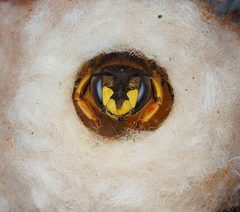
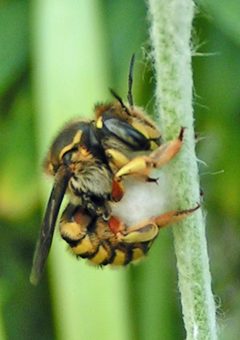
Anthidium manicatum, the European wool , is a solitary, cavity-nesting in the Megachilidae. Females collect plant trichomes (hairs) from leaves such as lamb's ears (Stachys byzantina) to line nest , giving the its . Males are highly territorial, defending patches of flowering plants against males and other . The species exhibits unusual : males are larger than females, contrary to most solitary bees. Native to Europe, Asia, and North Africa, it has become a widespread across North America, South America, New Zealand, and the Canary Islands after accidental introduction.
Pronunciation
How to pronounce Anthidium manicatum: //ænˈθɪdiəm ˌmænɪˈkeɪtəm//
These audio files are automatically generated. While they are not always 100% accurate, they are a good starting point.
Identification
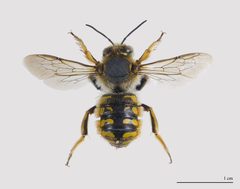
Males are larger than females (reverse of typical solitary pattern). Males have conspicuous abdominal spines on sixth and seventh segments—often mistaken for stingers, though only females possess true stingers. The combination of yellow-spotted black , grey and brown hair bands, and abdominal armature distinguishes males. Females recognized by white pilosity on tarsal segments and nearly black legs with small yellow spots. Distinguished from other Anthidium by male abdominal hair pattern and body size dimorphism.
Images
Habitat
Occupies diverse including gardens, fields, and meadows. Nests in pre-existing cavities such as rotting wood, burrows, or hollow stems. Shows preference for elevated nest sites, possibly to reduce and . Readily colonizes human-made structures and movable objects, facilitating spread.
Distribution
Native to Europe, Asia, and North Africa. Introduced and established in North America (first recorded 1963 in New York, reached California by 2007), South America (Argentina, Brazil, Paraguay, Uruguay), New Zealand (detected 2006), and the Canary Islands. Considered the most widely distributed unmanaged in the world. In the United Kingdom, primarily found in southern Wales and England, localized elsewhere.
Seasonality
Active from May to September in the United Kingdom. Males and females share the same season, unlike most solitary bees where males emerge earlier and disappear before females.
Diet
forager on pollen and nectar from diverse plant . Shows preference for blue flowers with long throats and Old World origins. Visits garden flowers and weeds. In New Zealand, predominantly visits (over 80%), especially Lamiaceae and Plantaginaceae, with occasional visits to native Veronica and Lobelia.
Host Associations
- Stachys byzantina - trichome sourceLamb's ears; primary source of plant hairs for nest lining
- Betonica - trichome source in Lamiaceae; used for wool collection
- Antirrhinum - trichome sourceSource of trichome secretions applied to
- Crepis - trichome sourceSource of trichome secretions
- Pelargonium - trichome sourceSource of trichome secretions
Life Cycle
Solitary with no social organization. Females construct nests in pre-existing cavities, creating multiple lined with collected plant trichomes. Each cell receives an and a provisioning mass of nectar and pollen. Entrance sealed with terminal plug of inorganic and organic materials. Females use specialized hair-like structures on exterior of to absorb plant secretions for application to cells. Developmental stages: egg, larva, pupa, .
Behavior
Females scrape plant hairs from leaves using toothed , roll them into balls, and transport them beneath the body to nests. Both sexes can maintain precise static hover near flowers. Males exhibit extreme territoriality, establishing resource-based territories (0.1–1.3 m²) around flowering plants. Territorial males patrol, chase, and physically attack males and heterospecific including honey bees, sometimes rendering them flightless. Males also harass females by holding them immobile and attempting repeated copulation. Non-territorial males employ alternative 'sneaking' tactics. Territorial plastic: abandoned in large, low-quality patches. Males sleep in condos or similar cavities at night.
Ecological Role
of diverse flowering plants. Aggressive territorial defense may disrupt foraging by other pollinators, though quantitative impact on native remains uncertain. In New Zealand, primarily interacts with other introduced bees rather than native . Nest construction using plant trichomes represents unique material exploitation among bees.
Human Relevance
Subject of ecological concern as with potential to compete with native . Occasionally damages wool socks or garments when collecting fibers. Male territorial makes them conspicuous and sometimes perceived as threats to honey bees, though experts consider impacts comparable to other natural . Studied as model system for resource defense and . Featured in pollinator gardens and educational programs.
Similar Taxa
- Anthidium maculosumMales resemble A. manicatum in appearance with similar spiniform ; distinguished by less rounded sixth sternum
- Anthidiellum notatumShares territorial mating but males chase rather than physically attack intruders
- Anthidiellum perplexumExhibits similar territorial but with less aggressive physical confrontation
- Anthidium banningenseShows territorial but differs in male aggression patterns
Misconceptions
Males sometimes called '' in media reports, with exaggerated claims of targeting and destroying honey bees. Male abdominal spines frequently mistaken for stingers. Territorial attacks on other interpreted as deliberate seeking out of victims rather than resource defense. Concerns about causing colony collapse disorder in honey bees are unfounded; has coexisted with honey bees in Europe for centuries without major apicultural impact.
More Details
Sexual dimorphism reversal
Unlike most Hymenoptera, males are larger than females, likely due to for territorial combat success. Male size correlates positively with territory quality, mating frequency, and reproductive success.
Mating system
Extreme with females mating continuously throughout life; copulation intervals as short as 35 seconds. Late male means later-mating males father disproportionate share of offspring, favoring resource defense strategy over timing.
Nest materials
Beyond plant trichomes, females incorporate mud, stones, resin, and leaves. Hydrophobic plant materials may serve antimicrobial function. Specialized tarsal structures absorb plant secretions for application.
Invasion biology
Spread facilitated by use of pre-existing cavities, often in movable objects. First California record 2007 in Sunnyvale; established in Davis by 2007. Occupies diverse climates from temperate to Mediterranean.
Sources and further reading
- BugGuide
- Wikipedia
- GBIF taxonomy match
- iNaturalist taxon
- NCBI Taxonomy
- Catalogue of Life
- Not a Terrorist | Bug Squad
- The Wonderful World of Insects | Bug Squad
- The Bee Team Visits the Haven | Bug Squad
- A Moth Like No Other: Neopalpa donaldtrumpi | Bug Squad
- The Native Bees in the UC Davis Bee Haven | Bug Squad
- Catch Me If You Can | Bug Squad
- European Wool Carder Bee, Anthidium manicatum (Linnaeus) (Insecta: Hymenoptera: Megachilidae)
- European Wool Carder Bee, Wool Carder Bee Anthidium manicatum (Insecta: Hymenoptera: Megachilidae)
- The reproductive behavior of Anthidium manicatum (Hymenoptera: Megachilidae) and the significance of size for territorial males
- Phenology of two territorial solitary bees, Anthidium manicatum and A. florentinum (Hymenoptera: Megachilidae)
- Global invasion by Anthidium manicatum (Linnaeus) (Hymenoptera: Megachilidae): assessing potential distribution in North America and beyond
- Assessing the impact of an introduced bee, Anthidium manicatum , on pollinator communities in New Zealand
- Territoriality is just an option: allocation of a resource fundamental to the resource defense polygyny in the European wool carder bee, Anthidium manicatum (Hymenoptera: Megachilidae)