
Anthidium maculosum
Cresson, 1878
Spotted Woolcarder
Anthidium maculosum is a solitary in the Megachilidae, notable for its unusual where males are significantly larger than females—a reversal of the typical pattern. Males establish and defend territories around flowering patches of Monarda mint, while females practice , mating multiple times to gain access to guarded resources. The ranges from the Pacific Northwest through Mexico to Honduras.
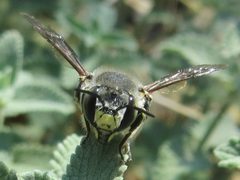
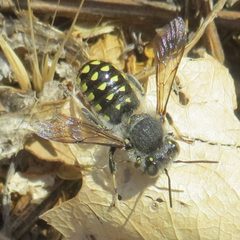
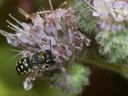
Pronunciation
How to pronounce Anthidium maculosum: /ænˈθɪdiəm ˌmækjʊˈloʊsəm/
These audio files are automatically generated. While they are not always 100% accurate, they are a good starting point.
Identification
Distinguished from other Anthidium by the combination of: spines on middle tibia; males larger than females (reverse of typical dimorphism); and association with Monarda flowers. Territorial males can be observed patrolling and defending flower patches. Size variation among males correlates with social status—territorial males > satellite males > wandering intruders.
Images
Appearance
Medium-sized megachilid with spines on the middle tibia. Males are markedly larger than females, with body size correlating strongly with width. Territorial males are larger than non-territorial satellite males. Specific coloration and maculation patterns are not detailed in available sources.
Habitat
Found in patches of flowering Monarda pectinata and related mint . Nests are constructed in holes excavated in wood. Occurs in diverse across its range from coastal to montane areas where suitable floral resources and nesting substrates exist.
Distribution
North and Middle America: from the Washington–Oregon border south through the western United States, throughout Mexico, and south to Honduras. Western limit at Texas; most common in Mexico and the southwestern United States.
Seasonality
Active during warmer months when temperatures are above freezing. observed outside nests for approximately three to four weeks. Territorial males may hold territories for up to at least 21 days during the breeding season.
Diet
Females collect pollen and nectar primarily from Monarda pectinata (a mint), with additional records from Monarda austromontana, Ballota pseudodictamnus, Salvia chamaedryoides, and other flowering plants in the mint (Lamiaceae).
Host Associations
- Monarda pectinata - primary pollen and nectar sourceFlowering mint; males defend territories around this plant
- Monarda austromontana - pollen and nectar source
- Ballota pseudodictamnus - pollen and nectar sourceUnited States records
- Salvia chamaedryoides - pollen and nectar sourceUnited States records
Life Cycle
Solitary lifecycle with no colonial organization. Females lay continuously during the breeding season, depositing them before closing . Development proceeds through egg, larva, and pupa stages within the brood cell. emerge and live approximately one year, with most of that time spent in the nest; active adult phase lasts three to four weeks.
Behavior
Males exhibit resource defense , establishing territories around clumps of flowering Monarda and aggressively excluding all flower-visiting insects except females. Territorial males patrol, grapple with intruders, and may emit to attract females. Two classes of non-territorial males exist: satellite males that occupy corners of territories, and wandering intruders that move between territories. Females practice , mating passively for approximately 20–30 seconds rather than resisting aggressive males, thereby minimizing time lost from foraging. Copulation occurs on flowers; males may mate with the same female at ~6 minute intervals and guard her during territory visits.
Ecological Role
of Monarda and related mint . Competes with carpenter bees (Xylocopa californica arizonensis) for trap-nest sites, with A. maculosum preventing establishment of nests in some cases.
Human Relevance
Contributes to pollination of native mints and ornamental Salvia . Occasionally mistaken for aggressive "" due to territorial , but poses no significant threat to honey bees or agriculture. Males may defend garden flowers, creating observable territorial displays.
Similar Taxa
- Anthidium manicatum (European wool carder bee)Similar territorial male and carding nesting material, but A. manicatum is introduced to North America, smaller overall, and associated with different plants (especially Stachys byzantina). A. maculosum is native, larger, and shows more extreme male-biased size dimorphism.
- Xylocopa californica arizonensis (carpenter bee)Shares nesting substrate (wooden holes) and geographic range, but distinguished by larger size, different pattern, and lack of male territoriality around flowers. A. maculosum prevents nest establishment through competition.
Misconceptions
Males are sometimes mischaracterized as deadly threats to honey bees. While males aggressively defend territories and may occasionally kill other bees, they do not actively hunt honey bees and their impact is comparable to other natural . The is not responsible for colony collapse disorder.
More Details
Evolution of female polyandry
Multiple mating in females appears to be an to male harassment rather than sperm limitation. Females receive sufficient sperm from single copulations but mate repeatedly because the time and energy costs of resisting aggressive males exceed those of brief additional matings. This grants females continued access to resource-rich territories guarded by males.
Male size polymorphism and mating success
Territorial status is size-dependent: larger males become territory holders, intermediate males become satellites, and smallest males wander as intruders. Territory owners perform the majority of matings, though subordinate males occasionally achieve copulation when territorial males are distracted.
Sources and further reading
- BugGuide
- Wikipedia
- GBIF taxonomy match
- iNaturalist taxon
- NCBI Taxonomy
- Catalogue of Life
- Not a Terrorist | Bug Squad
- The Wonderful World of Insects | Bug Squad
- Primary Type List | Entomology Research Museum
- The Bee Team Visits the Haven | Bug Squad
- UC Davis: All A'Buzz With Bee Nests and Art | Bug Squad
- A Moth Like No Other: Neopalpa donaldtrumpi | Bug Squad
- The reproductive behavior of Anthidium maculosum (Hymenoptera: Megachilidae) and the evolutionary significance of multiple copulations by females