
Acrotaphus
Townes, 1960
Species Guides
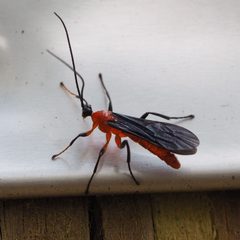
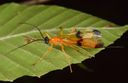
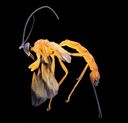
2Acrotaphus is a of spider-attacking in the Ichneumonidae, Pimplinae, tribe Ephialtini. The genus contains 27 described distributed across the New World, with particularly high diversity in the Neotropics including the Brazilian Amazon. These wasps are ectoparasitoids of orb-weaver spiders in the families Araneidae and Tetragnathidae. A defining characteristic of the genus is the ability to induce behavioral modification in spiders, causing them to construct specialized "cocoon webs" that support and protect the wasp pupae.
Pronunciation
How to pronounce Acrotaphus: //ˌæk.rəˈteɪ.fəs//
These audio files are automatically generated. While they are not always 100% accurate, they are a good starting point.
Identification
Acrotaphus can be distinguished from related polysphinctine (such as Hymenoepimecis and Eruga) by a combination of morphological characters including wing venation and genitalic structure. The genus belongs to the Polysphincta genus group, whose members are all spider ectoparasitoids. Definitive identification to level requires examination of male genitalia and reference to taxonomic keys; 27 species are currently recognized, many described recently (2019–2020). Field identification is complicated by the substantial intraspecific variation in size and coloration.
Images
Appearance
Medium-sized ichneumonid wasps with typical pimpline including elongated bodies and long . present; males and females differ in antennal structure. Male genitalia have been described taxonomically but specific external morphological characters distinguishing Acrotaphus from related require detailed examination. -level identification relies on subtle morphological differences including wing venation patterns and body proportions.
Habitat
Found in diverse across the New World, including tropical rainforests of the Amazon basin, where multiple have been described. Specific microhabitat associations are tied to spider distribution, primarily in vegetation supporting orb-weaver spider webs. No specialized habitat requirements beyond host availability have been documented.
Distribution
New World distribution ranging from the United States (recorded from Vermont, Massachusetts) through Mexico and Central America to South America, with highest in the Neotropics. The is particularly well-represented in Brazil, with multiple described from the Amazon region and the Cerrado (Bodoquena region). Specific country records include: United States, Mexico, Venezuela, Peru, Brazil, French Guiana, and likely others throughout Central and South America.
Host Associations
- Araneidae - primary ; orb-weaver spiders including Argiope, Neoscona, Wagneriana
- Tetragnathidae - secondary
- Argiope argentata - documented for A. chedelae
- Argiope trifasciata - documented for A. tibialis
- Neoscona arabesca - documented for A. wiltii
- Leucauge mariana - documented for A. tibialis
- Wagneriana - documented for A. wagnerianae
- Trypoxylon (Trypargilum) lactitarse - nest associationCrabronidae ; A. franklini and A. pseudoamazonicus recorded from nests
Life Cycle
Koinobiont ectoparasitoid. females locate spiders and lay a single on the host's body. The larva feeds externally on the living spider, eventually killing it. Prior to host death, the larva induces behavioral modification causing the spider to construct a modified "cocoon web"—a three-dimensional structure of non-adhesive threads lacking the typical orb web features (spirals, , hub). The larva then pupates within a cocoon suspended in this modified web. Development time from oviposition to adult spans multiple weeks to months depending on environmental conditions.
Behavior
females exhibit -searching targeting orb-weaver spiders. Oviposition involves brief paralysis of the host via stinging, followed by deposition. The most notable behavior is host manipulation: larvae chemically or neurally manipulate host spiders to construct specialized cocoon webs that differ dramatically from normal prey-capture webs. These cocoon webs provide superior protection and support for compared to normal orbs. The induced web architecture varies among and host combinations, ranging from modified resting-web structures to novel three-dimensional constructions without clear counterpart in unparasitized spider behavior.
Ecological Role
Acts as a regulator of orb-weaver spiders in Neotropical and Nearctic . By selectively parasitizing medium-sized spiders, may influence size structure and of spider populations. The behavioral manipulation of host spiders represents a complex host-parasitoid interaction that alters spider web-building and potentially affects local structure through indirect effects on spider .
Human Relevance
No direct economic importance. Of scientific interest as a model system for studying manipulation by and the evolution of behavioral manipulation in the Polysphincta group. Some have been named for cultural references (A. jackiechani) or in honor of researchers (A. franklini, A. homeofranklini).
Similar Taxa
- HymenoepimecisAlso polysphinctine spider ectoparasitoids that induce cocoon web construction; distinguished by morphological characters including wing venation and genitalic structure. Both share the derived trait of behavioral manipulation, suggesting this may be primitively present in their common ancestor.
- ErugaPolysphinctine with similar associations and behavioral manipulation capabilities; Eruga ca. gutfreundi induces different cocoon web architecture on the same host spider (Leucauge mariana) compared to Acrotaphus tibialis, demonstrating convergent but distinct manipulation strategies.
- PolysphinctaType of the Polysphincta genus group; shares ectoparasitoid lifestyle on spiders but Acrotaphus is distinguished by specific morphological characters and range.
More Details
Taxonomic History
The was established by Townes in 1960. Prior to 2019, only 11 were recognized. Intensive taxonomic work by Pádua, Sääksjärvi, and colleagues in 2019–2020 added 15 new species, more than doubling the known diversity. This recent activity reflects improved sampling in previously underexplored Neotropical regions rather than recent speciation.
Host Manipulation Mechanism
The mechanism by which Acrotaphus larvae induce cocoon web construction remains unknown, but is presumed to involve chemical manipulation of the . The resulting webs consistently lack adhesive spiral threads and incorporate dense tangles or three-dimensional architectures optimized for pupal survival rather than prey capture. This represents one of the most sophisticated examples of host behavioral manipulation among wasps.
Nesting Associations
Two (A. franklini and A. pseudoamazonicus) have been recorded from nests of the mud-dauber Trypoxylon (Trypargilum) lactitarse (Crabronidae), suggesting possible kleptoparasitic or commensal relationships with other wasps, though the ecological nature of this association requires further study.
Sources and further reading
- BugGuide
- Wikipedia
- GBIF taxonomy match
- iNaturalist taxon
- NCBI Taxonomy
- Catalogue of Life
- Bug Eric: Spider Sunday: Spider Enemies
- Host selection and cocoon web variation induced by the parasitoid wasp Acrotaphus chedelae
- Review of the New World genus Acrotaphus Townes, 1960 (Hymenoptera: Ichneumonidae: Pimplinae), with descriptions of fifteen new species
- A new species of Acrotaphus Townes (Hymenoptera: Ichneumonidae: Pimplinae) from the Brazilian Amazon, with notes on its host spider behavioral modification
- Behavioral manipulation of the orb‐weaver spider Argiope argentata (Araneae: Araneidae) by Acrotaphus chedelae (Hymenoptera: Ichneumonidae)
- The Polysphinctine WaspsAcrotaphus tibialis, Erugaca.gutfreundi, andHymenoepimecis tedfordi(Hymenoptera, Ichneumonidae, Pimplinae) Induce Their Host Spiders to Build Modified Webs