
Eruga
Townes & Townes, 1960
Species Guides
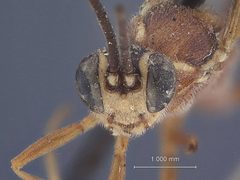
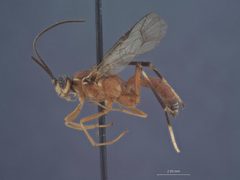
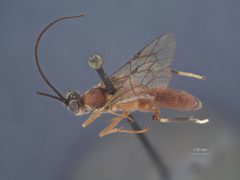
1Eruga is a of ichneumon wasps in the tribe Ephialtini, comprising approximately 15 distributed across the Afrotropical, Nearctic, and Neotropical regions. Members of this genus are ectoparasitoids of spiders, specifically targeting species in the Linyphiidae and Tetragnathidae. The genus is notable for behavioral manipulation of spiders, inducing them to construct modified 'cocoon webs' that support and protect the 's pupal cocoon.
Pronunciation
How to pronounce Eruga: /ˈɛ.ruː.ɡə/
These audio files are automatically generated. While they are not always 100% accurate, they are a good starting point.
Identification
As a within the polysphinctine group of ichneumonids, Eruga likely share the general characteristics of this clade: slender bodies, long , and adaptations for spider . Specific diagnostic features for the genus are not documented in the provided sources. Species-level identification requires examination of morphological characters described in original species descriptions.
Images
Distribution
Afrotropical, Nearctic, and Neotropical regions.
Host Associations
- Sphecozone sp. - Linyphiidae spider; of Eruga unilabiana
- Eurymorion sp. - Linyphiidae spider; of Eruga unilabiana
- Dubiaranea sp. - Linyphiidae spider; of Eruga unilabiana
- Leucauge mariana - Tetragnathidae spider; of Eruga cf. gutfreundi
- Argiope trifasciata - Tetragnathidae spider; of related polysphinctine , not confirmed for Eruga
Life Cycle
Ectoparasitoid development on spider . The is deposited as a white mass on the region of the spider's . First instar larvae partially emerge from the egg . Second instar larvae induce spiders to build modified cocoon webs. Third instar larvae possess eight pairs of retractable with tiny hooks that facilitate hanging and movement on web threads after host death. occurs within a cocoon constructed on the modified web.
Behavior
Induces spiders to abandon normal webs and construct specialized cocoon webs from scratch—a rarely observed in unparasitized individuals. The cocoon webs are structurally distinct from normal webs, typically featuring reduced sheet areas, shorter interception threads, and three-dimensional tangle structures with non-sticky radial lines converging at the cocoon site. In Eruga unilabiana, larvae move to hang on web threads before killing the host, a strategy not previously recorded in the polysphinctine group. Cocoons are constructed horizontally, differing from the vertical orientation typical of most polysphinctine .
Ecological Role
of sheet-weaving and orb-weaving spiders, regulating spider . The behavioral manipulation of represents a complex host-parasitoid interaction that may influence spider web architecture evolution.
Similar Taxa
- AcrotaphusBoth are polysphinctine ichneumonids that induce cocoon webs in spiders; Acrotaphus tibialis induces protective barrier tangles in Argiope trifasciata webs
- HymenoepimecisBoth are polysphinctine ichneumonids that manipulate Leucauge mariana to build different cocoon web structures; Hymenoepimecis tedfordi induces planar radial organization with tangles below
More Details
Web Manipulation Specificity
Different Eruga induce distinct cocoon web architectures in the same species. Eruga cf. gutfreundi induces a three-dimensional radially arranged cocoon web in Leucauge mariana that has no clear counterpart in unparasitized spider webs, while Hymenoepimecis tedfordi induces a different structure in the same host species.
Host Size Selection
Eruga unilabiana preferentially parasitizes intermediate-sized female spiders, likely because they provide sufficient resources for larval development while being less vulnerable to attack than larger individuals.
Sources and further reading
- BugGuide
- Wikipedia
- GBIF taxonomy match
- iNaturalist taxon
- NCBI Taxonomy
- Catalogue of Life
- Immature stages and natural history of Eruga unilabiana (Hymenoptera: Ichneumonidae), an ectoparasitoid of two linyphiid spiders
- Behavioral manipulation in two sheet web weaver‐spider by the parasitoid wasp, Eruga unilabiana Pádua & Sobczak, 2018 (hymenoptera: Ichneumonidae)
- The parasitoid wasp Eruga unilabiana Pádua & Sobczak, sp. nov. (Hymenoptera: Ichneumonidae) induces behavioral modification in its spider host
- The Polysphinctine WaspsAcrotaphus tibialis, Erugaca.gutfreundi, andHymenoepimecis tedfordi(Hymenoptera, Ichneumonidae, Pimplinae) Induce Their Host Spiders to Build Modified Webs