
Argiope trifasciata
(Forsskål, 1775)
banded garden spider, banded orb weaving spider, banded argiope, whitebacked garden spider
A large orb-weaving spider with a nearly distribution, native to the Americas but now found across six continents. Females construct distinctive spiral orb webs up to 60 cm in diameter, often decorated with zigzag patterns. The exhibits notable thermoregulatory through strategic web orientation and body positioning. Recent phylogeographic research suggests A. trifasciata may represent a complex of cryptic species rather than a single widespread species.
Pronunciation
How to pronounce Argiope trifasciata: /ɑrˈɡiːoʊpeɪ ˌtraɪfæsˈkjaɪtə/
These audio files are automatically generated. While they are not always 100% accurate, they are a good starting point.
Identification
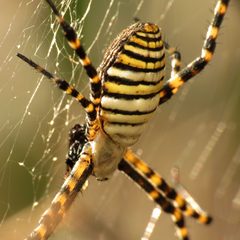
Distinguished from the congeneric Argiope aurantia by broken banding on the (versus solid black outer leg segments) and generally lighter coloration. The is more pointed compared to the broadly oval, blunt-ended abdomen of A. aurantia. Females are large (15–25 mm body length), while males are markedly smaller (4–5.5 mm). The surface is highly reflective silver with darker transverse bands across the abdomen, often with an inverted trident pattern visible.
Images
Habitat
Constructs orb webs in wetlands, open grassland areas, and gardens. Webs are typically placed low in shrubby vegetation sturdy enough to bear the spider's weight. In South Africa, inhabits all floral biomes except the Nama Karoo and Succulent Karoo biomes, and has been collected from crops including cotton, kenaf, lucerne, and tomatoes.
Distribution
Originally native to North and South America, now introduced worldwide and considered one of the few truly . Present in Europe on the Iberian Peninsula, Canary Islands, and Madeira; recorded from multiple African countries including South Africa (eight of nine provinces, elevations 3–1,557 m); established in Hawaii; reported from Panama and Colombia. Absent from Antarctica. Phylogeographic studies indicate fall into five distinct clades: East Asia, temperate Australia, Hawaii, New World, and Old World (Africa and most of the Palaearctic).
Seasonality
typically appear during autumn from early September to late October as temperatures drop. In Illinois, hatching occurs in early summer with individuals becoming conspicuous by mid-August when large enough to construct visible webs. In Egypt, females have been observed surviving relatively warm winter months. Activity is .
Diet
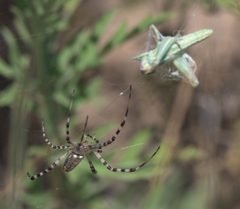
Feeds on insects captured in the web, including Odonata (dragonflies and damselflies). Large, powerful prey such as paper wasps are swiftly wrapped in silk to immobilize them before being injected with toxic saliva.
Behavior
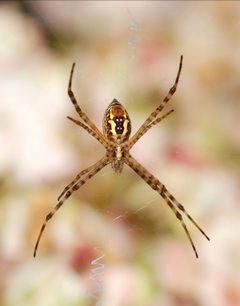
Hangs -down at the hub of the web throughout the day, with legs often arranged in pairs forming a cross shape. Some females conceal themselves in a hidden location near the web, alerted to prey by non-sticky threads leading to the center. Exhibits defensive web-shaking when approached, flexing front legs to set the web into vibration and create a blurred target. Constructs —thickened zigzag silk decorations in web centers—whose function remains debated (hypotheses include web protection from birds, camouflage, prey attraction via UV reflection, and ). Demonstrates thermoregulatory web orientation: in hot conditions, orients east-west with reflective silver surface facing south to reduce heat load; in cooler conditions, reverses orientation with dark surface facing south to maximize solar gain.
Ecological Role
of flying insects including Odonata. Webs with suffer less bird damage but capture fewer insects, indicating a trade-off between web protection and foraging success. Serves as agent in agricultural settings, though vulnerable to exposure.
Human Relevance
Considered beneficial in gardens for controlling insect pests. Listed as Least Concern by the South African National Biodiversity Institute due to wide distribution; protected in 14 protected areas in South Africa. Vulnerable to agricultural including chlorpyrifos and acephate, which impair web-building and cause mortality. Non-aggressive toward humans; bites occur only if spider is carelessly handled.
Similar Taxa
- Argiope aurantiaSimilar size and web architecture; distinguished by solid black outer leg segments (versus broken banding on ), more broadly oval , and alternate black/yellow leg banding pattern. pattern also differs.
- Argiope bruennichiSimilar appearance and occurs in Europe where A. trifasciata is present on Iberian Peninsula, Canary Islands, and Madeira; A. bruennichi is common in the Azores. Visual separation requires examination of abdominal pattern and leg banding details.
Sources and further reading
- BugGuide
- Wikipedia
- GBIF taxonomy match
- iNaturalist taxon
- NCBI Taxonomy
- Catalogue of Life
- Halloween ID challenge answer – Argiope trifasciata | Beetles In The Bush
- Bug Eric: Spider Sunday: Banded Argiope
- Araneae | Beetles In The Bush | Page 6
- Happy Halloween! | Beetles In The Bush
- A truly disturbed garden spider | Beetles In The Bush
- Nuevo reporte de Argiope trifasciata (Araneae: Araneidae) en Jurutungo – Chiriquí, Panamá New record of Argiope trifasciata (Araneae: Araneidae) in Jurutungo – Chiriquí, Panama
- Factors influencing predation on Odonata by Argiope trifasciata (Forsskål, 1775)
- Behavioral Response of Argiope trifasciata to Recent Foraging Gain: A Manipulative Study
- Phylogeography of the ‘cosmopolitan’ orb-weaverArgiope trifasciata(Araneae: Araneidae)
- Effects of chlorpyrifos and acephate on the web-building behavior of Argiope trifasciata
- Predator Avoidance Behaviors and Web Defensive Structures in the Orb Weavers Argiope Aurantia and Argiope TrifasciaTa(Araneae, Araneidae)
- Gene flow among habitat patches on a fragmented landscape in the spider Argiope trifasciata (Araneae: Araneidae)