
Neoscona arabesca
(Walckenaer, 1841)
Arabesque Orbweaver
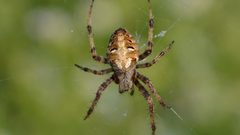
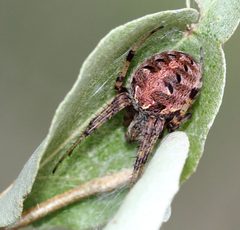
Neoscona arabesca is a common orb-weaving spider found throughout North America, recognized by the distinctive swirling, brightly colored markings on its that give it the 'arabesque orbweaver.' Females build vertical orb webs 15–45 cm in diameter with 18–20 , occupying the hub at night and retreating to a curled leaf during the day. The has been introduced to Nepal and China. It is a documented for the parasitic ichneumon Acrotaphus wiltii.
Pronunciation
How to pronounce Neoscona arabesca: //niːˈɒskoʊnə ærəˈbɛskə//
These audio files are automatically generated. While they are not always 100% accurate, they are a good starting point.
Identification
Distinguished from similar orbweavers by the prominent, swirling arabesque markings on the . The open hub of the web, crossed by only one or two threads, with the female resting with her abdomen tip pushed through this space at night, is a characteristic posture. abdominal pattern is more consistent than pattern and can help distinguish from . Differs from Neoscona crucifera (spotted orbweaver), which lacks distinct abdominal patterns and is larger (females 9–20 mm).
Images
Appearance
Females measure 5–7 mm in body length, males 5–6 mm. The is prominent and bears cryptic, brightly colored, swirling (arabesque) markings. The pattern is more consistent than the pattern and can aid identification. Overall coloration is variable but typically includes contrasting patterns that provide camouflage.
Habitat
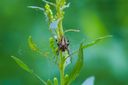
Occurs in fields, forests, gardens, and on human structures. In agricultural systems, has been documented in soybean fields. Webs are typically built in vegetation or on structures at heights suitable for intercepting flying insects.
Distribution
Native to North America, including the United States and Canada. Introduced to Nepal and China. GBIF records indicate presence in Middle America and the Caribbean, though native status in these regions is unclear.
Seasonality
Active during warmer months; specific varies by latitude. In temperate regions, are most conspicuous in late summer and fall. One per year in temperate climates.
Diet
Primarily Coleoptera (beetles), with relatively large numbers of also captured. In soybean fields, most prey captured are not considered agricultural pests. Feeding occurs primarily in the evening following web construction.
Host Associations
- Acrotaphus wiltii - Ichneumon that stings the spider into brief paralysis and lays a single ; larva feeds externally on the spider
Life Cycle
Females construct sacs concealed in rolled leaves. Spiderlings emerge when day length and temperature are suitable for prey availability. In temperate regions, one per year with not ; spiderlings overwinter in egg sacs.
Behavior
Females build vertical orb webs 15–45 cm in diameter with 18–20 . At night, the female rests in the center of the orb with the tip of her pushed through the open hub space. During daytime, she hides in a retreat away from the web, typically inside a curled-and-tied leaf. Males do not build webs and are found in nearby foliage or hunting on the ground. Non-aggressive; bites to humans are rare and occur only when the spider is threatened.
Ecological Role
in natural and agricultural . In soybean fields, functions as a predator with potential for , though most prey captured are non-pest . Contributes to insect and serves as prey for spider- predators including parasitic .
Human Relevance
Bites are not medically significant; pain is short-lived and comparable to a sting. Considered beneficial in gardens and agricultural settings for insect control. Often observed near outdoor lighting where prey insects congregate. Non-aggressive disposition makes it generally harmless to humans and pets.
Similar Taxa
- Neoscona cruciferaLacks distinct arabesque abdominal patterns; larger size (females 9–20 mm vs. 5–7 mm); markings on underside more consistent for identification but pattern less defined
- Neoscona oaxacensisWestern spotted orbweaver with highly variable spotted patterns rather than swirling arabesque markings; larger size (females 11–17 mm); range primarily southwestern North America
- Araneus cavaticusShares 'barn spider' with N. crucifera but not N. arabesca; similar size and general orbweaver but lacks arabesque markings
More Details
Web Architecture
The hub of the web is open, crossed by only one or two threads, which the female uses as a resting position at night with her tip protruding through the space.
Male Web Loss
males lose the physical capacity to produce the types of silk necessary for web construction upon sexual maturity, dedicating all energy to mate searching.
Parasitism Record
Documented as for Acrotaphus wiltii, an ichneumon that practices external on the spider.
Sources and further reading
- BugGuide
- Wikipedia
- GBIF taxonomy match
- iNaturalist taxon
- NCBI Taxonomy
- Catalogue of Life
- Bug Eric: Spider Sunday: Spider Enemies
- Bug Eric: Spider Sunday: Western Spotted Orbweaver
- French mathematician and spider aficionado Cédric Villani honoured with a new orb-weaver | Blog
- Bug Eric: Spider Sunday: Hentz's Orbweaver
- orb weavers | Beetles In The Bush
- Feeding behavior and prey ofNeoscona arabesca [Araneae: Araneidae] andTetragnatha laboriosa [Aranea: Tetragnathidae] in soybean fields