
Acrotaphus wiltii
(Cresson, 1870)
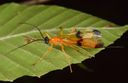
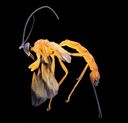
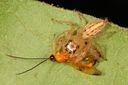
Acrotaphus wiltii is an ichneumon in the Ichneumonidae. It is a of spiders, particularly the orb-weaver Neoscona arabesca. The female wasp locates a spider, briefly paralyzes it with a sting, and lays a single on the spider's body. The larva develops as an external parasite, feeding on the living spider.
Pronunciation
How to pronounce Acrotaphus wiltii: /əˈkroʊtəfəs ˈwɪltaɪ/
These audio files are automatically generated. While they are not always 100% accurate, they are a good starting point.
Images
Distribution
North America. Specific locality records include Aweme (Manitoba, Canada), California, and Vermont.
Host Associations
- Neoscona arabesca - primary orb-weaver spider; larva feeds externally on living
Life Cycle
The female lays a single directly on the spider after brief paralysis. The larva hatches and feeds externally as a on the living spider, eventually pupating and emerging as an .
Behavior
Females actively search for spiders. Upon locating a host, the stings the spider to induce brief paralysis, then deposits a single on the spider's body before departing. The wasp does not construct a nest or cache the host.
Ecological Role
of spiders; control of orb-weaver spiders.
Similar Taxa
- Pepsis spp.Also spider , but Pepsis are pompilid wasps that permanently paralyze tarantulas and cache them in burrows, whereas Acrotaphus wiltii uses brief paralysis and does not cache
- Sceliphron caementariumAlso uses spiders as larval food, but is a sphecid that builds mud nests and stocks multiple spiders per , unlike the nest-free, single- strategy of A. wiltii
- Chalybion californicumAlso a sphecid spider-hunter that uses existing cavities rather than building nests, but still caches multiple spiders, unlike A. wiltii