
Temnothorax ambiguus
(Emery, 1895)
Doubtful Acorn Ant
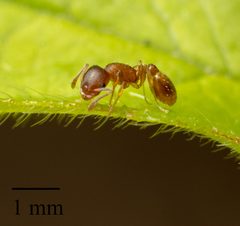
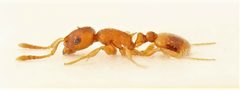
Temnothorax ambiguus is an in the Myrmicinae, commonly known as the Doubtful Acorn Ant. It serves as a species for the obligatory slave-making ant Protomognathus americanus and exhibits facultative slave-making itself. Laboratory studies demonstrate sophisticated larval recognition capabilities, with preferentially accepting nestmate larvae and discriminating between and allospecific . The species has been observed in contexts involving cavity-nesting habits typical of the , including nesting in hollow nuts and acorns.
Pronunciation
How to pronounce Temnothorax ambiguus: /tɛmnoʊˈθɔːræks æmˈbɪɡjuəs/
These audio files are automatically generated. While they are not always 100% accurate, they are a good starting point.
Identification
Temnothorax ambiguus is a small , typical of the Temnothorax which comprises minute to small ants ( usually 2–4 mm). Species-level identification requires examination of morphological characters including antennal scrobe, propodeal spines, and petiole node shape. Distinction from such as T. longispinosus relies on subtle morphometric differences and is best confirmed through expert taxonomic keys. The species lacks the pronounced morphological seen in larger ant genera.
Images
Habitat
Cavity-nesting that occupies hollow nuts, acorns, and similar pre-existing cavities in forested environments. Typical Temnothorax include leaf litter, rotting wood, and small cavities in trees or soil.
Distribution
North America. The occurs in temperate forest regions where it overlaps with related Temnothorax species and its slave-making Protomognathus americanus.
Host Associations
- Protomognathus americanus - of obligatory slave-making T. ambiguus serves as for raids by this specialized slave-making
- Temnothorax longispinosus - congeneric sympatric Occurs in same ; subject of comparative larval recognition studies
Behavior
exhibit sophisticated recognition . Laboratory studies demonstrate preferential acceptance of nestmate over non-nestmate larvae, and preferential retrieval of unrelated larvae over congeneric allospecific larvae. Workers consume more allospecific than conspecific larvae when given choice. When presented with conspecific versus Protomognathus americanus larvae, workers show toward conspecifics through earlier retrieval and reduced . Acceptance of slave-maker larvae increases through reciprocal contact with conspecific larvae, suggesting chemical cue transfer alters recognition signatures. The is a facultative slave-maker, capable of raiding related species.
Ecological Role
for the specialized slave-making Protomognathus americanus. As a facultative slave-maker, it participates in interspecific social dynamics within Temnothorax ant . Its cavity-nesting habits make it part of the leaf litter and soil cavity community in temperate forests.
Similar Taxa
- Temnothorax longispinosusCongeneric with overlapping distribution and ; both serve as for Protomognathus americanus and have been studied together in larval recognition experiments. Distinguished through subtle morphological and chemical differences.
- Temnothorax curvispinosusAnother North American congeneric acorn-dwelling with similar and ; requires careful examination for proper identification.
Sources and further reading
- BugGuide
- GBIF taxonomy match
- iNaturalist taxon
- NCBI Taxonomy
- Catalogue of Life
- Pensoft Editorial Team | Blog - Part 131
- Uncategorized | Blog - Part 27
- Novel Genes Determine Different Castes in Ant Colonies
- How One Entomologist is Exploring the Insect Diversity of Prairies
- Bug Eric: Home Bioblitz, Ongoing
- Brazil Bugs #12 – Desafio de identificação #5 | Beetles In The Bush
- Larval recognition by Temnothorax longispinosus and T. ambiguus hosts of the slave-making ant Protomognathus americanus revisited: colony-level referent ensures conspecific preference