
Temnothorax longispinosus
(Roger, 1863)
Long-spined Acorn Ant
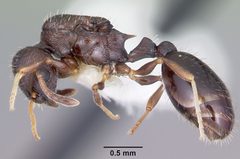
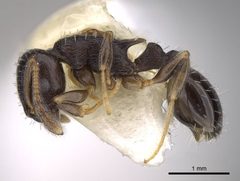
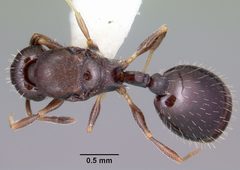
Temnothorax longispinosus is a small North American , measuring 2–2.5 mm in length, commonly known as the Long-spined Acorn Ant. It inhabits forest environments and nests primarily in preformed cavities within leaf litter, including hollow nuts and acorns. The species exhibits remarkable with three distinct morphs associated with alternative nest-founding strategies: small queens with reduced capacity that practice dependent colony founding by returning to natal nests; large queens with low fat reserves that found colonies via pleometrosis (cooperative founding with multiple queens); and large queens with high fat reserves that practice haplometrosis (solitary founding). This species serves as a for the slave-making ant Protomognathus americanus and has been extensively studied for its genomic adaptations to climate variation and pressure.
Pronunciation
How to pronounce Temnothorax longispinosus: //ˌtɛmnoʊˈθɔːræks ˌlɔːŋɡɪˈspaɪnoʊsəs//
These audio files are automatically generated. While they are not always 100% accurate, they are a good starting point.
Identification
Distinguished from similar Temnothorax by its small size (2–2.5 mm) and the presence of small protrusions towards the and petiole. provides a diagnostic feature: three distinct queen morphs occur within , differing in body size, wing length, and fat content. Small queens (short wings, very low fat) are produced in lower numbers than large morphs and are more frequently associated with polygynous nests. The species can be differentiated from its Temnothorax curvispinosus, with which it has been studied in competition experiments, through morphological examination and geographic distribution patterns. Molecular identification may be necessary for definitive separation from cryptic species within the .
Images
Appearance
Small measuring 2–2.5 mm in body length. The exhibits characteristic small protrusions extending from the body towards the and petiole, a trait common in the Temnothorax. Queens display distinct morphological : small queens possess short wings and very low fat reserves; large queens have long to very long wings with variable fat content (low or high). are and typical of the genus in general body plan.
Habitat
Forest , particularly deciduous and mixed forests. Nests occur in preformed structures within the leaf litter layer, especially hollow nuts (particularly acorns) and small twigs. Nesting habits vary seasonally but consistently utilize existing cavities rather than excavating new nest spaces. The occupies the forest floor microhabitat, with nests typically located in accumulated leaf litter and woody debris.
Distribution
Eastern United States, eastern Canada, and British Columbia. Specific studies have been conducted in southern Wisconsin and the northeastern United States. The occurs across a broad latitudinal range encompassing temperate forest of North America.
Host Associations
- Protomognathus americanus - for this slave-making ; subject to raiding and theft
Life Cycle
Colony founding occurs through three alternative strategies associated with morphs: (1) dependent founding by small queens with short wings and very low fat content, which return to natal nests at higher rates; (2) independent founding via pleometrosis (multiple queens cooperating) by large queens with low fat and long wings; (3) independent founding via haplometrosis (single queen) by large queens with high fat and very long wings. Small queens are produced in lower numbers than large morphs and are more common in polygynous colonies. Despite morphological specializations suggesting fixed strategies, queens exhibit extensive behavioral flexibility in founding .
Behavior
Exhibits with alternative colony-founding . Small queens show significantly reduced activity compared to large queens, which may facilitate returning to the natal nest after mating when swarms occur nearby. Both queen morphs mate exclusively in male swarms without female calling behavior. demonstrate larval recognition capabilities that ensure preference over heterospecific , with colony-level chemical referents governing discrimination. When the queen is removed or dies, some brood-care workers can develop ovaries and begin (worker ).
Human Relevance
Research model organism for studies of social insect evolution, , and genomic . Has been used in studies of with Temnothorax curvispinosus. Subject of investigation regarding phenological shifts and responses to climatic factors in prairie and forest . The ' association with acorn nesting makes it relevant for studies of forest floor dynamics and cavity-nesting .
Similar Taxa
- Temnothorax curvispinosusCo-occurs in eastern North America and has been studied in direct competition experiments; both are small acorn-nesting ants but differ in morphological details and geographic distribution patterns
- Temnothorax ambiguusSympatric of Protomognathus americanus; shares similar and but differs in larval recognition cues and geographic range
More Details
Genomic adaptations
genomic studies have identified candidate SNPs associated with , particularly in odorant receptor genes involved in sensory perception of smell. Cuticular hydrocarbon composition varies with climate (n-alkanes) and shows trends with parasite prevalence. Antennal correlates strongly with local parasite prevalence, indicating rapid evolutionary responses to coevolutionary pressure from social parasites.
Queen morph flexibility
Despite morphological specializations resembling with fixed , the three morphs of T. longispinosus show extensive behavioral overlap and flexibility, potentially representing early evolutionary stages of more specialized dispersal systems seen in other .
Sources and further reading
- BugGuide
- Wikipedia
- GBIF taxonomy match
- iNaturalist taxon
- NCBI Taxonomy
- Catalogue of Life
- Novel Genes Determine Different Castes in Ant Colonies
- How One Entomologist is Exploring the Insect Diversity of Prairies
- Pensoft Editorial Team | Blog - Part 131
- Uncategorized | Blog - Part 27
- Bug Eric: Home Bioblitz, Ongoing
- Brazil Bugs #12 – Desafio de identificação #5 | Beetles In The Bush
- Alternative mating behaviors of the queen polymorphic ant Temnothorax longispinosus
- Three queen morphs with alternative nest-founding behaviors in the ant, Temnothorax longispinosus
- Genomic basis of adaptation to climate and parasite prevalence and the importance of odorant perception in the ant Temnothorax longispinosus
- Larval recognition by Temnothorax longispinosus and T. ambiguus hosts of the slave-making ant Protomognathus americanus revisited: colony-level referent ensures conspecific preference