
Temnothorax
Mayr, 1861
Acorn Ants and Allies
Species Guides
17- Temnothorax ambiguus(Doubtful Acorn Ant)
- Temnothorax americanus(Slave-raiding Acorn Ant)
- Temnothorax andrei(Andre's Acorn Ant)
- Temnothorax caguatan
- Temnothorax curvispinosus(acorn ant)
- Temnothorax gallae
- Temnothorax longispinosus(Long-spined Acorn Ant)
- Temnothorax nevadensis(Nevada Acorn Ant)
- Temnothorax obliquicanthus
Temnothorax is a of small ants in the Myrmicinae containing over 500 worldwide. are typically small with mesosoma length around 0.7–1.5 mm. Colonies are generally monogynous with small , often fewer than 100 workers, though some species maintain multiple satellite nests. The genus has become an important model system for studying social , differentiation, and collective decision-making in ants due to their small colony size and ease of laboratory maintenance.
Pronunciation
How to pronounce Temnothorax: /tɛm.nəˈθɔː.ræks/
These audio files are automatically generated. While they are not always 100% accurate, they are a good starting point.
Identification
Temnothorax are distinguished from similar small myrmicine by their 11-segmented with a 3-segmented club, the presence of propodeal spines or teeth (often reduced), and their small colony size. They differ from Leptothorax (now restricted to the Leptothorax muscorum group) by morphological and molecular characters; recent phylogenetic studies have shown that Formicoxenus, Leptothorax, and Harpagoxenus are more distantly related. Temnothorax can be separated from Myrmica by the lack of a strongly projecting and different antennal club structure. Species-level identification typically requires examination of propodeal spine length, petiole node shape, and body under magnification.
Images
Appearance
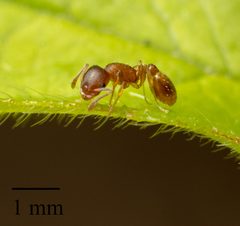
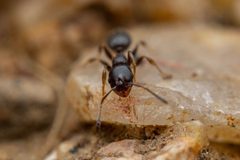
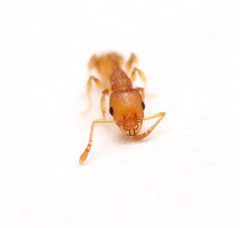
are small ants with mesosoma length typically 0.715 mm to 1.5 mm. Body form is generally slender with a distinct petiole and postpetiole. Coloration varies by , commonly ranging from yellowish-brown to dark brown or black. The is usually broader than long with 11-segmented featuring a 3-segmented club. are relatively small and positioned laterally. The propodeum typically bears spines or teeth, though these may be reduced in some species. Queens are larger than workers and possess wings prior to mating, which are subsequently shed.
Habitat
Many are arboreal, nesting in hollow stems, old or galleries, or plant galls. Others nest in ground-level cavities including hollow twigs, acorns, or nuts. Some species inhabit rock crevices or leaf litter. Nests are typically small and discrete, often occupying pre-existing cavities rather than excavating extensively. City-dwelling occur in urban parks and green spaces.
Distribution
Worldwide distribution with highest diversity in the Holarctic region. Approximately 60 occur in North America, with about 20 species documented from California alone. The occurs across Europe, Asia, and North Africa, with species also present in Central and South America. Western European have been extensively studied, including from the Paris and Lyon regions of France.
Seasonality
Activity patterns vary by climate and . Temperate species are active during warmer months, with colony typically occurring in spring and summer. In laboratory conditions, colonies can be maintained year-round. Specific seasonal patterns for most species are not well documented.
Diet
Trophic feeding on scavenged items including insect carcasses, honeydew, and elaiosomes of seeds. None are documented as active or aggressive . Laboratory colonies are maintained on diets including , honey, and vitamin supplements.
Life Cycle
Colonies are typically monogynous (single ) though facultative has been documented in several . Colony size ranges from a few dozen to few hundred , rarely exceeding 100 workers in most species. Colony founding occurs via haplometrosis (single queen) or pleometrosis (multiple queens). Reproductive are produced seasonally; queens mate and then shed wings to establish new colonies. Some colonies maintain multiple satellite nests connected by trails.
Behavior
forage within short distances of the nest, typically less than one meter, exhibiting central-place foraging . Colonies demonstrate sophisticated collective decision-making during nest , utilizing both visual cues and substrate-bound odor trails. Task allocation during emigration involves at least seven distinct roles including scouting, transport, transport, food collection, and nest construction; typically fewer than 25% of workers are active at any time. Division of labor is not strongly determined by colony size. Some are slave-makers, raiding nests of related species to steal brood; the described slave-making species Temnothorax pilagens uses chemical camouflage and targeted stinging to subdue colonies.
Ecological Role
engineers contributing to soil aeration and nutrient cycling as ground-dwelling . Serve as reliable bioindicators and bioremediators of trace metal pollution including cadmium. Some are for social including slave-making ants and parasitic cestodes. Arboreal species contribute to structure in plant microhabitats. Prey for specialized including the ponerine ant Thaumatomyrmex.
Human Relevance
Important model organisms for behavioral and research due to small colony size and ease of laboratory maintenance. Used extensively in studies of collective decision-making, social network dynamics, differentiation, and aging in social insects. Some have been documented to accumulate heavy metals, making them useful for environmental monitoring. Not considered significant agricultural pests or beneficial species.
Similar Taxa
- LeptothoraxHistorically confused with Temnothorax; now restricted to the Leptothorax muscorum group and distinguished by morphological and molecular characters; more distantly related than previously assumed
- MyrmicaSimilar small myrmicine ants but possess strongly projecting and different antennal club structure; more aggressive foragers and typically larger colonies
- FormicoxenusSocial that nest within Temnothorax colonies; previously considered distinct but phylogenetically nested within Temnothorax in some analyses; distinguished by parasitic lifestyle and morphological adaptations
- HarpagoxenusSlave-making ants related to Temnothorax; distinct characterized by specialized mandibular for raiding
More Details
Phylogenetic Reclassification
Recent molecular phylogenetic studies have shown that the Chalepoxenus, Myrmoxenus, and Protomognathus are nested within Temnothorax, suggesting these may warrant synonymy. The genus is distinct from the more distantly related Formicoxenus, Leptothorax (sensu stricto), and Harpagoxenus.
Research Significance
Temnothorax has become a premier model system for studying social , with research demonstrating that visual cues play a more important role in navigation than previously assumed for ants, and that control over varies between single- and mixed-species colonies. studies have revealed that worker-specific genes are more evolutionarily derived than queen-specific genes.
Sources and further reading
- BugGuide
- Wikipedia
- GBIF taxonomy match
- iNaturalist taxon
- NCBI Taxonomy
- Catalogue of Life
- Pensoft Editorial Team | Blog - Part 131
- Uncategorized | Blog - Part 27
- Novel Genes Determine Different Castes in Ant Colonies
- How One Entomologist is Exploring the Insect Diversity of Prairies
- Bug Eric: Home Bioblitz, Ongoing
- Brazil Bugs #12 – Desafio de identificação #5 | Beetles In The Bush
- Cadmium toxicokinetics differ between forest and city colonies of the ant Temnothorax nylanderi (Formicidae: Myrmicinae) (Foerster, 1850).