
Formicoxenus
Mayr, 1855
Guest Ants
Species Guides
1- Formicoxenus hirticornis(Dogwood Guest Ant)
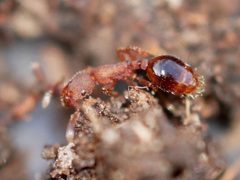
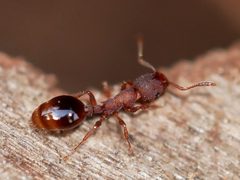
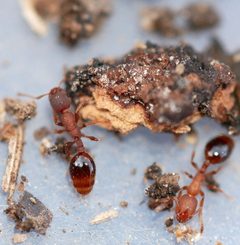
Formicoxenus is a of myrmicine ants comprising seven described . All members are obligate xenobionts (guest ants) that live within nests of species, primarily in the Nearctic and Palearctic regions. The genus is notable for repeated evolution of social and is closely related to Leptothorax and Harpagoxenus within the Formicoxenus genus-group. Species exhibit specialized behavioral and chemical adaptations for integration into host colonies.
Pronunciation
How to pronounce Formicoxenus: //fɔːrˌmɪkoʊˈzɛnəs//
These audio files are automatically generated. While they are not always 100% accurate, they are a good starting point.
Identification
Small ants found exclusively within nests of , primarily Myrmica and Formica. Distinguished from free-living Myrmicinae by their obligate association with host colonies. Chemical mimicry of host cuticular hydrocarbons facilitates integration. Molecular suggests Formicoxenus may not be monophyletic; some lineages previously assigned to Leptothorax may require taxonomic revision.
Images
Appearance
Small myrmicine ants. of some exhibit with distinct size classes; F. provancheri shows three worker size classes. Queens and males may show polymorphism in some species. Specific morphological features vary by species and are adapted for life within nests.
Habitat
Distribution
Nearctic and Palearctic regions. include: F. nitidulus (Europe, including UK and Poland), F. provancheri (North America), F. quebecensis (eastern Canada, western Canada [Alberta, British Columbia], Wisconsin), F. sibiricus (Siberia), F. chamberlini, F. diversipilosus, and F. hirticornis (North America). GBIF records indicate presence in Denmark, Norway, and Sweden.
Diet
Trophallactic exchanges with ; F. provancheri workers specialize in licking ('shampooing') host ants to obtain regurgitations. Specific diet details for other not documented.
Host Associations
Life Cycle
Colonies contain queens, , and . F. provancheri colonies maintain their own brood chambers within nests. Division of labor includes nurses (21% of colony), scouts (18%), and workers specialized in obtaining food from hosts (61%). Developmental details otherwise poorly documented.
Behavior
Obligate xenobiosis: permanent residence within colonies without killing the host . exhibit aggressive dominance toward host workers through physical attacks. Specialized division of labor: nurses remain in Formicoxenus nest areas; scouts explore external areas; majority of workers remain in host nest areas to obtain food via . Chemical mimicry of host cuticular hydrocarbons facilitates colony integration. Early experience affects host- interactions.
Ecological Role
Social (guest or xenobiont) that exploits colony resources. Extreme dependent on patchy host nest distribution. Multiple Formicoxenus colonies may coexist within single host nests. genetics suggest effective within-site in some .
Human Relevance
Subject of research on social evolution, chemical , and division of labor. Conservation concern for like F. nitidulus due to woodland fragmentation; single wood nests can support multiple colonies and have high conservation importance. Some represent new state or regional records when discovered.
Similar Taxa
- HarpagoxenusAlso in Formicoxenus -group; both are socially parasitic, but Harpagoxenus is typically slave-making while Formicoxenus is xenobiotic
- LeptothoraxClosely related in same genus-group; phylogenetic studies suggest Formicoxenus may not be monophyletic and some lineages may be misplaced in current
- Myrmica ; Formicoxenus may be mistaken for small Myrmica workers but are found only within host nests and show behavioral adaptations for
More Details
Phylogenetic uncertainty
Recent phylogenetic analyses based on nuclear and mitochondrial markers suggest Formicoxenus may not be monophyletic. Several monophyletic lineages within Leptothorax do not correspond to currently described , particularly in the Nearctic region.
Chemical integration
Formicoxenus use chemical mimicry of cuticular hydrocarbons to facilitate integration into host colonies, reducing aggression from host .
Conservation genetics
genetic studies of F. nitidulus show maintained genetic diversity despite extreme specialization, with clear differentiation between Scottish and English populations and evidence of multiple colonies per nest.
Sources and further reading
- BugGuide
- Wikipedia
- GBIF taxonomy match
- iNaturalist taxon
- NCBI Taxonomy
- Catalogue of Life
- Social Organization in the Guest‐ant Formicoxenus provancheri
- Southern Record of the Xenobiotic Ant Formicoxenus quebecensis from Eastern Wisconsin
- First Records of the Guest Ant Formicoxenus Quebecensis FrancoeurFrom Western Canada (Hymenoptera, Formicidae)
- Chemical mimicry between parasitic ants of the genus Formicoxenus and their host Myrmica (hymenoptera, Formicidae)
- Insights into the population genetics of an extreme habitat specialist, the wood ant commensal Formicoxenus nitidulus
- Effects of early experience on interactions between the parasite ant Formicoxenus provancheri and its host Myrmica incompleta (Hymenoptera: Formicidae)
- Effect of host species, host nest density and nest size on the occurrence of the shining guest ant Formicoxenus nitidulus (Hymenoptera: Formicidae)
- New sites in Poland and notes on the biology of socially parasitic ants Formicoxenus nitidulus (Nyl.) nad Harpagoxenus sublaevis (Nyl.) (Hymenoptera, Formicidae)
- Phylogeny of the Formicoxenus genus-group (Hymenoptera: Formicidae) reveals isolated lineages of Leptothorax acervorum in the Iberian Peninsula predating the Last Glacial Maximum