
Temnothorax curvispinosus
(Mayr, 1866)
acorn ant, Bent-spined Acorn Ant
Temnothorax curvispinosus is a small cavity-nesting common throughout the eastern United States. The species is frequently called the "acorn ant" due to its habit of nesting in hollowed-out acorns and other small plant cavities. Colonies exhibit sophisticated collective decision-making when selecting nest sites, with active recruiting nestmates through quality-dependent delays and quorum-based transport strategies. The species has been used as a model organism for studying social insect , micronutrient dynamics, and urban thermal .
Identification
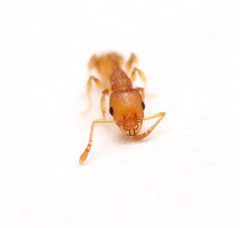
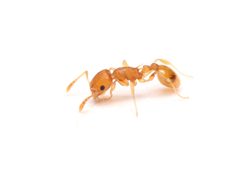
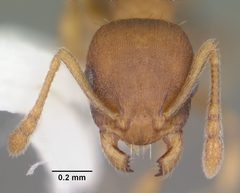
Temnothorax curvispinosus is a small , typically under 3 mm in length. The can be distinguished from by its curved propodeal spines, which give rise to both its (curvispinosus = curved spines) and "Bent-spined Acorn Ant." The species nests in small cavities with single entrance holes approximately 1 mm in diameter, a trait that distinguishes it from larger cavity-nesting ants. Positive identification to species level typically requires examination of morphological characters including spine shape and petiole structure.
Images
Habitat
Forested areas in both rural and urban environments. Nests occur in plant cavities, particularly hollowed-out acorns, as well as in soil and under rocks. The is ground-dwelling and prefers small enclosed spaces with narrow entrances that exclude larger .
Distribution
Widely distributed throughout the eastern United States. The is common across this range and has been documented in both natural forest and urban settings.
Life Cycle
Colonies progress through a defined colony cycle with distinct periods: Pre-Reproductive, Reproductive, Pre-Winter, and Winter. The cycle involves growth from founding stage to mature colony, with reproductive produced during the Reproductive Period. Colony micronutrient composition shifts significantly across these periods, with differential accumulation of minerals in queens, , and .
Behavior
Colonies exhibit collective nest-site choice mediated by an active minority of . When a worker discovers a promising site, she recruits nestmates after a delay inversely proportional to site quality. Recruitment proceeds through tandem runs (slow, recruiting active ants) followed by transport of the passive majority. Transport speed increases with experience. Workers use a quorum rule to decide between and direct transport, with quorum threshold varying based on prior experience. Direct -to-ant contact is required for quorum perception. Colonies can actively compare sites, rejecting mediocre options when better alternatives exist while accepting the same sites when paired with worse alternatives.
Human Relevance
The serves as a model organism for behavioral research, particularly in studies of collective decision-making and social insect cognition. Urban have demonstrated rapid evolutionary to thermal environments, showing improved heat and increased thermal plasticity compared to rural populations. This makes the species valuable for studying urban evolutionary processes.
Similar Taxa
- Temnothorax longispinosusA congeneric acorn-dwelling that frequently co-occurs in the same and has been studied alongside T. curvispinosus in competition experiments. Distinguished by longer propodeal spines and different allometric proportions.
- Temnothorax albipennisA European with qualitatively similar nest-site choice but quantitative differences suggesting greater emphasis on speed. Used in comparative behavioral studies.
More Details
Micronutrient Dynamics
Colony-level micronutrient composition changes predictably across the colony cycle. and queens show general loss of some micronutrients during Winter. Magnesium and manganese increase during Pre-Reproductive and Reproductive periods in both , while calcium and zinc increase only in queens. Potassium peaks in Pre-Winter for both castes, and sodium increases specifically in workers during this period. Manganese levels are lower in than in workers, queens, or during .
Urban Adaptation
Urban have evolved improved heat and increased plasticity in thermal response compared to rural populations, representing documented cases of contemporary urban evolution in social insects.
Model System Status
The has been explicitly described by researchers as an "ideal model system to study " due to the ability to induce in -care , allowing comparison of across and reproductive states.
Sources and further reading
- BugGuide
- Wikipedia
- GBIF taxonomy match
- iNaturalist taxon
- NCBI Taxonomy
- Catalogue of Life
- How One Entomologist is Exploring the Insect Diversity of Prairies
- Pensoft Editorial Team | Blog - Part 131
- Uncategorized | Blog - Part 27
- Novel Genes Determine Different Castes in Ant Colonies
- Bug Eric: Home Bioblitz, Ongoing
- Brazil Bugs #12 – Desafio de identificação #5 | Beetles In The Bush
- Behavioral mechanisms of collective nest-site choice by the ant Temnothorax curvispinosus
- Micronutrient Changes in Colonies of the AntTemnothorax curvispinosus(Hymenoptera: Formicidae) during the Colony Cycle