
Disholcaspis simulata
Kinsey, 1922
Dried Peach Gall Wasp
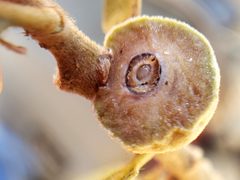
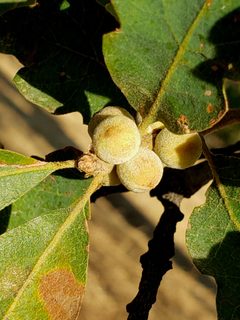
Disholcaspis simulata is a of gall wasp in the Cynipidae, first described by Alfred C. Kinsey in 1922. Like other members of its , this species induces the formation of characteristic galls on oak trees (Quercus spp.). The species exhibits the complex typical of many cynipid , with both sexual and agamic (parthenogenetic) . The specific epithet 'simulata' and 'Dried Peach Gall Wasp' suggest the gall's resemblance to a dried peach in appearance.
Pronunciation
How to pronounce Disholcaspis simulata: //daɪˌshɒlˈkæspɪs ˌsɪmjʊˈleɪtə//
These audio files are automatically generated. While they are not always 100% accurate, they are a good starting point.
Identification
Identification relies primarily on the distinctive gall formed on oaks. The 'dried peach' gall is presumably rounded, somewhat shriveled in appearance, and detachably attached to twigs or leaves. The is distinguished from other Disholcaspis by gall , host specificity, and seasonal timing of . Microscopic examination of specimens may reveal subtle morphological differences in , wing venation, and genitalia, but these require knowledge.
Images
Habitat
Associated with oak-dominated , including deciduous forests, woodlands, and areas where oak occur. The requires healthy, actively growing oak tissue for gall induction.
Distribution
Distribution data is limited in the provided sources. As a North American described by Kinsey, it likely occurs in regions where its oaks are present. The Disholcaspis is well-represented in western North America, particularly in association with white oaks (Quercus section Quercus).
Seasonality
Exhibits the typical cynipid . Sexual emerges in spring from inconspicuous, soft galls on buds, flowers, or young leaves. Agamic () generation emerges in late autumn or winter from the larger, more conspicuous 'dried peach' galls. This seasonal partitioning is characteristic of the .
Host Associations
- Quercus - obligate Specific oak not definitively established in available sources, but likely associated with white oaks given -level patterns.
Life Cycle
Complex with . Sexual : winged males and females emerge in spring, mate, and females lay in oak tissue inducing small, inconspicuous spring galls. Larvae develop and emerge as agamic females. Agamic generation: wingless females emerge in late autumn/winter from larger, woody galls, reproduce parthenogenetically, and lay eggs inducing the next sexual generation's galls. This cyclical pattern is characteristic of Cynipidae.
Behavior
Females inject chemical compounds (likely including venom components) along with during oviposition, stimulating the plant to form a protective gall structure. The does not actively care for offspring beyond provisioning the gall. of the sexual may be found on or near oaks during spring periods.
Ecological Role
As a gall inducer, modifies plant growth patterns to create protected microhabitats for its larvae. Galls may serve as resources for other organisms: attack gall wasp larvae, and (other insects) may occupy galls without directly harming the gall wasp. Galls generally cause only cosmetic damage to host trees and do not significantly impact tree health.
Human Relevance
Minimal direct economic impact. Galls may be of interest to naturalists and entomologists studying plant-insect interactions. The is one of many studied by Alfred C. Kinsey early in his scientific career, before his more famous work in human sexuality. Galls may occasionally be noticed by observers of oak trees but are not considered significant pests.
Similar Taxa
- Disholcaspis quercusglobulusAlso forms round, detachable galls on oak twigs; distinguished by gall and specificity.
- Disholcaspis quercusmammaForms rough oak bullet galls; distinguished by gall texture and appearance ('rough bullet' vs. 'dried peach').
- Disholcaspis cinerosaForms mealy oak galls; distinguished by gall surface texture and appearance.
More Details
Taxonomic history
Described by Alfred C. Kinsey in 1922. Kinsey spent two decades studying Cynipidae at Indiana University before his later work, making this part of an important early body of entomological research.
Gall induction mechanism
Recent research (Guiguet et al., 2023) indicates that gall-inducing Cynipidae possess enlarged venom glands relative to non-gall-inducing relatives, implicating venom components in the chemical signaling that induces gall formation. The specific compounds remain under investigation.