
Disholcaspis cinerosa
(Bassett, 1881)
Mealy oak gall wasp
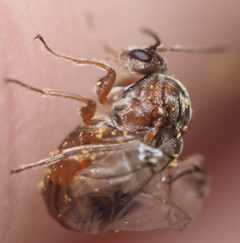
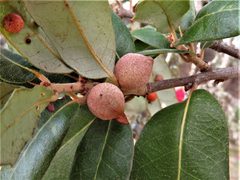
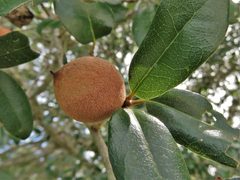
Disholcaspis cinerosa, commonly known as the mealy oak gall wasp, is a of gall wasp in the Cynipidae. It induces distinctive galls on oak trees (Quercus spp.), specifically known as "mealy oak galls." The species has been documented to possess exceptionally large venom glands relative to its body size—when unfolded, the venom gland is approximately 10 times longer than the —making it a notable subject in studies of gall induction mechanisms. Like other cynipid , it exhibits an with both sexual and (parthenogenetic) .
Pronunciation
How to pronounce Disholcaspis cinerosa: /dɪˈhɒlkəspɪs sɪˈnɛroʊsə/
These audio files are automatically generated. While they are not always 100% accurate, they are a good starting point.
Identification
The is identified by the distinctive mealy oak galls it produces on oak . Galls are typically round, woolly or mealy in texture, and often clustered on twigs. are small, typically 2-3 mm in length, with reduced wing venation characteristic of Cynipidae. The species is distinguished from such as Disholcaspis quercusmamma (oak rough bulletgall wasp) and Disholcaspis quercusglobulus (round bullet gall wasp) by gall : D. cinerosa produces galls with a mealy or fuzzy surface texture, whereas D. quercusmamma produces rough, bullet-shaped galls and D. quercusglobulus produces smooth, spherical galls.
Images
Habitat
Associated with oak-dominated forests and woodlands, particularly in regions where oak (Quercus spp.) occur. Galls are found on twigs and stems of oak trees.
Distribution
Documented from North America, with records primarily from the United States. Specific distribution details beyond this are not well-supported in available sources.
Host Associations
- Quercus - gall inductionInduces mealy oak galls on oak twigs and stems
Life Cycle
Exhibits the characteristic cynipid : a sexual producing bisexual that emerge in spring, and an agamic () generation of parthenogenetic females that typically emerge in late autumn or winter. The sexual generation produces the large, conspicuous galls from which the agamic females emerge.
Ecological Role
As a gall inducer, manipulates oak plant tissue to create protective structures for larval development. The galls provide and food resources for the 's larvae. Galls may also serve as microhabitats for other organisms, including (guest organisms) and wasps.
Human Relevance
Subject of scientific research due to its exceptionally large venom glands, which have been implicated in gall induction mechanisms. The mealy oak galls it produces are distinctive and can be used for identification purposes in field studies.
Similar Taxa
- Disholcaspis quercusmammaAlso produces bullet-shaped galls on oaks, but D. quercusmamma galls are rough and occupy one-third of the volume in venom size versus D. cinerosa's 10x abdomen length unfolded venom gland
- Disholcaspis quercusglobulusProduces smooth, spherical round bullet galls on oaks, particularly Quercus muhlenbergii, with distinct gall from the mealy-textured galls of D. cinerosa