
Disholcaspis quercusmamma
(Walsh, 1869)
oak rough bulletgall wasp
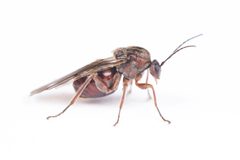
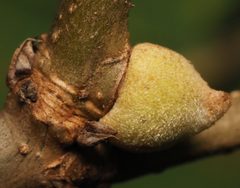
Disholcaspis quercusmamma, the oak rough bulletgall , is a cynipid gall wasp that induces distinctive bullet-shaped galls on twigs of white oaks. The exhibits an with sexual and phases, each producing morphologically different galls. The fall bullet galls are large, conspicuous structures with a velvety surface and pointed apex, while spring galls are small and inconspicuous on leaf buds. This wasp possesses notably enlarged venom glands, with the venom occupying approximately one-third of abdominal volume, implicating venom compounds in gall induction.

Pronunciation
How to pronounce Disholcaspis quercusmamma: //ˌdɪs.hɒlˈkæspɪs ˌkwɜr.kəsˈmæmə//
These audio files are automatically generated. While they are not always 100% accurate, they are a good starting point.
Identification
Distinguished from the similar Disholcaspis quercusglobulus (round bullet gall wasp) by the velvety surface texture and pointed apex ('nipple') of its galls; D. quercusglobulus galls are round and lack these features. The specific epithet 'mamma' (Latin for breast) references this nipple-like projection. Galls are solid, detachable, and typically occur singly or in small clusters on twigs rather than leaves.
Images
Habitat
Associated with white oaks (Quercus sect. Quercus) in deciduous forest environments. Documented trees include bur oak (Q. macrocarpa), swamp white oak (Q. bicolor), overcup oak (Q. lyrata), and chinquapin oak (Q. muhlenbergii). Occurs in dry-mesic upland deciduous forests and similar oak-dominated .
Distribution
North America; records from the eastern and central United States including Missouri, with oaks distributed across this range. Specific distribution boundaries not precisely documented in available sources.
Seasonality
Bisexual emerge mid-to-late spring from small spring leaf galls; generation females emerge late fall from large bullet galls and immediately oviposit into leaf buds. Gall formation visible in summer and fall for the asexual generation, spring for the sexual generation.
Diet
Larvae feed on nutritive tissue within the gall structure induced on oak tissues. do not feed; their mouthparts are adapted for oviposition rather than feeding.
Host Associations
- Quercus macrocarpa - bur oak
- Quercus bicolor - swamp white oak
- Quercus lyrata - overcup oak
- Quercus muhlenbergii - chinquapin oak
- Sycophila dubia - Eurytomidae, parasitizes larvae within galls
- Torymus denticulatus - Torymidae, parasitizes larvae within galls
- Mesopolobus sp. - Pteromalidae, parasitizes larvae within galls
- Pteromalus sp. - Pteromalidae, parasitizes larvae within galls
Life Cycle
with distinct sexual and phases. Sexual : males and females develop in small, inconspicuous spring leaf galls, emerge mid-to-late spring, mate, and females oviposit into twig cambium inducing fall bullet galls. Asexual (agamic) generation: only females develop in fall bullet galls, emerge late fall, reproduce parthenogenetically, and oviposit single into leaf buds inducing spring leaf galls. Sex determination by : males haploid from unfertilized eggs, females from fertilized eggs.
Behavior
Females use modified ovipositor to inject through phloem into contact with cambium, where secretions (likely venom compounds) stimulate meristematic proliferation and gall formation. Fall galls exude honeydew-like material that fosters growth and attracts stinging insects (bald-faced , yellowjackets) and biting insects (carpenter ants), potentially providing protective services for developing larvae.
Ecological Role
Gall inducer that manipulates oak tissue development. Creates structure exploited by multiple and . Indirectly influences dynamics through honeydew production that supports and attracts predatory and defensive insects.
Human Relevance
Subject of entomological research on gall induction mechanisms; notably large venom glands have been studied to understand the biochemical basis of plant manipulation. Galls cause cosmetic damage to ornamental oaks but rarely threaten tree health.
Similar Taxa
- Disholcaspis quercusglobulusAlso produces bullet galls on white oaks, but galls are round with smooth rather than velvety surface and lack the pointed apex; often found on same including chinquapin oak
- Disholcaspis cinerosaRelated mealy oak gall wasp with similarly enlarged venom glands, but produces different gall (mealy appearance) on oaks
Sources and further reading
- BugGuide
- Wikipedia
- iNaturalist taxon
- NCBI Taxonomy
- Gall-Inducing Wasps Have Enlarged Venom Glands, Study Finds
- The Insects Behind the Weird Growths on Plants
- Coccinelidae | Beetles In The Bush
- Bug Eric: Wasp Wednesday: Gall Wasps
- Cynipidae | Beetles In The Bush
- Description and Biology of the Sexual Generation of Disholcaspis quercusmamma (Walsh and Riley) (Hymenoptera: Cynipidae), with Notes on Associated Parasitoids