
Cerceris insolita
Cresson, 1865
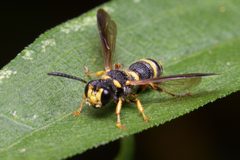
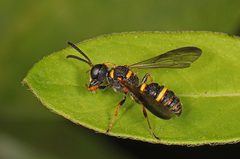
Cerceris insolita is a solitary predatory in the Crabronidae, found in North America. Like other members of the Cerceris, it is a ground-nesting wasp that provisions its nests with paralyzed insect prey for its larvae. The was described by Cresson in 1865. Specific details regarding its prey preferences, nesting , and precise distribution within North America remain poorly documented in the available literature.
Pronunciation
How to pronounce Cerceris insolita: //sɛrˈsɛrɪs ɪnˈsɒlɪtə//
These audio files are automatically generated. While they are not always 100% accurate, they are a good starting point.
Identification
Cerceris insolita can be distinguished from other Cerceris by subtle morphological characters, though specific diagnostic features for this species are not well-documented in readily available sources. Females of the typically have three yellow facial markings, while males have two. Identification to species level likely requires examination of genitalia and other microscopic features. The genus Cerceris is characterized by a robust body, relatively short , and often distinctive color patterns on the and . Nests, when found, are pencil-sized burrows in sandy soil with symmetrical mounds of fine-textured diggings.
Images
Habitat
Based on -level characteristics, Cerceris insolita likely nests in well-drained, sandy or sandy-clay soils in open, sunny areas. Related Cerceris favor such as ball fields, dirt roads, playgrounds, and campsites with lightly vegetated, compacted ground. The species requires access to suitable prey in nearby wooded or forested areas.
Distribution
North America, with confirmed records from Canada (Ontario) and the United States. The precise range within North America is not well-delineated in available sources.
Life Cycle
As a solitary , Cerceris insolita likely follows the typical crabronid : females dig underground nests, provision individual with paralyzed prey, lay on the prey, and seal the cells. Larvae develop by consuming the paralyzed prey, pupate within the nest, and emerge as the following season. Specific details for this are not documented.
Behavior
Females are solitary hunters that capture and paralyze prey with their sting, then transport it to underground nests. Prey is carried upside down and -forward beneath the during , resulting in a slower, more direct flight path compared to unburdened . When threatened, females may drop prey at the nest entrance rather than entering with it. Nests are often loosely aggregated in suitable patches.
Ecological Role
As a of other insects, Cerceris insolita contributes to of its prey . Like other Cerceris species, it may serve as a biosurveillance tool for detecting wood-boring , though this has not been specifically documented for C. insolita.
Human Relevance
Not specifically documented. Related Cerceris , particularly C. fumipennis, are valuable for biosurveillance of pests such as the emerald ash borer. Cerceris insolita may have similar potential if its prey preferences include economically significant wood-boring beetles.
Similar Taxa
- Cerceris fumipennisShares the same and general nesting habits, but specializes almost exclusively on Buprestidae (jewel beetles) and is extensively used for biosurveillance. C. insolita likely has different prey preferences.
- Cerceris bicornisAnother North American Cerceris that preys on weevils (Curculionidae) rather than buprestids. Burrow entrances may appear slightly larger, and discarded weevils rather than beetles indicate its presence.
- Bembix americanaA sand wasp that constructs superficially similar burrows, but these enter the ground at an angle with asymmetrically distributed diggings, and are found in sandier substrates. Does not leave paralyzed prey at nest entrances.
More Details
Taxonomic Note
Cerceris insolita was originally placed in the in some sources, but current classification places it in Crabronidae ( Philanthinae) based on phylogenetic revisions of Hymenoptera.
Data Deficiency
Despite being described in 1865, C. insolita remains poorly studied compared to such as C. fumipennis. Most ecological and behavioral information presented here is inferred from -level patterns and must be verified through targeted study.
Sources and further reading
- BugGuide
- Wikipedia
- GBIF taxonomy match
- iNaturalist taxon
- Catalogue of Life
- Working with Cerceris fumipennis—Part 2 | Beetles In The Bush
- Working with Cerceris fumipennis—Part 1 | Beetles In The Bush
- Hymenoptera | Beetles In The Bush | Page 6
- Wasp, Geographic Data Improve Surveillance for Emerald Ash Borer
- Predatory Wasps and Citizen Scientists are Taking on the Emerald Ash Borer
- ID Challenge #19 | Beetles In The Bush