
Stictiella emarginata
(Cresson, 1865)
sand wasp
Stictiella emarginata is a solitary sand wasp in the Crabronidae, Bembicinae. It constructs nests in sandy soils and provisions with lepidopteran larvae, primarily Noctuidae and Hesperiidae. The occurs across eastern North America from northern Michigan to the Atlantic Coast, with a season concentrated in late June through early August. Nesting includes temporary nest closure, mound leveling, and orientation flights.
Pronunciation
How to pronounce Stictiella emarginata: /stɪkˈtiːɛlə ɛˌmɑːrdʒɪˈneɪtə/
These audio files are automatically generated. While they are not always 100% accurate, they are a good starting point.
Identification
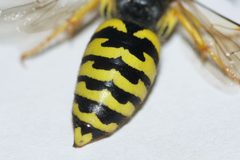
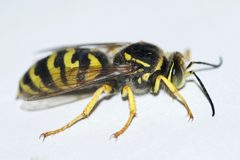
Distinguished from other Stictiella by the (notched) apex of the , the source of its specific epithet. As a member of the Bembicini tribe, it shares the general sand wasp body plan with other Stictiella: slender build, relatively long legs adapted for digging, and banded coloration typical of the group. Specific diagnostic characters relative to would require examination of genitalic and other subtle morphological features.
Images
Habitat
Sandy soil areas, particularly in open natural . Documented nesting in sand prairie and sand blowout environments. In Ontario, occurs at Canadian Forces Base Borden in Simcoe County in sandy .
Distribution
Eastern North America from northern Michigan to the Atlantic Coast; documented in Ontario (Simcoe County), New York, Michigan. Previously considered to have a disjunct distribution, but museum and field records confirm geographic continuity across this range.
Seasonality
Late June through early August; peak season inferred from field observations and collection records in Ontario, New York, and Michigan.
Diet
of lepidopteran larvae; provisions nests with Noctuidae (owlet moths) and Hesperiidae ().
Life Cycle
Solitary nesting . Females construct nests in sandy soil with multiple , each provisioned with multiple prey items. Nesting includes temporary closure of nest entrance, mound leveling to conceal the nest, and orientation for location memory.
Behavior
Exhibits temporary nest closure between provisioning trips, leveling the soil mound at the nest entrance to reduce detection. Performs orientation to memorize nest location. Prey transport involves carrying paralyzed lepidopteran larvae to the nest.
Ecological Role
of lepidopteran larvae, potentially contributing to of Noctuidae and Hesperiidae in sandy .
Similar Taxa
- Bembix americanaAlso a sand wasp in Bembicinae, but differs in prey use (flies rather than lepidopteran larvae) and lacks the .
- Other Stictiella speciesWestern North American and Mexican share general but differ in geographic range and subtle structural features; S. emarginata is the primary eastern .
Sources and further reading
- BugGuide
- Wikipedia
- GBIF taxonomy match
- iNaturalist taxon
- Catalogue of Life
- Bembicid Holdings | Entomology Research Museum
- Disteniidae | Beetles In The Bush
- Ascalaphidae | Beetles In The Bush
- August | 2022 | Beetles In The Bush
- North America’s largest stag beetle | Beetles In The Bush
- Nesting Behavior, Ecology, Seasonal and Geographic Distribution of the Sand Wasp, <em>Stictiella emarginata</em> (Hymenoptera: Sphecidae)