
Hoplisoides hamatus
(Handlirsch, 1888)
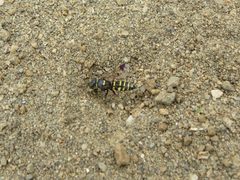
Hoplisoides hamatus is a sand wasp in the Crabronidae. It is found in North America, with records from Canada including British Columbia. Like other members of the Hoplisoides, it is a solitary that hunts treehoppers in the family Membracidae as prey for its larvae.
Pronunciation
How to pronounce Hoplisoides hamatus: //hɒˈplɪsɔɪˌdiːz həˈmeɪtəs//
These audio files are automatically generated. While they are not always 100% accurate, they are a good starting point.
Identification
Hoplisoides hamatus can be distinguished from other sand wasps by its membership in the Hoplisoides, which is characterized by spotted wings. The is part of a genus of approximately 18 species in North America north of Mexico, with the majority of species occurring in western regions. Specific diagnostic features for H. hamatus relative to are not documented in available sources.
Images
Habitat
Sandy soils where females excavate burrows for nesting. Based on -level , likely associated with supporting prey (Membracidae) and colonies that provide honeydew.
Distribution
North America; recorded from Canada including British Columbia.
Diet
and treehoppers ( Membracidae) as larval provisions; adults have been observed feeding on honeydew from colonies.
Host Associations
- Membracidae - preyTreehoppers are paralyzed and stored as food for larval offspring
- Aphidoidea - food source feed on honeydew secreted by aphids
Life Cycle
Females dig burrows in sand with tunnels descending at angles of 45-70° for approximately 10 cm, reaching depths of about 6 cm. Terminal measure roughly 9-11 mm long and 7-9 mm in diameter. Each cell is provisioned with multiple paralyzed treehoppers (estimated 10-15 per cell for related , varying with prey size). A single is laid on the last prey item. Females typically construct multiple nests during their lifetime.
Behavior
Females enter and exit burrows -first, unlike most burrowing that back out during construction. After nest completion, the entrance is filled to disguise its location, followed by a low orientation before departing to hunt. Females may dig in several spots before selecting a final nest site. are rarely observed on flowers but may be found near colonies.
Ecological Role
of treehoppers; may contribute to of Membracidae. Serves as for kleptoparasitic including in the Nysson, cuckoo wasps (Elampus viridicyaneus), velvet ants (Dasymutilla vesta), and satellite flies (Sarcophagidae such as Senotainia trilineata).
Similar Taxa
- Hoplisoides nebulosusSimilar size, , and prey preferences; H. nebulosus occurs mostly in the eastern U.S. and has been more extensively documented
- Mason wasps (Eumeninae)Similar of scraping soil and splayed wing posture at rest, but distinguished by spotted wings and -first burrow entry in Hoplisoides
- Other Crabronidae sand waspsShared characteristics of solitary nesting and prey provisioning, but Hoplisoides distinguished by spotted wings and specialization