
Elampus
Spinola, 1806
Species Guides
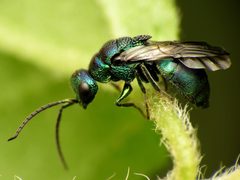
1Elampus is a of cuckoo wasps in the Chrysididae. are distributed across Europe, Asia, Africa, and North America. Members of this genus are kleptoparasites, laying in the nests of other or in intermediate that are subsequently captured by the principal host. The genus includes at least nine described species, with E. bidens known to employ a 'Trojan horse' strategy using leafhopper as intermediate hosts.
Pronunciation
How to pronounce Elampus: /ɛˈlæmpəs/
These audio files are automatically generated. While they are not always 100% accurate, they are a good starting point.
Identification
Elampus can be recognized by their metallic coloration typical of chrysidid , compact body form, and reduced wing venation. Specific identification to species level requires examination of external genitalia and other microscopic features. The is distinguished from other chrysidid genera by a combination of structural characters including mesosomal and metasomal proportions.
Images
Habitat
vary by . E. bidens occurs in European vineyard agro-, particularly areas with less-intensive agriculture. Other species occupy a range of terrestrial habitats where their nest, including sandy soils and areas with colonies that attract honeydew-feeding .
Distribution
Europe, Asia, Africa, and North America. Specific distribution records include Denmark, Norway, and Sweden. E. bidens has been documented in north-western Italy with parasitisation rates varying by region.
Diet
have been observed feeding on honeydew from colonies. Larvae are kleptoparasitic, consuming the provisions stored by for their own offspring.
Host Associations
- Scaphoideus titanus - intermediate (leafhopper )E. bidens lays in 3rd-5th instar nymphs; leafhoppers are of Flavescence Dorée phytoplasma
- Orientus ishidae - intermediate (leafhopper )E. bidens lays in 3rd-5th instar nymphs; leafhoppers are of Flavescence Dorée phytoplasma
- Apoid wasp (unidentified species) - principal Captures parasitized leafhoppers and transports them to its nest, enabling E. bidens to enter indirectly
- Hoplisoides nebulosus - E. viridicyaneus parasitizes nests of this sand wasp
Life Cycle
Females lay either directly in nests or in intermediate hosts. In E. bidens, eggs are laid in 3rd to 5th instar nymphs of leafhopper intermediate hosts; larvae develop endoparasitically inside these leafhoppers. The parasitized leafhoppers are subsequently captured by an apoid wasp and transported to its nest, where the cuckoo wasp larva completes development by consuming the host's provisions. Most female wasps produce multiple nests or events in their lifetime.
Behavior
Kleptoparasitic includes locating nests or suitable intermediate hosts. E. bidens employs a 'Trojan horse' strategy, using parasitized leafhoppers to gain entry to apoid nests indirectly. rarely visit flowers but may be found near colonies feeding on honeydew. Some do not spend much time on final closure of burrows, making them vulnerable to additional .
Ecological Role
As kleptoparasites, Elampus regulate of their . E. bidens has potential as a agent for leafhopper of Flavescence Dorée , with parasitisation rates exceeding 25% in suitable in north-western Italy. This has potential economic implications for in vineyard .
Human Relevance
E. bidens has attracted research interest for its potential role in controlling leafhopper of Flavescence Dorée, a serious phytoplasma of European vineyards. The ' high parasitisation rates in some agricultural areas suggest possible applications in programs.
Similar Taxa
- Other Chrysididae genera (e.g., Chrysis, Hedychrum)Similar metallic coloration and kleptoparasitic lifestyle; distinguished by structural characters of mesosoma and metasoma, and wing venation patterns
- Nysson (Crabronidae)Also parasitizes nests of sand wasps like Hoplisoides; distinguished by -level characters including wing structure and larval development mode
More Details
Research Note on E. bidens
A 2023 study documented the novel - association of E. bidens with two leafhopper , Scaphoideus titanus and Orientus ishidae. This represents a previously unknown 'Trojan horse' strategy in chrysidid . The original host of E. bidens remains unknown, suggesting this species may have undergone a host shift or has broader host plasticity than previously recognized.
Taxonomic Status
The contains at least nine described : E. albipennis, E. ambiguus, E. bidens, E. cecchiniae, E. gayi, E. kashmirensis, E. macuxi, E. musashinus, and E. pulchricollis. E. viridicyaneus is mentioned in literature as a of Hoplisoides nests.
Sources and further reading
- BugGuide
- Wikipedia
- GBIF taxonomy match
- iNaturalist taxon
- NCBI Taxonomy
- Bug Eric: Wasp Wednesday: Hoplisoides nebulosus
- Bug Eric: July 2012
- New host-parasitoid association and the Trojan horse strategy adopted by the cuckoo wasp Elampus bidens with two vectors of Flavescence Dorée: Scaphoideus titanus and Orientus ishidae