
Cimbex americanus
Leach, 1817
elm sawfly, North American Elm Sawfly
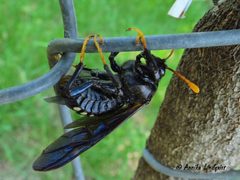
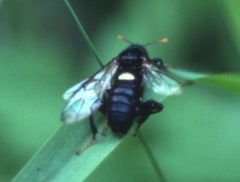
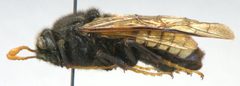
Cimbex americanus, commonly known as the elm , is a large, non-stinging sawfly in the Cimbicidae. measure approximately 20–30 mm in body length and are among the largest sawflies in North America. The exhibits in coloration: males have yellow-orange , while females display black abdomens with yellow transverse bands. Larvae feed on foliage of various broadleaf trees, particularly elm and willow, and can reach 50 mm in length. The species has a single per year, with larvae in soil cocoons before pupating in spring.
Pronunciation
How to pronounce Cimbex americanus: //ˈsɪmbɛks əˌmɛrɪˈkeɪnəs//
These audio files are automatically generated. While they are not always 100% accurate, they are a good starting point.
Identification
Distinguished from other by its exceptional size— are noticeably larger than most symphytan . The clubbed are characteristic of Cimbicidae. The -like, robust body form and lack of a constricted waist separate it from vespid wasps. in abdominal coloration is diagnostic: males are yellow-orange, females banded black and yellow. Larvae are recognized by seven pairs of (vs. five or fewer in Lepidoptera), the black stripe, pebbly skin texture, and coiling defensive . Similar large sawflies in the Trichiosoma are generally smaller and have different color patterns.
Images
Habitat
Associated with deciduous forests and woodlands containing trees. are found in meadows, forest edges, and open areas near host tree stands. Larvae occur on foliage of host trees in forest, riparian, and urban settings. The utilizes a range of from lowland riparian zones to montane forests up to at least 2,300 m elevation.
Distribution
Transcontinental in North America, ranging from the Atlantic seaboard to the Rocky Mountains and Pacific coast states, extending north to Alaska and south through the contiguous United States. The has been recorded from all Canadian provinces and most U.S. states. Observations span from Florida to northern Canada and from California to the Atlantic coast.
Seasonality
are active primarily from late spring through summer, with peak typically in June and July depending on latitude and elevation. Larvae are present from late spring through fall, with most observations between June and October. Mature larvae descend to the ground to spin cocoons in late summer or fall, where they overwinter. A single occurs per year.
Diet
Larvae are folivores, feeding on leaves of various broadleaf trees including elm (Ulmus), willow (Salix), basswood/linden (Tilia), birch (Betula), poplar (Populus), alder (Alnus), and maple (Acer). Despite the , elm is not the exclusive . do not feed on pollen or nectar; males have been observed stripping bark from twigs to access sap, and both sexes use their strong for this purpose.
Host Associations
- Ulmus spp. - larval Primary giving the its
- Salix spp. - larval Frequently utilized , especially in western
- Tilia spp. - larval Occasionally used
- Betula spp. - larval Occasionally used
- Populus spp. - larval Occasionally used
- Alnus spp. - larval Occasionally used
- Acer spp. - larval Occasionally used
Life Cycle
(one per year). Females use a saw-like ovipositor to insert into leaf tissue of trees. Larvae feed externally on foliage, progressing through several instars. When fully grown, larvae descend to the ground and construct tough, papery cocoons in leaf litter or shallow soil, where they overwinter in the larval stage. occurs in spring, with emerging to mate and oviposit. The prepupal stage in the cocoon is parasitized by the sarcophagid fly Opheltes glaucopterus.
Behavior
are capable of buzzing and using spiny legs defensively when captured, but lack a sting entirely. Males engage in aerial territorial disputes, perching on elevated vegetation and chasing rivals or investigating intruders. Both sexes use strong to strip bark from twigs, sometimes girdling branches to access sap. Larvae exhibit characteristic coiling when disturbed, preparing to release defensive chemicals from thoracic glands if further provoked. Larvae typically rest in a coiled position.
Ecological Role
As a folivore, larvae contribute to nutrient cycling through herbivory and serve as prey for various and . The functions as a for multiple parasitoids including the ichneumon Opheltes glaucopterus barberi (larval ), the parasite Trichogramma minutum, and the sarcophagid fly Boettcheria cimbicis (pupal parasite). are minor through incidental contact during bark-stripping activities. Defoliation by larvae is typically minor but can occasionally be significant on ornamental shade trees.
Human Relevance
Occasionally considered a minor pest when larvae cause noticeable defoliation of ornamental elm or willow trees, particularly in the northern Midwest. The is generally not of economic concern. are frequently mistaken for large or bees due to their size and appearance, causing unnecessary alarm, but they are entirely harmless to humans. The species is of interest to entomologists and naturalists as one of North America's largest .
Similar Taxa
- Trichiosoma triangulumAnother large cimbicid , but generally smaller than C. americanus and with different coloration and structure
- Vespula spp. (yellowjackets)Superficially similar yellow-and-black patterning, but distinguished by narrow petiole ( waist), stinging capability, and smaller size
- Bombus spp. (bumble bees)Similar robust, hairy appearance, but distinguished by branched body hairs, different wing venation, and absence of clubbed
Misconceptions
Despite its -like appearance and , this does not possess a sting and is harmless to humans. The '' name refers to the saw-like ovipositor of females, not to any defensive capability. The species is frequently mistaken for a due to its plump, hairy body form, but it lacks the branched hairs and pollen-collecting structures of true bees.
More Details
Nomenclatural note
The was originally described as Cimbex americana by William Elford Leach in 1817, treating the as feminine. However, Cimbex derives from a masculine Greek noun, and the International Commission on Zoological requires masculine species epithets. The correct name is thus Cimbex americanus.
Rearing observations
Larvae can be successfully reared in captivity by providing fresh foliage and a suitable substrate for cocoon construction. Cocoons should be exposed to natural cycles to trigger proper timing; refrigeration is unnecessary but temperature fluctuations may enhance synchronization with seasonal cues.