
Cimbicidae
Club-horned Sawflies, Clubhorn Sawflies
Genus Guides
3- Abia(Honeysuckle Sawflies and Allies)
- Cimbex(Elm sawflies)
- Trichiosoma(Hairy-clubhorn Sawflies)
is a small of large-bodied in the suborder , characterized by with prominent clubs or knobs. of some exceed 3 cm in length and rank among the heaviest of all Hymenoptera. The family contains approximately 20 and 200 described species worldwide. Larvae are solitary herbivores that feed on plant foliage.
Pronunciation
How to pronounce Cimbicidae: /sɪmˈbɪsɪdiː/
These audio files are automatically generated. While they are not always 100% accurate, they are a good starting point.
Identification
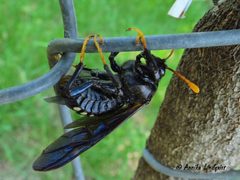
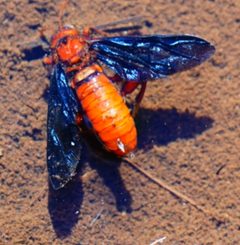
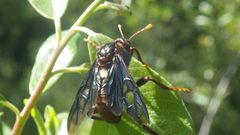
The combination of large body size and distinctly clubbed separates from other . Larvae are distinguished from Lepidoptera caterpillars by possessing seven pairs of rather than five or fewer. The rough, pebbly skin texture and defensive coiling when disturbed are additional larval characteristics. Adults may be mistaken for bees due to their plump, hairy appearance, but lack the narrow waist of .
Images
Habitat
Found in diverse environments including deciduous and mixed forests, meadows, and riparian areas with trees. Larvae are associated with woody plants including elm, willow, birch, poplar, alder, maple, and basswood. are often observed in open areas such as meadows where males may defend territories.
Distribution
Widespread in the Northern Hemisphere. Documented from North America (including U.S., Canada, and Alaska), Europe, and Asia. North American records span from the Atlantic seaboard to the Rocky Mountains and Pacific coast states. Specific distribution varies by ; Cimbex americana occurs across much of North America, while Cimbex femoratus is found in Europe.
Seasonality
activity typically occurs in late spring through summer, with observations from May through August in various regions. Larval development occurs primarily between June and October, with timing varying by latitude and elevation. One per year; larvae overwinter in cocoons and pupate the following spring.
Diet
Larvae are solitary herbivores feeding on leaves of deciduous trees and shrubs. Documented include elm (Ulmus), willow (Salix), birch (Betula), poplar (Populus), alder (Alnus), maple (Acer), and basswood/linden (Tilia). feed on sap by stripping bark from twigs, sometimes girdling them; they do not feed on pollen, nectar, or prey.
Host Associations
- Ulmus (elm) - larval food plantPrimary for Cimbex americana, though not exclusive
- Salix (willow) - larval food plantMajor for Cimbex americana
- Betula (birch) - larval food plant for Cimbex americana and Cimbex femoratus in Europe
- Populus (poplar) - larval food plantDocumented for Cimbex americana
- Alnus (alder) - larval food plantDocumented for Cimbex americana
- Acer (maple) - larval food plantOccasional for Cimbex americana
- Tilia (basswood/linden) - larval food plantOccasional for Cimbex americana
Life Cycle
Complete with one per year. Females insert into leaves using a saw-like ovipositor. Larvae feed solitarily on foliage, then crawl to the ground to spin tough, papery cocoons in leaf litter or shallow soil. Larvae overwinter in cocoons, pupating the following spring. emerge and mate; males may defend territories in meadows.
Behavior
Larvae coil when disturbed and rest in coiled positions; they can release volatile defensive chemicals from thoracic glands if threatened. are sexually dimorphic in some . Males of some species engage in aerial territorial disputes and may return to the same perch after being disturbed. Adults do not sting despite their intimidating appearance.
Ecological Role
Herbivores that contribute to nutrient cycling through leaf consumption and subsequent deposition of . Larvae serve as prey for various including (Trichogramma minutum), larval parasites (Opheltes glaucopterus barberi), and pupal parasites (Boettcheria cimbicis). may influence tree health through bark-stripping that occasionally girdles twigs.
Human Relevance
Generally considered benign; rarely causes significant defoliation of shade trees. Occasionally reported as a minor pest of elm, particularly in the northern Midwest, but typically do not reach damaging levels. Larvae are sometimes encountered by gardeners and naturalists; their large size and unusual appearance generate interest. may be mistaken for stinging or bees due to their size and appearance, causing unnecessary concern.
Similar Taxa
- Tenthredinidae (common sawflies)Lack the distinctly clubbed of ; generally smaller body size
- Argidae (argid sawflies) not clubbed; different larval and
- Apidae (bees) resemble bees in plump, hairy appearance, but lack the constricted waist (petiole) of ; also lack pollen-collecting structures
- Vespidae (wasps) lack the narrow waist and stinger of vespid ; have clubbed not found in this
- Lepidoptera caterpillars larvae resemble caterpillars but possess seven pairs of versus five or fewer in Lepidoptera; also have rough, pebbly skin texture distinct from most caterpillars
Misconceptions
Despite their -like appearance and ',' do not sting and are harmless to humans. The name 'sawfly' refers to the saw-like ovipositor used for -laying, not to any defensive capability. Their large size and robust build often lead to misidentification as dangerous wasps or hornets.
More Details
Taxonomic note
The is placed in the superfamily within the suborder (), representing one of the more basal lineages of Hymenoptera.
Defensive chemistry
Elm sawfly larvae possess thoracic glands capable of releasing volatile compounds when disturbed, a chemical defense mechanism against .
Size record
Some are among the heaviest of all Hymenoptera, with body mass exceeding that of many larger-appearing but more slender and bees.