
Abia
Honeysuckle Sawflies and Allies
Species Guides
4- Abia aenea(Cryptic Clubhorn)
- Abia americana
- Abia fasciata(Blotch-winged Honeysuckle Sawfly)
- Abia inflata(North American Honeysuckle Sawfly)
Abia is a of in the Cimbicidae. These are stout-bodied insects commonly encountered in Europe. in this genus were formerly placed in the genus Zaraea, which is now considered a synonym. The genus includes several species that feed on conifers and honeysuckles.
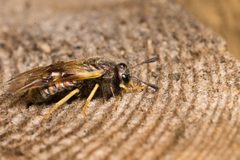
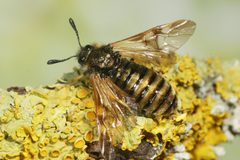
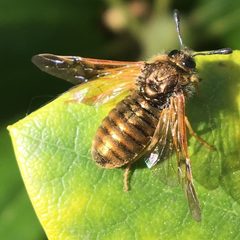
Pronunciation
How to pronounce Abia: /ˈeɪ.bi.ə/
These audio files are automatically generated. While they are not always 100% accurate, they are a good starting point.
Identification
Distinguished from other by the combination of stout body, clubbed , and wing venation. Formerly confused with Zaraea, but now unified under Abia. Can be separated from related Cimbicidae by specific antennal structure and body proportions. Larvae distinguished from caterpillars by presence of on all abdominal segments and absence of .
Images
Appearance
Stout-bodied with robust build. have a characteristic broad, somewhat flattened appearance typical of Cimbicidae. are clubbed or thickened toward the tip. Coloration varies by , often with yellow, brown, or black patterning. Wings are broad with relatively simple venation. Larvae are caterpillar-like with on all abdominal segments, lacking the (hooked spines) found on Lepidoptera larvae.
Habitat
Found in woodland edges, hedgerows, and gardens where plants occur. Associated with coniferous and deciduous vegetation. often observed flying slowly among vegetation.
Distribution
Primarily Palearctic distribution, with strongest representation in Europe. Records extend into parts of Asia. Some have more restricted ranges within this broad region.
Seasonality
active from late spring through summer, with peak activity varying by and latitude. Larvae present during summer months.
Diet
Larvae feed on conifers and honeysuckles (Lonicera). Specific associations vary by .
Host Associations
- Lonicera - larval food plantHoneysuckles
- Coniferae - larval food plantVarious conifer
Life Cycle
Complete with , larva, pupa, and stages. Larvae are external feeders on plant foliage. occurs in soil or concealed locations.
Behavior
fly slowly and deliberately, often visiting flowers. Larvae feed openly on foliage and may be gregarious. When disturbed, larvae may adopt a characteristic looping posture.
Ecological Role
Herbivores that contribute to nutrient cycling through leaf consumption. Larvae serve as food source for birds and other . may contribute to pollination while visiting flowers.
Human Relevance
Occasional minor pests in gardens and forestry when larval are high. Generally not of significant economic concern. Of interest to entomologists and naturalists.
Similar Taxa
- CimbexAlso in Cimbicidae; differs in antennal structure and body proportions
- TrichiosomaRelated cimbicid with different antennal and wing characteristics
More Details
Taxonomic history
The Zaraea was synonymized with Abia after phylogenetic analysis showed it was not monophyletic. This consolidation affected several European .