
Cimbex
Olivier, 1790
Elm sawflies, Birch sawflies, Almond leaf wasps
Species Guides
3- Cimbex americanus(elm sawfly)
- Cimbex pacificus(Pacific Sawfly)
- Cimbex rubidus(Rusty Willow Sawfly)
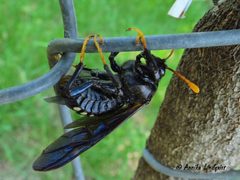
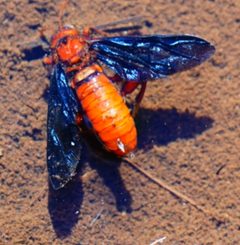
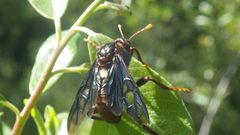
Cimbex is a of large, robust in the Cimbicidae, distributed across North America, Europe, and Asia. are among the largest sawflies, with body lengths reaching 20-25 mm, and are frequently mistaken for bees or due to their plump appearance and yellow-and-black coloration. The genus includes notable such as C. americanus (elm sawfly), C. femoratus (birch sawfly), and C. quadrimaculatus (almond leaf wasp), some of which are significant defoliators of trees. Larvae are caterpillar-like, with seven pairs of distinguishing them from lepidopteran caterpillars, and possess chemical defense glands. The genus has a fossil record extending from the Eocene to the Miocene.
Pronunciation
How to pronounce Cimbex: //ˈkɪmbɛks//
These audio files are automatically generated. While they are not always 100% accurate, they are a good starting point.
Identification
distinguished from other by large size, robust build, and clubbed . Resemble bees or but lack the constricted 'wasp waist' of Hymenoptera. Males with enlarged hind in some . Larvae identified by seven pairs of (/ caterpillars have five or fewer), coiled defensive posture when disturbed, rough pebbly texture, and black stripe. Cimbicidae antennae are clubbed and relatively short compared to other sawfly .
Images
Habitat
Deciduous forests, woodlands, and riparian areas with trees. Agricultural settings where host trees occur, including almond orchards (C. quadrimaculatus). Meadows adjacent to forest edges where engage in aerial interactions.
Distribution
North America (including United States, Canada, Alaska), Europe, and Asia. Fossil records from Eocene to Miocene in United States, Japan, and China. Specific distribution varies by : C. americanus widespread across North America from Atlantic to Rocky Mountains and Pacific coast; C. femoratus in Europe; C. quadrimaculatus in Turkey and parts of Asia.
Seasonality
active primarily in late spring and summer (May-July in North America). Larvae present from June through October, with some regional variation (e.g., May observations in South Carolina). One per year; larvae overwinter in cocoons and pupate the following spring.
Diet
Larvae feed on foliage of deciduous trees including elm (Ulmus), willow (Salix), birch (Betula), basswood/linden (Tilia), poplar (Populus), alder (Alnus), maple (Acer), and almond (Prunus amygdalus). feed on sap by stripping bark from twigs, sometimes girdling them; do not feed on pollen or nectar.
Host Associations
- Prunus amygdalus (almond) - larval food plantC. quadrimaculatus
- Ulmus (elm) - larval food plantC. americanus, primary
- Salix (willow) - larval food plantC. americanus, frequently used
- Betula (birch) - larval food plantC. femoratus, C. americanus occasionally
- Tilia (basswood/linden) - larval food plantC. americanus occasionally
- Populus (poplar) - larval food plantC. americanus occasionally
- Alnus (alder) - larval food plantC. americanus occasionally
- Acer (maple) - larval food plantC. americanus occasionally
- Trichogramma minutum - C. americanus
- Opheltes glaucopterus - larval C. americanus, C. quadrimaculatus
- Phobetes nigriceps - larva-pupa C. quadrimaculatus, new record for Turkey and Asia
- Listrognathus mactator - C. quadrimaculatus, new record for Turkey
- Boettcheria cimbicis - pupal C. americanus, sarcophagid fly
Life Cycle
Complete with one per year. Females insert into leaves using saw-like ovipositor. Larvae feed on foliage, growing to approximately 43 mm, then crawl to ground and spin tough, papery cocoon in leaf litter or just below soil surface. Larvae overwinter in cocoons, pupating the following spring. emerge in late spring to summer.
Behavior
males engage in aerial duels and may defend territories, returning to perches after being disturbed. Larvae coil into defensive posture when disturbed; if further threatened, release volatile defensive chemicals from thoracic glands. Adults lack stinger despite intimidating appearance. Both sexes use strong to strip bark for sap feeding.
Ecological Role
Herbivore and defoliator of deciduous trees; rarely causes significant damage except in situations. Serves as for various and flies, contributing to dynamics. Pollination role minimal or absent.
Human Relevance
Occasional pest of shade trees, particularly elm, and agricultural pest of almonds in some regions. Rarely causes economically significant damage. Subject to programs in almond orchards. often provoke alarm due to large size and -like appearance, but pose no sting threat.
Similar Taxa
- Trichiosoma (family Cimbicidae)Also large cimbicid with clubbed ; distinguished by different body proportions and larval associations
- Other sawfly families (Tenthredinidae, Diprionidae)Smaller size, different structure (often thread-like or serrate rather than clubbed), different larval numbers or arrangements
- Bees and wasps (Apidae, Vespidae)Convergent yellow-black coloration and robust build; distinguished by lack of constricted waist, clubbed , and wing venation in Cimbex
- Lepidoptera caterpillarsSimilar larval appearance; distinguished by seven pairs of in Cimbex (vs. five or fewer in Lepidoptera), rough pebbly skin, and defensive coiling
Misconceptions
Despite and appearance, Cimbex are not bees or (though they are Hymenoptera), and cannot sting. The '' name refers to the saw-like ovipositor, not to any association with sawing wood. Larvae are often mistaken for caterpillars but are structurally distinct.
Sources and further reading
- BugGuide
- Wikipedia
- GBIF taxonomy match
- iNaturalist taxon
- NCBI Taxonomy
- Catalogue of Life
- Bug Eric: Emerald Valley, 2016
- Cimbicidae | Beetles In The Bush
- Bug Eric: Wasp Wednesday: Elm Sawfly
- Bug Eric: Strange Behavior Explained (Sort of)
- The Internal Organs of Reproduction of the Male Saw-Fly, Cimbex Americana Leach.
- Insecticidal effects of wood vinegars produced from organic wastes on harmful almond leaf bee Cimbex quadrimaculata (Müller, 1766) (Hymenoptera: Cimbicidae)
- Ichneumonid parasitoids of the sawfly Cimbex quadrimaculata (Müller) feeding on almonds in Antalya, along with a new parasitoid and new record
- Listrognathus mactator(Thunberg, 1824) (Hymenoptera: Ichneumonidae) — A New Recorded Parasitoid ofCimbexQuadrimaculatus(O. F. Müller, 1766) (Hymenoptera: Cimbicidae) in Turkey
- The Parasitization Rate of Larva-Pupal Parasitoid Phobetes nigriceps (Gravenhorst) (Hymenoptera: Ichneumonidae) of Almond Leaf Bee Cimbex quadrimaculata (O. F. Müller) (Hymenoptera: Cimbicidae) in the Diyarbakır and Elazığ Provinces
- Comparative evaluation of machine learning models for predicting Cimbex quadrimaculata population density across multiple problem formulations.