
Alaptus
Westwood, 1839
Species Guides
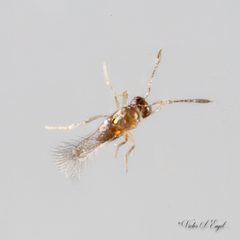
1- Alaptus eriococci(Fairyfly)
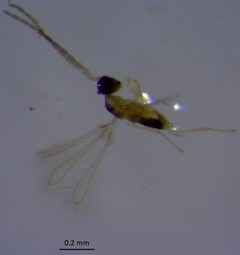
Alaptus is a of minute egg parasitoid wasps in the Mymaridae, commonly known as fairyflies. The genus contains approximately 17 described in the Holarctic region, with several new species described from North America and Russia in recent taxonomic revisions. These are specialized of (barklice), with some species also associated with scale insects and other small eggs. Alaptus species are among the smallest insects, with body lengths typically under 1 mm.
Pronunciation
How to pronounce Alaptus: /əˈlæptəs/
These audio files are automatically generated. While they are not always 100% accurate, they are a good starting point.
Identification
Identification to level requires examination of female (number of segments, proportions of club), wing venation and setation, body proportions, and male genitalia. The 2017 revision by Triapitsyn provides a key to females of 17 Holarctic species. Key diagnostic features include: number of funicular segments, proportions of antennal club segments, wing length relative to body, and details of wing setation. Alaptus can be distinguished from similar mymarid by the combination of: female antennae with distinct 3-segmented club, fore wing with relatively long marginal setae, and specific wing venation patterns.
Images
Habitat
Associated with where occur, including bark of trees, dead wood, leaf litter, and other moist microhabitats that support barklice . Specific microhabitat preferences vary by but generally involve the substrate where psocid are deposited.
Distribution
Primarily Holarctic distribution. Documented from: Canada (Ontario, Alberta, Yukon), USA (Florida, Michigan, New York), Russia (Sakhalin Island, Far East), Europe, Egypt, China, and Denmark. Several have extralimital records in tropical and subtropical regions.
Host Associations
- Mesopsocus species - primary
- Psocoptera (barklice) - primary group in bark, dead wood, and leaf litter
- Icerya (scale insects) - implied by epithet A. iceryae; specific records need verification
Life Cycle
Develops as solitary or gregarious within eggs. Typical chalcidoid development: egg, larva, , pupa, . Multiple per year likely, synchronized with host . stage varies by and climate.
Behavior
has been quantitatively studied in A. fusculus, showing structured behavioral sequences with leg-specific patterns. Females search for in bark crevices and other microhabitats. Oviposition into host eggs using slender ovipositor.
Ecological Role
contributing to of barklice () and potentially other small arthropods. Acts as a natural agent of in forest and woodland .
Human Relevance
No direct economic importance. Of academic interest for studies on insect , miniature body size, and - dynamics. Potential indirect relevance in forest functioning through regulation of .
Similar Taxa
- GonatocerusBoth are mymarid , but Gonatocerus typically parasitize leafhopper and planthopper eggs (Cicadellidae, Delphacidae) rather than eggs, and have different antennal and wing venation characters
- AnagrusAnother mymarid with similar minute size, but Anagrus parasitize of leafhoppers and planthoppers, have different antennal structure (often with fewer segments), and distinct wing venation patterns
- MymarShares characteristics but Mymar have different antennal structure and are associated with different groups including various Hemiptera
More Details
Taxonomic history
The has undergone extensive taxonomic revision, with numerous synonymies proposed in the 2017 revision by Triapitsyn. Several names previously recognized as valid were synonymized, and new species were described from previously unsampled regions.
Research significance
Alaptus fusculus has been a model organism for quantitative behavioral studies, particularly regarding and behavioral sequence analysis using information theory approaches.
Collection challenges
Due to extremely small size, specimens require specialized collection techniques including yellow pan traps, sweeping of appropriate microhabitats, and careful examination of -infested bark and litter .
Sources and further reading
- BugGuide
- GBIF taxonomy match
- iNaturalist taxon
- NCBI Taxonomy
- Catalogue of Life
- Publications | Entomology Research Museum
- A quantitative study of the grooming behaviour of the mymarid wasp Alaptus fusculus
- Revision of Alaptus (Hymenoptera: Mymaridae) in the Holarctic region, with taxonomic notes on some extralimital species
- Host Spatial Pattern, Parasitoid Interference and the Modelling of the Dynamics of Alaptus fusculus (Hym.: Mymaridae), a Parasitoid of Two Mesopsocus Species (Psocoptera)