
Mesopsocus
Kolbe, 1880
Species Guides
3- Mesopsocus immunis(woodland barklouse)
- Mesopsocus laticeps(middle barklouse)
- Mesopsocus unipunctatus(barklouse)
Mesopsocus is a of barklice (Psocodea: Mesopsocidae) comprising more than 60 described . Members are small, soft-bodied insects that inhabit bark surfaces and tree trunks, where they feed on epiphytic growths. The genus has been studied for its ecological dynamics, including partitioning among coexisting species and industrial melanism in response to pollution. Some species serve as for in the Mymaridae.
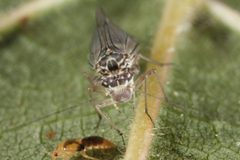
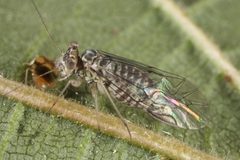
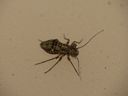
Pronunciation
How to pronounce Mesopsocus: /mɛsɒpˈsɒkəs/
These audio files are automatically generated. While they are not always 100% accurate, they are a good starting point.
Images
Habitat
Tree bark surfaces, particularly conifers such as larch (Larix). Documented occupy vertical zones on tree trunks, with some stratifying by height to reduce competition.
Distribution
Bulgaria; Germany; Great Britain; Israel; Luxembourg; Morocco; Japan; Singapore; Turkey; Denmark; Norway; Sweden. Within England, some show north-south clinal variation in color morph frequency correlated with industrial pollution gradients.
Diet
Epiphytic lichens, , and other microflora on bark surfaces. Feeding habits inferred from direct observation of M. immunis and M. unipunctatus on larch trees.
Host Associations
- Larix (larch) - habitat_substratePrimary tree substrate in studied English
- epiphytic lichens - food_resourceConsumed as part of diet on bark surfaces
- epiphytic algae - food_resourceConsumed as part of diet on bark surfaces
- Alaptus fusculus - Mymarid of at least two Mesopsocus
Behavior
Coexisting exhibit vertical stratification on tree trunks to partition space and reduce . Seasonal temporal shifts in peaks occur among sympatric species. Industrial melanism has been documented, with melanic morph frequency decreasing from industrial south to rural north in Yorkshire, England; melanism is inherited as a Mendelian with separate linked controlling - and coloration.
Ecological Role
Bark-dwelling consumer contributing to epiphytic dynamics and potentially nutrient cycling through consumption of lichens and . Serves as for , supporting higher .
Sources and further reading
- BugGuide
- Wikipedia
- GBIF taxonomy match
- iNaturalist taxon
- NCBI Taxonomy
- Catalogue of Life
- Industrial melanism in Mesopsocus unipunctatus (Müll.) (Psocoptera) in northern England
- Mesopsocus Populations on Larch in England‐‐The Distribution and Dynamics of Two Closely‐Related Coexisting Species of Psocoptera Sharing the Same Food Resource
- Host Spatial Pattern, Parasitoid Interference and the Modelling of the Dynamics of Alaptus fusculus (Hym.: Mymaridae), a Parasitoid of Two Mesopsocus Species (Psocoptera)
- The genome sequence of a barkfly, Mesopsocus fuscifrons Meinander, 1966.