
Mesopsocus laticeps
(Kolbe, 1880)
middle barklouse
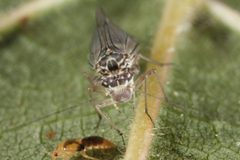
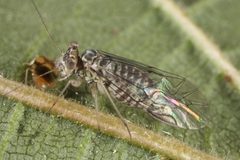
Mesopsocus laticeps is a of middle barklouse in the Mesopsocidae. It is widely distributed across Europe, Northern Asia (excluding China), North America, and Southern Asia. As a member of the order Psocodea, it belongs to a group of insects commonly known as barklice or booklice, though barklice specifically refers to the free-living species found on vegetation and bark rather than the domestic pests.
Pronunciation
How to pronounce Mesopsocus laticeps: /ˌmɛsəpˈsəʊkəs ˈlætɪsɛps/
These audio files are automatically generated. While they are not always 100% accurate, they are a good starting point.
Identification
The specific epithet "laticeps" (meaning "broad-headed") suggests a broad relative to body proportions, a trait that may aid in distinguishing this from . Members of the Mesopsocus can be differentiated from other barklice by a combination of wing venation patterns, body size, and antennal segment counts, though species-level identification typically requires examination of genitalic structures.
Images
Distribution
Documented from Europe (including Germany, Austria, Belgium, Denmark, Finland, France, Great Britain, Hungary, Italy, Luxembourg, Netherlands, Norway, Poland, Romania, Spain, Switzerland), Northern Asia (Mongolia, Japan), and North America (USA, Canada). GBIF records indicate presence across these regions with highest observation in Central and Northern Europe.
Ecological Role
As a barklouse, likely contributes to nutrient cycling through consumption of lichens, , and organic debris on bark and foliage surfaces. Members of Mesopsocidae are generally considered harmless decomposers in forest and woodland .
Human Relevance
Not known to be a pest . Unlike some Psocodea (booklice) that infest stored products or buildings, barklice in the Mesopsocidae are free-living and associated with outdoor vegetation. No documented negative economic or health impacts.
Similar Taxa
- Mesopsocus immunisCongeneric with overlapping European distribution; requires examination of male genitalia and wing markings for definitive separation.
- Mesopsocus unipunctatusAnother European ; distinguished by differences in forewing pigmentation patterns and pterostigma shape.
- Elipsocus spp.Formerly included this (as E. laticeps); related in same distinguished by wing venation details and body proportions.
More Details
Taxonomic history
Originally described as Elipsocus laticeps by Kolbe in 1880, later transferred to Mesopsocus. This reclassification reflects refined understanding of morphological relationships within Mesopsocidae.
Observation frequency
iNaturalist records indicate 72 observations, suggesting it is encountered with moderate frequency by naturalists, though likely under-recorded due to small size and inconspicuous habits.