
Comperiella bifasciata
Howard, 1906
Comperiella bifasciata is a tiny parasitic wasp in the Encyrtidae used extensively in of armored scale insects on citrus. Two distinct biological races exist: a Japanese type that parasitizes yellow (Aonidiella citrina) and a Chinese type that parasitizes California red scale (Aonidiella aurantii). Despite being morphologically identical and capable of hybridizing in laboratory conditions, these races maintain separate identities in the field through against less fit hybrids. The was first introduced to California in 1908 from Japan, but failed to establish on red scale due to a misidentification of its original ; successful establishment on red scale occurred only after subsequent introductions from China between 1947 and 1949.
Pronunciation
How to pronounce Comperiella bifasciata: /kɔmˌpɛɹ.iˈɛl.lə baɪfæsiˈɑːtə/
These audio files are automatically generated. While they are not always 100% accurate, they are a good starting point.
Identification
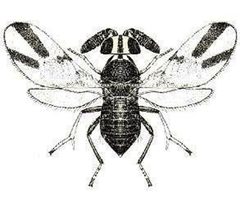
Distinguished from other Comperiella by the two white bars; C. unifasciata has a single head bar and C. lemniscata has different head markings. in wing patterning aids field identification of females. Molecular or biological assays may be required to distinguish the Japanese and Chinese biological races, as they are morphologically identical.
Images
Appearance
Tiny black with two prominent white bars on the . Females display more conspicuous head markings and possess dark patches on the wings that create a forked-tail appearance. Males have unblotched, clear wings without these dark patches.
Habitat
Citrus orchards, particularly orange groves. In California, found in coastal and inland valley citrus-growing regions including the San Joaquin Valley. Native range includes Japan and China.
Distribution
Introduced and established in California (USA), South Australia, and other citrus-growing regions worldwide. Native to East Asia (Japan, China). Specific distribution records include: Adygey, Assam, Bihar, California, and Delhi.
Host Associations
- Aonidiella aurantii - California red scale; parasitized by Chinese biological race
- Aonidiella citrina - Yellow ; parasitized by Japanese biological race
- Aonidiella taxus - Original of Japanese race, misidentified in early introductions
- Chrysomphalus bifasciculatus - Original of Japanese race in Japan
Life Cycle
Endoparasitoid development: female oviposits singly into third and fourth instar female scale insects, though will attack any stage except gravid females that have already produced . hatches internally; larva feeds and grows inside . Upon , black meconium pellets are deposited and pushed to one side beneath the cover. Adult occurs through a jagged-edged hole chewed through the host body and scale covering. Host response in A. aurantii kills approximately 60% of , with 50% of parasitized scales surviving to reproduce; nearly 100% of eggs develop successfully in A. citrina.
Behavior
females actively search for suitable scale insects, demonstrating preference for third and fourth instar female . Oviposition is solitary—one per host. The exhibits host race formation with strong fidelity: Japanese race females preferentially oviposit in yellow scale, Chinese race in red scale. Hybrids between races are produced in laboratory conditions but appear to be eliminated by in field due to reduced .
Ecological Role
Key agent regulating of economically important armored scale insects on citrus. Acts as a -dependent mortality factor. In California's San Joaquin Valley, serves as the primary of yellow and a supplementary control agent for red scale in inland climates where the ectoparasitoid Aphytis is less effective. Population-level effects differ between : stabilizes yellow scale populations but has limited impact on red scale due to host immune .
Human Relevance
Widely employed in programs for citrus pest management. First introduced to California in 1908; re-introduced successfully 1947–1949 after initial failure due to misidentification. Remains economically important in of California red scale and yellow , particularly in inland citrus-growing regions. The two biological races are managed separately based on target pest .
Similar Taxa
- Aphytis spp.Also used for California red scale control; distinguished as ectoparasitoids that consume larvae externally, whereas C. bifasciata is an endoparasitoid. Aphytis outcompetes C. bifasciata in coastal climates but is less effective inland.
- Comperiella unifasciataCongeneric distinguished by having a single white bar on the rather than two.
- Comperiella lemniscataCongeneric with different marking pattern.
More Details
Biological Races
Two distinct biological races exist: Japanese (from Aonidiella taxus and Chrysomphalus bifasciculatus) and Chinese (from Aonidiella aurantii). These are maintained as separate in California through isolation and against hybrids, despite morphological identity and laboratory hybridization capability.
Encapsulation Resistance
The differential success on red versus yellow stems primarily from immune rather than . Aonidiella aurantii exhibits strong response that kills ~60% of developing C. bifasciata, while A. citrina allows nearly 100% parasite survival.
Sources and further reading
- BugGuide
- Wikipedia
- GBIF taxonomy match
- iNaturalist taxon
- NCBI Taxonomy
- Catalogue of Life
- Encyrtid Holdings | Entomology Research Museum
- Meloidae Holdings | Entomology Research Museum
- The influence of the parasite Comperiella bifasciata How. on the populations of two species of armoured scale insects, Aonidiella auramtii (Mask.) and A. citrina (Coq.), in South Australia
- Within-Tree Distribution of California Red Scale, Aonidiella aurantii (Maskell) (Homoptera: Diaspididae), and Its Parasitoid Comperiella bifasciata Howard (Hymenoptera: Encyrtidae) on Orange Trees in the San Joaquin Valley