
Comperiella
Howard, 1906
Species Guides
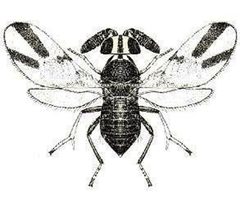
1Comperiella is a of parasitic in the Encyrtidae, containing approximately 10 . Species in this genus are internal of armored scale insects (Diaspididae), with documented including Aonidiella aurantii, A. citrina, A. orientalis, Aspidiotus rigidus, and Chrysomphalus ficus. Several species have been employed or studied as agents against agricultural pests, particularly in citrus and coconut production systems. The genus was established by Howard in 1906.
Pronunciation
How to pronounce Comperiella: //kɔm.pɛɹ.iˈɛl.lə//
These audio files are automatically generated. While they are not always 100% accurate, they are a good starting point.
Identification
-level identification within Comperiella typically requires examination of wing banding patterns, structure, and other microscopic morphological features. C. bifasciata has two pale bands across the forewings, while C. unifasciata has a single band and C. lemniscata has a different banding pattern. The can be distinguished from related encyrtid genera by combinations of antennal segmentation, mesoscutal , and ovipositor structure, though specific diagnostic characters require taxonomic knowledge.
Images
Habitat
Agricultural , particularly orchards and plantations where scale insects occur. Documented include citrus groves, coconut plantations, and guava orchards. Distribution modeling for C. calauanica indicates sensitivity to precipitation seasonality and mean temperature of the driest quarter.
Distribution
occur across multiple continents including Australia, Egypt, the Philippines, South Africa, and the United States (California). C. bifasciata has been studied in South Australia and California; C. lemniscata has been recorded from Egypt and Australia; C. calauanica and C. unifasciata occur in the Philippines; C. pia is known from Queensland, Australia.
Host Associations
- Aonidiella aurantii - California red scale; internal
- Aonidiella citrina - yellow
- Aonidiella orientalis - oriental
- Aspidiotus rigidus - coconut scale insect; for C. calauanica and C. unifasciata
- Chrysomphalus ficus - circular black scale; for C. pia
Behavior
Females oviposit into scale insects. C. lemniscata has been observed to successfully develop in second- and third-instar female , with a preference for third-instar females when given a choice; male scales are used only in second instar and at low levels. C. bifasciata exhibits host race formation, with different showing varying degrees of resistance by different host .
Ecological Role
Internal of armored scale insects (Diaspididae). Functions as a agent in agricultural systems, with varying effectiveness depending on and local conditions. The relationship with hosts can be influenced by host immune responses such as of parasitoid or larvae.
Human Relevance
Several have been evaluated or deployed for of agricultural pests. C. bifasciata has been used against Aonidiella aurantii and A. citrina in citrus. C. calauanica and C. unifasciata show promise for controlling Aspidiotus rigidus in coconut plantations in the Philippines. Effectiveness varies by species due to differences in host immune responses and -host compatibility.
Similar Taxa
- ComperiaSame (Encyrtinae) and similar lifestyle; distinguished by morphological details of wing venation and genitalia
- MetaphycusRelated encyrtid also containing insect ; Comperiella typically have more pronounced wing banding patterns and different antennal structures
Sources and further reading
- BugGuide
- Wikipedia
- iNaturalist taxon
- NCBI Taxonomy
- Catalogue of Life
- Encyrtid Holdings | Entomology Research Museum
- DISTRIBUTION OF THE PARASITOID, COMPERIELLA LIMINISTACA (HYMENOPTERA: ENCYRTIDAE) IN EGYPT WITH EMPHASIS ON THE EGYPTIAN OASES
- A Host–Parasitoid Model for Aspidiotus rigidus (Hemiptera: Diaspididae) and Comperiella calauanica (Hymenoptera: Encyrtidae)
- NEW RECORD OF THE PARASITOID, COMPERIELLA LEMNISCATA COMPERE AND ANNECKE (HYMENOPTERA: ENCYRTIDAE) ON AONIDIELLA AURAN77I (HOMOPTERA: DIASPIDIDAE) ON GUAVA IN EGYPT
- The influence of the parasite Comperiella bifasciata How. on the populations of two species of armoured scale insects, Aonidiella auramtii (Mask.) and A. citrina (Coq.), in South Australia
- EFFECT OF SOME NATURAL COMPOUNDS ON AONIDIELLA AURANTII (MASKELL) (HEMIPTERA; COCCOIDEA: DIASPIDIDAE) AND ITS PARASITOID COMPERIELLA LEMNISCATA COMPERE AND ANNECKE (HYMENOPTERA: ENCYRTIDAE) ON CITRUS IN EGYPT
- Within-Tree Distribution of California Red Scale, Aonidiella aurantii (Maskell) (Homoptera: Diaspididae), and Its Parasitoid Comperiella bifasciata Howard (Hymenoptera: Encyrtidae) on Orange Trees in the San Joaquin Valley
- COMPERIELLA PIA (GIRAULT) (HYMENOPTERA: ENCYRTIDAE), A PARASITOID OF THE CIRCULAR BLACK SCALE (CHRYSOMPHALUS FICUS ASHMEAD) FROM QUEENSLAND
- Oviposition by Comperiella lemniscata Compere and Annecke (Hymenoptera: Encyrtidae) in Aonidiella orientalis (Newstead) (Hemiptera: Diaspididae)
- First Philippine record of the parasitoid, Comperiella sp. (Hymenoptera: Encyrtidae): a potential biocontrol agent against Aspidiotus rigidus (Hemiptera: Diaspididae)
- A Bioclimate-Based Maximum Entropy Model for Comperiella calauanica Barrion, Almarinez and Amalin (Hymenoptera: Encyrtidae) in the Philippines