
Acerophagus
Smith, 1880
Acerophagus is a of in the Encyrtidae, first described by Smith in 1880. in this genus are primary endoparasitoids of mealybugs (Pseudococcidae), with several species employed in classical and programs worldwide. The genus includes notable species such as A. papayae, which has been successfully used to manage the papaya mealybug (Paracoccus marginatus) across Africa, Asia, and the Americas. Members exhibit koinobiont development and variable reproductive strategies including arrhenotokous .
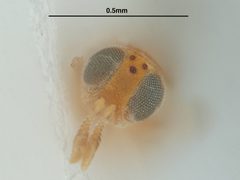
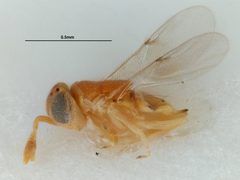
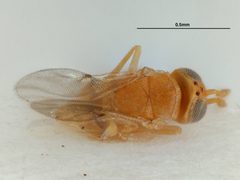
Pronunciation
How to pronounce Acerophagus: /ˌeɪ.sɛˈrɒ.fə.ɡəs/
These audio files are automatically generated. While they are not always 100% accurate, they are a good starting point.
Identification
identification within Acerophagus requires examination of female specimens, particularly focusing on gastral coloration patterns. Some New World species display distinctive dark cross bands on the gastral dorsum. Detailed morphological study of , wing venation, and body proportions is necessary for accurate determination. An identification key to females of New World species with dark cross-banded gasters has been published.
Images
Habitat
Associated with plants of mealybug prey, including papaya, cassava, mulberry, Plumeria alba, rambutan, and various agricultural and ornamental crops.
Distribution
Widespread across tropical and subtropical regions. Documented from North America (including California, Texas, Florida, Hawaii, Louisiana, Mexico, Puerto Rico), Central and South America, Africa, Asia (including India), and the Pacific. Specific distribution varies by ; A. papayae is native to Mexico and Central America and has been introduced to Africa, Asia, and elsewhere for .
Diet
feed on honeydew and other sugar sources; laboratory studies demonstrate extended longevity when provided with 10% honey solution versus water alone.
Host Associations
- Paracoccus marginatus - primary papaya mealybug; major target for
- Ferrisia virgata - primary striped mealybug
- Phenacoccus peruvianus - primary mealybug
- Hypogeococcus sp. - primary mealybug on Achyranthes aspera and Portulaca
- Pseudococcidae - primary -level association
Life Cycle
Koinobiont endoparasitoid development. -to- development time approximately 15 days at 26.5°C for A. texanus. Pre-ovipositional period of approximately 3 days in A. texanus. typically die during larval development. Development time and adult body size vary with host stage and host plant. Sex ratio of progeny is influenced by host instar at parasitization, with younger hosts producing male-biased sex ratios.
Behavior
Gregarious endoparasitoid; multiple individuals may develop within a single . Exhibits host stage preference, with 2nd and 3rd instar nymphs preferred over mealybugs in parasitization. Mated females produce female-biased progeny (approximately 5:1 ratio in A. texanus); unmated females reproduce parthenogenetically producing only males ().
Ecological Role
Primary of mealybugs, contributing to natural suppression of pest . Several are important agents in programs, reducing reliance on chemical in agricultural systems.
Human Relevance
Significant agents for mealybug pests. Acerophagus papayae has been successfully deployed in programs against the papaya mealybug in Africa, Asia, and the Americas, often achieving substantial pest suppression. Mass rearing protocols have been developed for augmentative release programs. The represents an economically important group of natural enemies in sustainable agriculture.
Similar Taxa
- AnagyrusBoth are Encyrtidae of mealybugs; Acerophagus distinguished by specific antennal and gastral
- PseudleptomastixCo-occurring mealybug used in ; Acerophagus typically exhibits different range and developmental characteristics
- MetaphycusAnother Encyrtidae parasitizing Coccoidea; requires careful morphological examination to distinguish
Sources and further reading
- BugGuide
- GBIF taxonomy match
- iNaturalist taxon
- NCBI Taxonomy
- Catalogue of Life
- Acerophagus californicus Rosen body 3 | Entomology Research Museum
- Encyrtid Holdings | Entomology Research Museum
- Primary Type List | Entomology Research Museum
- Acerophagus-papayae-Anagyrus-loecki-wp - Entomology Today
- Acerophagus papayae Archives - Entomology Today
- Why Augmentative Biological Control Holds Promise for Advancing Agriculture in Developing Countries
- Plumeria alba an alternate host for mass multiplication of papaya mealybug parasitoid, Acerophagus papayae
- Biology of Acerophagus texanus (Howard, 1898) (Hymenoptera: Encyrtidae), a parasitoid of Ferrisia virgata Cockerell (Hemiptera: Pseudococcidae)
- Potential distribution of Acerophagus papayae, a parasitoid of the papaya mealybug (Paracoccus marginatus), across Africa
- Effect of temperature on the biology and fitness traits of papaya mealybug parasitoid Acerophagus papayae
- Chemical ecology of Acerophagus papayae Noyes and Schauff Vis-à-Vis Gas Chromatography
- ASPECTS OF BIOLOGY OF Acerophagus papayae Noyes & Schauff (HYMENOPTERA: ENCYRTIDAE), PARASITOID OF THE PAPAYA MEALYBUG
- Fitness trade-offs in parasitoid-host system: with special reference to Acerophagus papayae noyes on papaya mealybug, Paracoccus marginatus williams and granara de willink
- Co-evolutionary Dynamics and Life Table Analysis of Acerophagus papayae in Response to Papaya Mealybug Paracoccus marginatus
- Reproductive strategies and food sources used by Acerophagus n. sp. near coccois, a new successful parasitoid of the invasive mealybug Phenacoccus peruvianus
- A new species of Acerophagus Smith (Hymenoptera: Encyrtidae) from Vieques Island, Puerto Rico (USA), parasitoid of the mealybug Hypogeococcus sp. (Hemiptera: Pseudococcidae)
- Prospects of Classical Biological Control of Papaya Mealybug in Kenya: Performance of its Exotic Parasitoid, Acerophagus Papayae, Under Laboratory and Field Conditions
- Specificity in host instar selection, parasitism and developmental time of Acerophagus papayae (Hymenoptera: Encyrtidae) on Paracoccus marginatus
- Ecological coevolution of parasitoid, Acerophagus papayae noyes and Schauff on papaya mealybug, Paracoccus marginatus Williams and granara de Willink
- New Distribution and Host Records of Encyrtidae (Hymenoptera: Chalcidoidea) from India Including First Reports ofAcerophagus orientalis(Ferriere) andCryptanusia albiclavaGirault
- Effect of Native and Non-native Hosts on the Biology of <I>Acerophagus papayae</I> Noyes and Schauff, the Introduced Parasitoid of <I>Paracoccus marginatus</I> Williams and Granara De Willink
- Parasitoid Wasp Acerophagus papayae: A Promising Solution for the Control of Papaya Mealybug Paracoccus marginatus in Cassava Fields in Vietnam.