
Ferrisia virgata
(Cockerell, 1893)
striped mealybug, grey mealybug
Ferrisia virgata, commonly known as the striped mealybug, is a highly pest in the Pseudococcidae. First described from Jamaica in 1893, it spread globally within approximately a decade and is now established in all tropical and subtropical zoogeographic regions. The species is recognized by two dark longitudinal stripes and is a significant agricultural pest with a range spanning over 203 in 77 plant families. It plant badnavirus affecting cocoa and black pepper, and has been demonstrated to acquire but not effectively transmit 'Candidatus Liberibacter asiaticus', the bacterium associated with citrus huanglongbing.
Pronunciation
How to pronounce Ferrisia virgata: /fɛˈrɪziə ˈvɜːɡətə/
These audio files are automatically generated. While they are not always 100% accurate, they are a good starting point.
Identification
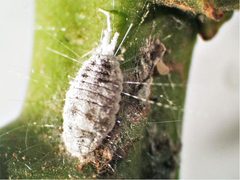
Distinguished from other mealybug by the presence of two dark longitudinal stripes. In Florida, it can be confused with Nipaecoccus viridis and Nipaecoccus nipae, but lacks the green reaction to 10% KOH that is diagnostic for N. viridis. Molecular identification via or slide-mounting of females is required for definitive identification, particularly for purposes. The small size and cryptic habits make detection difficult at inspection points.
Images
Appearance
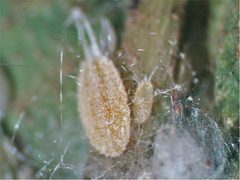
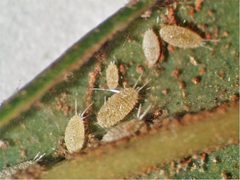
females are 4.0–4.5 mm in length. The body is covered with white, powdery, meal-like wax typical of mealybugs. Diagnostic features include two prominent dark longitudinal stripes running the length of the body. The lacks the marginal filaments found in some other mealybug . Slide-mounting of adult females is required for definitive species-level identification, though the striped pattern provides a useful field characteristic.
Habitat
Agricultural and horticultural environments in tropical and subtropical regions. Infests above-ground plant parts, particularly aggregating on leaf , stems, and fruit clusters. Found in nursery crops, floriculture operations, and field plantings. Tolerates subtropical and to some extent temperate conditions, though is most rapid in tropical climates.
Distribution
Neotropical origin (first described from Jamaica). Now established globally in tropical and subtropical zoogeographic regions including: Asia (Burma, Cambodia, China, India, Indonesia, Malaysia, Pakistan, Philippines, Thailand), Africa (Angola, Cameroon, Egypt, Ethiopia, Ghana, Ivory Coast, Kenya, Madagascar, Nigeria, South Africa, Tanzania, Uganda), Australasia and Pacific Islands (Australia, Fiji, Hawaii, New Caledonia, Solomon Islands), North America (Mexico, southeastern United States including Florida), Central America and West Indies ( Rica, Honduras, Panama, West Indies), and South America (Argentina, Brazil, Colombia, Guyana, Suriname, Venezuela). First recorded in Tunisia and North Africa in 2016–2017.
Diet
Phloem sap feeder; feeds on plant vascular tissues using . Extracts nutrients from the phloem, excreting excess sugars as honeydew.
Host Associations
- Cotton - pestDocumented ; studied for cultivar resistance
- Cocoa - pest cocoa swollen shoot virus in Ghana
- Black pepper (Piper nigrum) - pest Badnavirus
- Citrus - pestCan acquire 'Candidatus Liberibacter asiaticus' but does not transmit
- Coffee - pestDocumented plant
- Jute - pestDocumented plant
- Soybean - pestDamaging field crop
- Tomato - pestDamaging field crop
- Acalypha - pestOrnamental shrub
- Azalea - pestOrnamental
- Lantana camara - pestFirst record in Tunisia
- Cassava - pestStudied for associated bacterial
Life Cycle
Develops through and multiple nymphal instars before reaching adulthood. is sexual and . stages described in literature but specific developmental durations vary with temperature and plant. Rapid reproduction occurs under tropical conditions.
Behavior
Aggregates in groups on leaf , stems, and fruit clusters. Secretes honeydew that promotes growth of , reducing photosynthetic capacity and aesthetic value of plants. Can reproduce both sexually and, in some conditions, through resulting in overlapping . stage (first instar nymphs) disperses to new plant parts or hosts.
Ecological Role
Agricultural pest causing direct damage through phloem feeding and indirect damage through development. Acts as a for plant badnavirus affecting economically important crops. Has been demonstrated to acquire but not effectively transmit 'Candidatus Liberibacter asiaticus', indicating a dead-end relationship for this . Associated with diverse bacterial endosymbiont including Proteobacteria (99.36% of classified sequences), Firmicutes, Actinobacteria, and Bacteroidetes that may influence host physiology and resistance.
Human Relevance
Significant economic pest of tropical and subtropical agriculture. Causes yield losses in cotton, cocoa, black pepper, coffee, and numerous fruit, nut, and spice crops. Interception risk at plant inspection due to small size and cryptic habits. Increasing international trade in fresh plant material facilitates continued spread. Subject to programs using encyrtid including Aenasius advena and Blepyrus insularis. contact to these parasitoids has been studied to integrate chemical and biological control.
Similar Taxa
- Nipaecoccus viridisCo-occurs in Florida ornamental landscapes; distinguished by green reaction to 10% KOH (F. virgata does not show this reaction)
- Nipaecoccus nipaeCommon mealybug in Florida; lacks the two dark stripes diagnostic for F. virgata
- Planococcus citriCitrus mealybug often found with F. virgata; differs in wax pattern and body shape
- Paracoccus marginatusPapaya mealybug invading Florida; differs in marginal filament arrangement and body shape
More Details
Bacterial Endosymbionts
Metagenomic analysis reveals diverse bacterial dominated by Proteobacteria (99.36%), with minor contributions from Firmicutes, Actinobacteria, and Bacteroidetes. These endosymbionts may contribute to resistance and plant utilization.
'Candidatus Liberibacter asiaticus' Acquisition
Can acquire Las bacterium from infected periwinkle and citrus with 100% acquisition after 1–2 weeks feeding on infected leaf discs. Las detected in gut, salivary glands, and body cavity, with higher titers in gut and body than salivary glands. However, transmission to healthy plants has not been demonstrated, suggesting a biological barrier to competence unlike the efficient vectors Diaphorina citri and Trioza erytreae.
Taxonomic History
Originally described as Dactylopius virgata by Cockerell in 1893 from Jamaica. Later transferred to Ferrisiana virgata and currently Ferrisia virgata. The rapid global spread within a decade of description illustrates the ' potential facilitated by human transport of infested plants.
Sources and further reading
- BugGuide
- Wikipedia
- iNaturalist taxon
- NCBI Taxonomy
- Catalogue of Life
- Grasshoppers of Colorado
- Grasshoppers of Colorado
- Encyrtid Holdings | Entomology Research Museum
- Alpine Grasshopper Identification
- Key to Subfamily Gomphocerinae
- Green Light: New ID Test Ready for Invasive Mealybug Pest
- Ferrisia virgata . [Distribution map].
- Ferrisia virgata (striped mealybug).
- Striped Mealybug Ferrisia virgata Cockerell (Insecta: Hemiptera: Pseudococcidae)
- Ferrisia virgata Cockerell (Hemiptera: Pseudococcidae): first record in Tunisia
- Host selection and establishment of striped mealybug, Ferrisia virgata, on cotton cultivars
- The Biology of the Grey Mealybug, Ferrisia virgata (Cockerell) (Pseudococcidae, Homoptera)
- Metagenomic DNA analysis of bacterial communities associated with striped mealy bugs, Ferrisia virgata (Cockerell) (Homoptera: Pseudococcidae) infesting Cassava
- Correction: The Phloem-Sap Feeding Mealybug (Ferrisia virgata) Carries ‘Candidatus Liberibacter asiaticus’ Populations That Do Not Cause Disease in Host Plants
- Acquisition and Transmission Efficiency of the HLB Bacterium, ‘Candidatus Liberibacter asiaticus’ by the Striped Mealybug, Ferrisia virgata
- Contact toxicity of different pesticides to the encyrtid parasitoids,Aenasius advenaandBlepyrus insularisof the striped mealybug,Ferrisia virgata