
Ferrisia
Fullaway, 1923
mealybugs
Species Guides
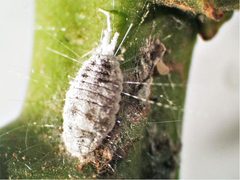
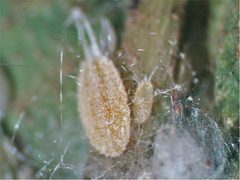
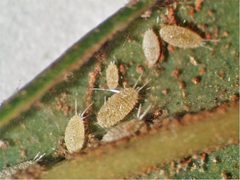
1- Ferrisia virgata(striped mealybug)
Ferrisia is a of mealybugs (Hemiptera: Pseudococcidae) established by David T. Fullaway in 1923 with F. virgata as the type . The genus underwent taxonomic revision in 2012, resulting in recognition of 18 species including eight newly described species, and the transfer of F. floridana to the new genus Pseudoferrisia. Species of Ferrisia are characterized by distinctive morphological features including enlarged tubular ducts with associated discoidal pores, and oral-collar tubular ducts of varying sizes. The genus is native to the Americas but includes species now found worldwide, with F. virgata being a particularly widespread and economically significant pest.
Pronunciation
How to pronounce Ferrisia: //fɛˈrɪ.si.ə//
These audio files are automatically generated. While they are not always 100% accurate, they are a good starting point.
Identification
females of Ferrisia are distinguished by the presence of enlarged tubular ducts with sclerotized areas, often associated with one or more discoidal pores located at or near the outer edges of these sclerotized areas. The oral-collar tubular ducts vary in size and distribution among species: some species have small ducts to multilocular disc pore rows and on submarginal areas without forming marginal clusters, while others show different patterns of duct clustering. Species-level identification requires examination of the size, shape, and position of discoidal pores relative to the dorsal enlarged tubular ducts, as well as the distribution patterns of ventral oral-collar tubular ducts. Slide-mounted specimens are necessary for reliable species identification; live specimens appear as small, soft-bodied insects covered with white, powdery wax.
Images
Distribution
The Ferrisia is native to the Americas. Individual show varying distributions: F. virgata is in tropical and subtropical regions worldwide, having spread globally within about 10 years of its original description from Jamaica; F. dasylirii occurs in North America and the Caribbean; F. gilli is found in California on pistachios and almonds; F. quaintancii occurs in the United States; and F. malvastra, F. meridionalis, F. multiformis, F. setosa, and F. terani have more restricted distributions in the Americas. F. san was described from southern Vietnam, representing the second Ferrisia species recorded from that country.
Diet
Phloem sap feeding on plants.
Ecological Role
of Ferrisia function as agricultural pests through direct phloem feeding damage and indirect effects via honeydew production that supports growth. Some species serve as of plant : F. virgata transmits cocoa swollen shoot virus and a Badnavirus affecting black pepper, and has been documented carrying 'Candidatus Liberibacter asiaticus' (the bacterium associated with citrus huanglongbing) without successfully transmitting the . The serves as prey for various natural enemies including in the Encyrtidae (such as Cirrhencyrtus species) and predatory beetles including Zagreus bimaculosus (Coccinellidae).
Human Relevance
Several Ferrisia are significant agricultural pests. F. virgata (striped mealybug) is a major pest of cotton, cocoa, citrus, and numerous ornamental and food crops, with documented in over 203 across 77 plant . F. gilli is an established pest of pistachios in California and occasionally affects almonds. The genus presents challenges for plant due to small size, cryptic habits, and the difficulty of rapid field identification. The 2012 taxonomic revision clarified species boundaries, improving diagnostic capabilities for this economically important group.
Similar Taxa
- PseudoferrisiaPseudoferrisia was erected in 2012 to accommodate Ferrisia floridana, which was found to represent a distinct based on morphological and molecular data. The two genera can be distinguished by features of the female , particularly the structure and distribution of tubular ducts and pores.
- NipaecoccusNipaecoccus such as N. viridis and N. nipae co-occur with Ferrisia species in Florida and other regions, and are similar in general appearance as small, soft-bodied mealybugs with white waxy coverings. They can be distinguished by specific morphological features visible under magnification, and N. viridis exhibits a unique green coloration in alkaline solutions (pH 11-14) that Ferrisia species lack.
- PseudococcusPseudococcus such as P. viburni (obscure mealybug) and P. maritimus (grape mealybug) are frequently confused with Ferrisia species in agricultural settings. They share similar mealybug and pest status but differ in specific features such as the presence and arrangement of wax filaments, body coloration, and the color of exuded fluids when disturbed.
Sources and further reading
- BugGuide
- Wikipedia
- GBIF taxonomy match
- iNaturalist taxon
- NCBI Taxonomy
- Catalogue of Life
- Encyrtid Holdings | Entomology Research Museum
- Green Light: New ID Test Ready for Invasive Mealybug Pest
- Obscure Mealybug Found on Almond Trees for First Time in California
- three mealybug adult females - Entomology Today
- Ferrisia virgata (striped mealybug).
- Ferrisia virgata . [Distribution map].
- Striped Mealybug Ferrisia virgata Cockerell (Insecta: Hemiptera: Pseudococcidae)
- Ferrisia virgata Cockerell (Hemiptera: Pseudococcidae): first record in Tunisia
- A new species of the genus Ferrisia (Hemiptera: Coccomorpha: Pseudococcidae) from southern Vietnam
- The Biology of the Grey Mealybug, Ferrisia virgata (Cockerell) (Pseudococcidae, Homoptera)
- A taxonomic revision of the mealybug genus Ferrisia Fullaway (Hemiptera: Pseudococcidae), with descriptions of eight new species and a new genus
- Ferrisia virgata1 and Dysmicoccus brevipes1 as Hosts of Cirrhencyrtus spp.2 in Southern Chiapas, Mexico
- Metagenomic DNA analysis of bacterial communities associated with striped mealy bugs, Ferrisia virgata (Cockerell) (Homoptera: Pseudococcidae) infesting Cassava
- Correction: The Phloem-Sap Feeding Mealybug (Ferrisia virgata) Carries ‘Candidatus Liberibacter asiaticus’ Populations That Do Not Cause Disease in Host Plants
- Biology ofZagreus bimaculosusMulsant (Coleoptera: Coccinellidae), a Predator ofFerrisia dasylirii(Cockerell) (Hemiptera: Pseudococcidae)
- Acquisition and Transmission Efficiency of the HLB Bacterium, ‘Candidatus Liberibacter asiaticus’ by the Striped Mealybug, Ferrisia virgata
- Host selection and establishment of striped mealybug, Ferrisia virgata, on cotton cultivars