
Brachymeria podagrica
(Fabricius, 1787)
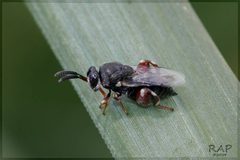
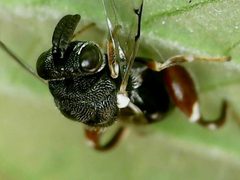
Brachymeria podagrica is a in the Chalcididae, known from Brazil, Saudi Arabia, Colombia, and multiple other regions worldwide. The is a solitary idiobiont parasitoid of dipteran pupae, particularly flesh flies (Sarcophagidae) and blow flies (Calliphoridae). It has been documented attacking Sarcodexia lambens, Peckia collusor, Hemilucilia flavifacies, Chrysomya albiceps, and Sarcophaga dux, among other . Development from to takes approximately 20–27 days under favorable conditions, with requiring 155–180 days. Adults are commonly observed near colonies feeding on honeydew, and occasionally visit flowers such as wild carrot. The species has forensic significance due to its predictable emergence from fly pupae on decomposing corpses.
Pronunciation
How to pronounce Brachymeria podagrica: /ˌbrækɪˈmɪəriə poʊˈdæɡrɪkə/
These audio files are automatically generated. While they are not always 100% accurate, they are a good starting point.
Identification
Distinguished from other Brachymeria by combination of associations, geographic origin, and detailed morphological characters requiring keys (Burks 1936 for Nearctic species). The swollen hind and bowed tibiae are -level characters; species identification requires examination of antennal segmentation, wing venation, and body . Previously confused with B. fonscolombei, now treated as synonym.
Images
Habitat
Urban and semi-urban environments near domestic garbage, eucalyptus trees, and areas with decomposing organic matter. frequent colonies for honeydew feeding, shaded vegetation near artificial wetlands, and flowering plants. availability (carrion-breeding flies) determines local distribution.
Distribution
distribution including: Brazil (Goiás, multiple records), Saudi Arabia (Bisha City, Asir Region—first record), Colombia (Medellín—first record), Galápagos Islands, Australia (Northern Territory, Queensland), Italy (Sicily), India (Tamil Nadu), and widespread Holarctic presence. Described as occurring 'almost everywhere around the world'.
Diet
feed on honeydew from colonies and nectar from flowers including wild carrot (Daucus carota). Larvae are developing within dipteran pupae.
Host Associations
- Sarcodexia lambens - Sarcophagidae; 9.0% rate in Brazil study
- Peckia collusor - Sarcophagidae; 14.5% in Colombia
- Hemilucilia flavifacies - Calliphoridae; 10.0% in Goiás, Brazil
- Chrysomya albiceps - Calliphoridae; first report Brazil
- Sarcophaga dux - Sarcophagidae; laboratory development studies
- Sinthesiomyia - Muscidae; literature record
- Cochliomyia - Calliphoridae; literature record
- Lucilia - Calliphoridae; literature record
- Calliphora coloradensis - Calliphoridae; literature record
- Callitroga macellaria - Calliphoridae; literature record
- Phaenicia sericata - Calliphoridae; literature record
- Phaenicia mexicana - Calliphoridae; literature record
- Phormia regina - Calliphoridae; literature record
- Sarcophaga carnaria - Sarcophagidae; literature record
- Sarcophaga haemorrhoidalis - Sarcophagidae; literature record
- Sarcophaga impar - Sarcophagidae; literature record
- Sarcophaga peregrina - Sarcophagidae; literature record
Life Cycle
Solitary with complete . Female oviposits into larva using elongated ovipositor; hatches and larva develops within host pupa. Developmental period from egg hatching to : 20–27 days under favorable conditions. extended to 155–180 days. Typically single offspring per host despite potential for multiple oviposition events.
Behavior
exhibit 'playing possum' —hugging legs to body and remaining motionless when disturbed. Males establish territories around nectar sources and defend against other males. Seek shade during heat of day, often among cattails or shaded cottonwood leaves. Strong jumping ability using modified hind legs for rapid escape and initiation.
Ecological Role
Natural agent regulating of Diptera including carrion flies and flesh flies. Important in as predictable colonizer of decomposing corpses; timing provides post-mortem interval estimates. May contribute to suppression of pest caterpillars and muscoid flies through primary and secondary .
Human Relevance
Forensic significance: predictable of carrion-breeding flies on human and animal remains, useful for investigations. potential: may limit blow fly and flesh fly infesting animal carcasses and associated with issues. Subject of laboratory competition studies with other pupal parasitoids (Nasonia vitripennis, Dirhinus himalayanus).
Similar Taxa
- Brachymeria fonscolombeiFormerly treated as distinct , now synonymized with B. podagrica; both share Holarctic distribution and of blow flies and flesh flies
- Nasonia vitripennisPteromalid of similar dipteran ; outcompetes B. podagrica in mixed (50% vs. 0% success rate in laboratory trials)
- Dirhinus himalayanusChalcidid of Sarcophaga dux; higher monoinfection success (86%) but completely excluded by N. vitripennis in mixed
More Details
Taxonomic history
Long confused with B. fonscolombei (Dufour), which is now treated as a junior synonym. The was described by Fabricius in 1787 as Chalcis podagrica.
Forensic application
Developmental data at different temperatures needed to improve utility in criminal investigations; current studies focus on preimaginal development timing for post-mortem interval estimation.
Competitive interactions
Laboratory studies demonstrate hierarchical competitive ability: Nasonia vitripennis > Dirhinus himalayanus > Brachymeria podagrica. In simultaneous with N. vitripennis, B. podagrica development is severely suppressed (0–6% success vs. 56% in monoinfections).
Sources and further reading
- BugGuide
- GBIF taxonomy match
- iNaturalist taxon
- NCBI Taxonomy
- Catalogue of Life
- Publications | Entomology Research Museum
- Bug Eric: Wasp Wednesday: Brachymeria
- Bug Eric: Wasp Wednesday: The Wasp Tree Part II
- FIRST RECORD OF Brachymeria podagrica (HYMENOPTERA: CHALCIDIDAE) AS PARASITOID OF Peckia collusor (DIPTERA: SARCOPHAGIDAE)
- First Record ofBrachymeria podagrica(Hymenoptera: Chalcididae) in Bisha City, Asir Region, Saudi Arabia
- BRACHYMERIA PODAGRICA (FABRICIUS) (HYMENOPTERA: CHALCIDIDAE) AS PARASITOIDS OF SARCODEXIA LAMBENS (WIEDEMANN) (DIPTERA: SARCOPHAGIDAE) IN BRAZIL
- BRACHYMERIA PODAGRICA (FABRICIUS) (HYMENOPTERA: CHALCIDIDAE) AS PARASITOID OF HEMILUCILIA FLAVIFACIES ENDERLEIN (DIPTERA: CALLIPHORIDAE) COLLECTED IN STATE OF GOIÁS, BRAZIL
- Brachymeria podagrica (Fabricius) (Hymenoptera: Chalcididae) as a parasitoid of Chrysomya albiceps (Wiedemann) (Diptera: Calliphoridae): first report in Brazil
- Development and Competition of Three Parasitoid Wasps, Brachymeria podagrica, Dirhinus himalayanus, and Nasonia vitripennis, in Their Host, Sarcophaga dux, in Single and Mixed Infections
- On the life cycle of Brachymeria podagrica (Fabricius, 1787) (Hymenoptera: Chalcididae) – a parasitoid of sacrophagid, calliphorid, and muscid flies