
Azotidae
Nikol'skaya & Yasnosh, 1966
Genus Guides
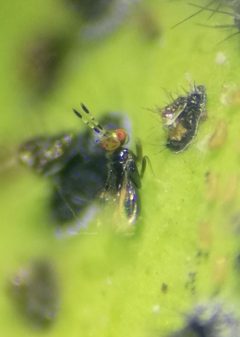
1Azotidae is a small of chalcidoid wasps containing a single , Ablerus Howard, 1894, with approximately 92–94 described . The family was elevated from status within Aphelinidae in 1966 and is now recognized as a distinct family in Chalcidoidea. Azotidae are obligate hyperparasitoids that attack primary of hemipteran pests, particularly those associated with scale insects (Diaspididae), whiteflies (Aleyrodidae), and mealybugs. Their makes them significant tertiary consumers in agricultural .
Pronunciation
How to pronounce Azotidae: /əˈzoʊtɪˌdiː/
These audio files are automatically generated. While they are not always 100% accurate, they are a good starting point.
Identification
Distinguished from other Chalcidoidea by combination of: forewing with smoky patterns but lacking oblique bald line; large rounded stigma on stigma ; absence of postmarginal vein; female with 7 segments and reduced third funicular segment; longer than and combined with exposed prominent ovipositor. Formerly classified within Aphelinidae, now separated based on these morphological and biological characteristics. Single- family (Ablerus) simplifies identification at family level.
Images
Habitat
Terrestrial environments, primarily epicontinental. Associated with supporting of scale insects, whiteflies, and mealybugs and their primary . Recorded from agricultural, native vegetation, and island including the Galápagos archipelago.
Distribution
. Documented from: Brazil (São Paulo), Argentina, Chile, Uruguay, Mexico, Ecuador (including Galápagos Islands), Eritrea, Georgia, Azerbaijan, Russia (Far East), China (Fujian), Malta, Spain, Mediterranean/Palaearctic region, and Australasia.
Host Associations
- Diaspididae - indirectHyperparasitoid of primary attacking scale insects including Chionaspis, Diaspidiotus, Lepidosaphes, Parlatoria, Contigaspis, and Leucaspis ulmi
- Aleyrodidae - indirectHyperparasitoid of primary attacking whiteflies
- Pseudococcidae - indirectHyperparasitoid of primary attacking mealybugs
- Encyrtidae - directAttacked as primary
- Aphelinidae - directAttacked as primary
- Lasiocampidae - unknown association recorded but relationship unclear
- Issidae - unknown association recorded but relationship unclear
Life Cycle
Hyperparasitoid development: females deposit using prominent ovipositor into eggs or larvae of primary (Chalcidoidea, particularly Encyrtidae and Aphelinidae) that are themselves developing within hemipteran . Some confirmed as oophagous, feeding directly on host eggs. Development occurs within the primary parasitoid host, emerging as .
Behavior
Obligate hyperparasitoid : females locate and attack primary of scale insects, whiteflies, and mealybugs. Oviposition strategy involves penetrating structures with elongated ovipositor. No direct ; all nutrition obtained through parasitoid development within host.
Ecological Role
Tertiary consumer in , functioning as hyperparasitoid that regulates of primary . Potential to influence outcomes of agricultural pests including scale insects and whiteflies, though net impact on pest suppression depends on relative densities of primary and hyperparasitoid populations.
Human Relevance
Relevance primarily through association with programs targeting agricultural pests. Hyperparasitoid activity may interfere with efficacy of primary used in pest management of scale insects and whiteflies. No direct economic products or medical significance documented.
Similar Taxa
- AphelinidaeFormerly classified as Azotinae within Aphelinidae; separated based on hyperparasitoid (Aphelinidae are primarily primary ), antennal segmentation, and wing venation characters including stigma shape and postmarginal absence
- EncyrtidaeSimilar reduced wing venation and body form; distinguished by Azotidae hyperparasitoid habit versus typically primary role in Encyrtidae, plus specific antennal and proportions
More Details
Taxonomic history
Originally described as Azotinae of Aphelinidae; elevated to Azotidae by Nikol'skaya & Yasnosh in 1966. Azotus Howard, 1898 synonymized with Ablerus Howard, 1894 by Girault in 1913; Myocnemella synonymized by Hyatt in 1994. Accepted in Brazilian taxonomic catalog 2020.
Species diversity
contains single Ablerus with 92–94 described worldwide; relatively small family within Chalcidoidea.
Sources and further reading
- BugGuide
- GBIF taxonomy match
- iNaturalist taxon
- NCBI Taxonomy
- Catalogue of Life
- Taxonomic and Biological Aspects of the Azotidae Family (Insecta: Hymenoptera)
- First record of the family Azotidae from Ecuador, with a description of a new species of Ablerus Howard (Hymenoptera: Chalcidoidea: Azotidae) from the Galapagos Islands