
Diaspidiotus
Berlese, 1896
Species Guides
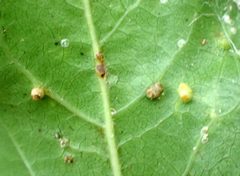
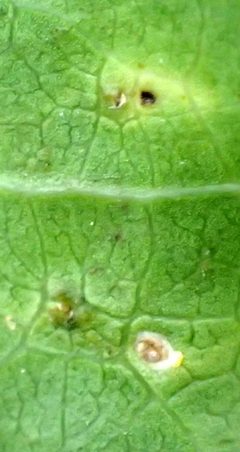
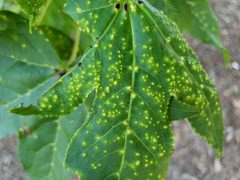
1- Diaspidiotus liquidambaris(Sweetgum Scale)
Diaspidiotus is a of armored scale insects ( Diaspididae) comprising over 80-90 described with worldwide distribution. Species in this genus are phloem-feeding pests of deciduous trees and fruit crops, including economically important species such as the San José (D. perniciosus) and oystershell scale (D. ostreaeformis). These scales secrete a protective waxy covering (test) over their bodies and are frequently intercepted in agricultural due to their similarity to critical quarantine pests.
Pronunciation
How to pronounce Diaspidiotus: //daɪəˌspɪdiˈoʊtəs//
These audio files are automatically generated. While they are not always 100% accurate, they are a good starting point.
Identification
Members of Diaspidiotus can be distinguished from other by features of the second instar including: dimorphic characters between sexes in test shape (oval in males, circular in females), body shape (elongate in males, pyriform in females), and glandular system development (males possess more long macroducts and short macroducts absent in females). However, -level identification within the genus requires examination of microscopic characters and is frequently subject to misidentification; for example, South American previously identified as D. ancylus have been shown to belong to the genus Clavaspis.
Images
Habitat
occur on deciduous trees including fruit trees and ornamental species. D. ostreaeformis has been documented from apple orchards and birch stands in Poland, and from shelter belts adjacent to orchards in New Zealand. D. perniciosus occurs in apple orchards in South Africa and other regions. plant associations influence abundance and ; for example, D. ostreaeformis specimens from Malus domestica have fewer long macroducts than those from Betula pendula.
Distribution
Worldwide. Documented from Europe (Austria, Belgium, Bulgaria, Czech Republic, Finland, France, Germany, Greece, Hungary, Italy, Malta, Moldova, Norway, Poland, Portugal, Romania, Russia, Spain, Sweden, Switzerland, UK, Ukraine), Asia (Armenia, China, Georgia, India, Iran, Iraq, Israel, Japan, Kazakhstan, Korea, Kyrgyzstan, Nepal, Pakistan, Tajikistan, Turkey, Uzbekistan), Africa (Algeria, Egypt), North America (Canada, USA), South America (Argentina), and Oceania (Australia, New Zealand). Specific collection records include Warsaw and Kampinos National Park, Poland; Western Cape, South Africa; and Central Otago, New Zealand.
Seasonality
D. perniciosus shows bimodal with peaks in October-November and February-March in South Africa, with multiple overlapping per year. D. ostreaeformis crawlers disperse from December to April in New Zealand, with on apples preceding that on other .
Host Associations
- Malus domestica - apple; D. ostreaeformis and D. perniciosus
- Betula pendula - silver birch; D. ostreaeformis
- Prunus spp. - D. ostreaeformis
- Pyrus spp. - pear; D. ostreaeformis
- Alnus spp. - alders; D. ostreaeformis, majority susceptible
- Sorbus spp. - D. ostreaeformis, majority susceptible
- Carpinus betulus - hornbeam; D. ostreaeformis, appears
Life Cycle
occurs. Development includes (first instar), second instar, and stages. Second instar exhibits in test shape, body form, and glandular systems. D. perniciosus overwinters as partly grown nymphs beneath waxy covers. Multiple per year occur in warmer climates.
Behavior
(mobile first instars) disperse to settle on fruit, leaves, and wood. D. perniciosus crawlers initially settle on lower tree portions and north-facing aspects, then progressively colonize upper portions; show strong preference for fruit spurs and pruning wounds. D. ostreaeformis invades orchards from external trees, with declining linearly from >90% adjacent to shelter belts to <1% at 64 meters distance.
Human Relevance
Major agricultural pests causing direct damage to fruit quality and tree vigor through phloem feeding. D. perniciosus and D. ostreaeformis are particularly significant on apple and pear crops. D. ostreaeformis achieves major pest status because it is indistinguishable on harvested fruit from the critical pest D. perniciosus, creating phytosanitary risks for export crops. Yield losses up to 40% have been documented for related pests in comparable systems. Sulfoxaflor has been identified as an effective control agent against D. perniciosus with reduced harm to beneficial compared to broad-spectrum .
Similar Taxa
- Clavaspis patagonensisPreviously misidentified as D. ancylus in Chile and Argentina; distinguished by sequences and morphological characters, with C. patagonensis occurring throughout Chile and parts of Argentina while D. ancylus appears absent from South America
- Diaspidiotus perniciosus vs. D. ostreaeformisFrequently confused on harvested fruit; D. ostreaeformis is indistinguishable from D. perniciosus on fruit, creating identification challenges, though they differ in and range
More Details
Morphological plasticity
The number of long macroducts in D. ostreaeformis second instar varies by plant, with specimens from Malus domestica having fewer than those from Betula pendula. This intraspecific variation complicates identification based solely on morphological characters.
Management challenges
Control of D. ostreaeformis on orchard shelter trees is complicated by phenological asynchrony with crop sprays; spring sprays targeting provide only short-term reduction, while mid-summer -targeted sprays are more effective. The wide range including common shelter creates ongoing invasion pressure into managed orchards.
Sources and further reading
- BugGuide
- Wikipedia
- GBIF taxonomy match
- iNaturalist taxon
- NCBI Taxonomy
- Catalogue of Life
- Sulfoxaflor Found to Be Less Harmful to Beneficial Predators of Soybean Aphids
- Diaspidiotus ostreaeformis . [Distribution map].
- Morphology of the second instar of Diaspidiotus ostreaeformis (Curtis, 1843) (Hemiptera: Diaspididae)
- Temporal distribution of San José scale Diaspidiotus perniciosus (Hemiptera: Diaspididae) on an apple tree
- Spatial distribution of San José scale Diaspidiotus perniciosus (Hemiptera: Diaspididae) on an apple tree
- Bioecology of san jose louse Diaspidiotus perniciosus (hemiptera: Diaspididae) on apple variety anna in draa ben khedda area (tizi-ouzou, Algeria)
- Functional response of the aphelinid parasitoid,Aphytis diaspidis:Effect of host scale species,Diaspidiotus perniciosusandHemiberlesia lataniae
- Observations on the host plants of oystershell scale ( Diaspidiotus ostreaeformis : Hemiptera: Diaspididae)
- Impacts of shelter tree species on the pest status of oystershell scale ( Diaspidiotus ostreaeformis Hem: Diaspididae) in Central Otago, and options for integrated pest management
- Identity of the native South American armored scale insect species (Hemiptera: Coccomorpha: Diaspididae) widely misidentified as the North American species Diaspidiotus ancylus Putnam