
Cephus pygmaeus
(Linnaeus, 1767)
European wheat stem sawfly, wheat stem sawfly
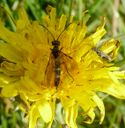
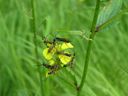
Cephus pygmaeus is a in the Cephidae, widely distributed across Europe, western Asia, and North Africa, with introduced in North America. are small, -like insects that emerge in early spring and are active during wheat stem elongation. Larvae develop inside wheat stems, causing significant agricultural damage by tunneling and cutting stems. The is a major pest of wheat and other cereal crops, with reaching over 50% in some regions.
Pronunciation
How to pronounce Cephus pygmaeus: /ˈkɛfəs pɪɡˈmiːəs/
These audio files are automatically generated. While they are not always 100% accurate, they are a good starting point.
Identification
Small hymenopteran with -like appearance; distinguished from related Trachelus tabidus by morphological features of and ovipositor. typically 5-8 mm in length. Larvae are legless, cream-colored found inside wheat stems.
Images
Habitat
Agricultural environments, specifically wheat fields; also found in barley, rye, and wild oat stands. Thrives in semi-arid to temperate cereal-growing regions.
Distribution
Native to Europe (widespread including Britain, France, Germany, Scandinavia, Mediterranean countries), western Asia (Turkey, Iran, Iraq, Syria, Israel), and North Africa (Algeria, Egypt, Morocco). Introduced to North America: established in Canada (Ontario, Nova Scotia, Prairie Provinces) and northeastern USA (New York, Pennsylvania).
Seasonality
emerge February-March in southern Israel, with timing varying by latitude; peak activity coincides with wheat stem elongation. Larvae present April-May. occurs in stems late winter (January-February).
Diet
Larvae feed internally on wheat stems, consuming pith and vascular tissues; do not feed significantly.
Life Cycle
Complete with single per year. laid in wheat stems; larvae tunnel downward, cutting stems near base causing 'white .' Larvae enter in cut stubs through summer and winter; pupate in situ during late winter; emerge following year.
Behavior
triggered by rainfall and temperature cues. Females more numerous than males; males emerge 4-6 days earlier. Larvae characteristically cut wheat stems at base, causing lodging and yield loss.
Ecological Role
Agricultural pest of major economic significance in wheat-growing regions; influenced by stem solidness of wheat varieties. Subject to by including Collyria calcitrator (Ichneumonidae) and Pediobius beneficus (Eulophidae).
Human Relevance
Significant pest of wheat, barley, and rye; responsible for substantial yield losses in Europe, Asia, and introduced North American . Management strategies include breeding for solid-stemmed wheat varieties and using imported .
Similar Taxa
- Trachelus tabidusCo-occurs in wheat fields in southern Israel and other regions; distinguished by morphological features and ; T. tabidus typically more abundant in some areas.
- Cephus cinctusRelated North American native ; also a major wheat pest in western Canada; historically confused in management programs.
Sources and further reading
- BugGuide
- GBIF taxonomy match
- Cerambycidae | Beetles In The Bush | Page 10
- Formicidae | Beetles In The Bush | Page 2
- Flower ants? Check again! | Beetles In The Bush
- Cephus pygmaeus . [Distribution map].
- Parasites of the Wheat-stem Sawfly,Cephus pygmaeus, Linnaeus, in England
- Biology of the stem sawflies Trachelus tabidus and Cephus pygmaeus in the Negev of southern Israel
- Notes on the Distribution ofCephus Pygmaeus, Linn., and of its Parasite,Collyria calcitrator, Gray
- Stem solidness as an important factor for wheat protection from European wheat stem sawfly (Cephus pygmaeus L.) in Altai
- Status in Ontario of Collyria calcitrator (Grav.) (Hymenoptera: Ichneumonidae) and of Pediobius beneficus (Gahan) (Hymenoptera: Eulophidae) as Parasites of the European Wheat Stem Sawfly, Cephus pygmaeus (L.) (Hymenoptera: Cephidae)
- Distribution of the European Wheat Stem Sawfly Cephus pygmaeus (L.) (Hymenoptera, Cephidae) in the Russian Federation and the Dynamics of Its Density and Harmfulness in the Forest-Steppe of the Middle Volga Region